



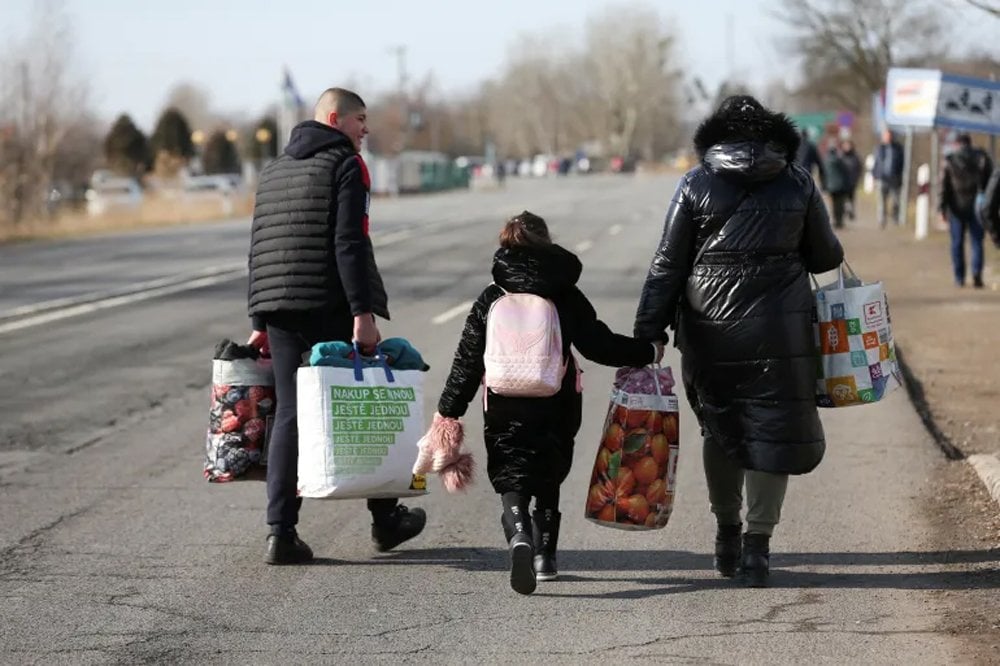

Thousands of people remaining in occupied southern Ukraine have begun to flee the city of Oleshky as hunger deepens, local officials and humanitarian workers said, describing conditions on the left bank of the Dnipro as increasingly desperate.
Oleshky has been under Russian occupation since 2022 and lies close to the eastern bank of the river, where, after Ukraine liberated Kherson in the autumn of 2022, the Dnipro has largely formed the frontline between Ukrainian and Russian forces in the south.
Population Drops and Supplies Deteriorate
Tetiana Hasanenko, head of the Oleshky Military Administration, told ABC News that the area’s pre-war population of about 40,000 has fallen to as low as 6,000, with only around 2,000 people still in the city. She said living conditions have deteriorated quickly and that the occupation authority shows little interest in improving them.
A volunteer coordinating evacuation efforts, Kseniia Arkhipova, said a collapse in food deliveries prompted another round of departures. In messages relayed to ABC News, residents described rationing remaining food, chronic shortages of medication and moving between abandoned houses to avoid drone attacks and Russian troops.
One message said: “The blockade is complete,” adding that drones and fires have become constant.
Route through Minefields Called the “Road of Death”
Arkhipova said those fleeing first have to reach the village of Radensk, about 14 miles east of Oleshky, deeper into territory held by Russia. She described the route as the “road of death” because of mines and drones across the area.
She said Radensk may offer food and temporary accommodation, but the danger continues, with roads still mined. Some evacuees try to continue further by catching lifts in local cars or tractors towards other parts of occupied Kherson and closer to the Black Sea coast, from where, she said, people may arrange longer routes back towards Ukrainian-held territory, often via Belarus.
Arkhipova said the journey can cost up to $500 per person, covering food, accommodation and payments for drivers. By September, she said she had helped 47 people leave, while about 300 were still waiting to evacuate.
Evacuees face threats from the start, including mines, FPV drones and Russian checkpoints. Arkhipova said people often move in groups to avoid mines and that many have lost identity documents during shelling or flooding. She linked the loss of papers to the devastation in the Kherson region after the Kakhovka dam was destroyed in June 2023, a move that Moscow and officials in occupied areas denied they were responsible for.
She added that people detained at checkpoints may be interrogated for hours and risk detention. Arkhipova described one case in which, she said, an evacuee reported that her passport had burned during an attack and that she was accused of spying.
Blockade Claims, Hospital Conditions and UN Warnings
Arkhipova said Russian forces restrict movement on local roads that have not been cleared of mines, for fear residents might see where Ukrainian forces are concentrated, including trenches and artillery positions. Ukrainian officials also alleged that anyone suspected of contact with Ukrainian authorities or armed forces faces execution.
She said Russian troops steal food and evict residents, particularly from homes with electricity, solar panels or generators. She also claimed that troops move on foot through areas under drone observation and that bodies are left in the street.
Hasanenko and Arkhipova described the local hospital as close to collapse. Arkhipova said the facility “is on its last breath” with no fuel and no medicine. She said staff continue working but that treatment can only delay deaths. Hasanenko said more than 100 bodies were in the hospital basement and that it had had no electricity for four years.
Ukraine’s 30th Marine Corps, responsible for the area, said it monitors conditions on the left bank with drones. Spokesperson Pavlo Drogal told ABC News there was a “huge deficit” of drinking water, electricity and food products. He said Ukrainian forces do not conduct remote mining of logistical routes there, adding that Russian forces do the mining.
Ukrainian Foreign Minister Andrii Sybiha raised Oleshky’s situation at the UN General Assembly in New York this week, warning of a “humanitarian catastrophe” and calling for immediate evacuation, while accusing Russia of obstructing relief. The Kremlin later acknowledged a “critical situation” in Oleshky, but blamed Ukrainian forces for blocking humanitarian supplies.
Join the discussion? 

25 September 2026
-
 1
1
Recommended Comments
Create an account or sign in to comment