



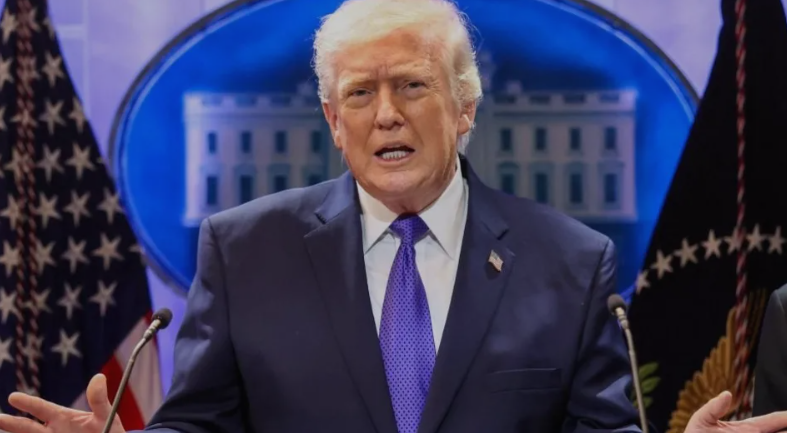

President Donald Trump has issued a stern warning to countries "playing games" with recent trade deals. This follows a Supreme Court decision that blocked many of his previously imposed tariffs.
Get the latest headlines in your email 
In response, countries are reassessing their trade arrangements. The European Union announced the suspension of a deal ratified over the summer, while India postponed talks to finalize a separate agreement.
On Truth Social, Trump warned that countries exploiting the ruling might encounter even higher tariffs. The Supreme Court decision overturned his tariffs from the previous year, imposed under the 1977 International Emergency Economic Powers Act, citing that the law did not authorize such measures.
Trump reacted by proposing a new 15% global tariff, replacing the initial 10%. This new tariff, set to take effect Tuesday, exempts some products. However, it has left many countries uncertain about deals negotiated following his initial tariff measures. These deals often included lower levies in exchange for promises to facilitate American businesses abroad.
The UK is actively seeking clarity on its trade agreement with the US, previously setting tariffs at 10%. UK Business and Trade Secretary Peter Kyle expressed concerns about the current uncertainty and assured that "all options" are being considered to protect UK interests.
Bernd Lange, chair of the European Parliament's International Trade Committee, noted the suspension of deal ratification between the US and EU, highlighting increased uncertainty.
The White House maintains its stance on trade, leveraging other legal avenues to continue imposing tariffs. Trump employed Section 122 to temporarily impose tariffs without Congressional approval, and launched investigations under Section 301, targeting specific unfair trade practices.
These new tariffs will coexist alongside others on items like steel, aluminum, and cars, unaffected by the court ruling. US Trade Representative Jamieson Greer stated that the core of US trade policy remains unchanged, despite shifts in legal mechanisms.
The uncertainty has impacted financial markets, leading to a 1% drop in the S&P 500. This is partly due to the ongoing trade uncertainty, which analysts expect to persist.
The 15% tariffs are scheduled to expire after 150 days unless extended by Congress. However, Senate Democratic leader Chuck Schumer has pledged to oppose any efforts to extend them. Schumer criticized Trump's economic strategies as detrimental.
Despite this, Trump maintains that congressional approval is not required for tariff implementation, asserting his authority to continue his trade agenda.
Join the discussion? 
Already a member? 
 Adapted by ASEAN Now · Source · 23 Feb 2026
-
 1
1