John207
Member
-
Joined
-
Last visited
Everything posted by John207
-
Fair point. In slides 4 and 7, there is no note linking the statement "Exemption of Personal Income Tax on foreign-sourced income" to RD743. Therefore, this should be interpreted as a standalone statement of complete exemption, regardless of other factors.
-
Thanks for the link. Nothing in writing regarding the tax exemption on income earned abroad in the same year it is remitted. At the moment, we only have a verbal statement from one RD official, Mr. Kasapon Singprasert. Other officials may have differing interpretations. Hopefully, we’ll soon see a newly issued Royal Decree or Ministerial Directive, as Oldcpu recently mentioned in a post, that clearly addresses this issue, and possibly more, for everyone to count on.
-
I like the idea of seeing a plan, or even just a sketch, behind the creation of RD743, and how it could connect with a potential worldwide income WWI taxation exemption. It’s definitely an interesting take! On the other hand, one could also see RD743 as a strategy to attract wealthy individuals, along with their income and business, to Thailand. But after a few years, the government might look to expand its tax base and implement WWI taxation across the board, which could make RD743 redundant. That said, what Wordchild shared about LTR visa holders still being exempt even under WWI taxation, makes your hypothesis seem more realistic, which is definitely good news!
-
Excellent! As far as I'm concerned, that's the best bit of news to come out of the meeting. Thanks for bringing it to light! Having to remit funds earned in a different year is a far smaller obstacle to overcome in comparison. Of course, it's all theoretical for now, but it's a positive starting point
-
Am I interpreting [my bold part] correctly by saying that, should worldwide income taxation be introduced, LTR visa holders will still be exempt from that as well?
-
I've got one too just now, and like you, I didn’t receive the initial invitation. However, some days ago, I reached out to them via email to inquire about their selection criteria, specifically whether they prioritized certain type of LTR over others. In their response, they avoided addressing that question and just sent me the same generic template reply that others have mentioned here. Unfortunately I’m physically incapacitated at the moment so I won’t be able to attend either.
-
"010 / 66" is the visa number. 66 being the year they stamped it in your passport.
-
I completely agree that Thailand’s tax system currently suffers from very lax enforcement. However, with the rapid rise of AI and biometric identification, both of which are advancing exponentially year after year, the technical ability to properly enforce personal income tax (including worldwide income) in my view is no longer science fiction for Thailand. A relatively modest team of semi-skilled IT specialists and tax officials could, in the near future, make comprehensive enforcement entirely feasible, something that would have been unthinkable just 5 or 10 years ago. My personal speculation is that the main obstacle right now isn’t technology, but rather resistance from powerful vested interests who benefit from the current lax regime. That may be why Thailand isn’t quite ready to fully enforce worldwide income taxation yet, though, as another poster recently pointed out and speculating in the forum, we might not be too far off either. In any case, worldwide income taxation for residents is clearly the direction most countries are heading. Even Cambodia introduced it years ago, and several African nations (Kenya, Tanzania, etc.) have followed suit on paper. Of course, as far as I know, actual enforcement in many of these places remains almost non existent for now. Still, as a resident, I personally wouldn’t want to bet on them never starting to enforce it. The reason why is, take Cambodia as an example: on paper, severe or repeated failure to declare any assessable income (e.g., under-reporting by 10% or more twice in three years) can lead to 1–5 years in prison plus fines of $25K to $50K in local currency equivalent. The penalties for a first offence are less explicitly spelled out, but they’re clearly draconian. Anyone curious can read Article 242 (page 81) and work back from there for more details on the related articles in the official tax law here: https://embindpp.gov.in/pdf/menu/Tax-Law-Cambodia-2023.pdf Another major squeeze that’s been tightening since around 2017/18 is the OECD’s Common Reporting Standard CRS. Virtually all compliant banks, brokers, and financial institutions now require a Tax Identification Number TIN from your country of tax residence. If you can’t provide one, they simply refuse to open new accounts or, increasingly, close existing ones. A friend of mine recently had his long standing brokerage account shut down for exactly this reason after the latest Thai tax residency changes kicked in. The bottom line is that the old strategy of just move to another country and stay off the radar is becoming harder and harder every year. The combination of better technology, CRS data exchange, and steadily tougher domestic laws means the window for staying invisible is closing fast.
-
Thanks for the post and for highlighting some interesting points from page 82. I’m still not entirely clear whether the tax exemption for funds earned and remitted within the same tax year was solely the view of the BOI, or if there was a shift in perspective within the TRD. The fact that the change wasn't publicized makes me lean toward the former, but that’s just speculation on my part. Dozens of thousands retired expats have been living in Thailand for decades, remitting funds that were supposed to be earned in the previous tax year, without paying tax. As far as I know, no audits have been conducted on them to verify compliance with the law. So, it seems like business as usual, and I don’t expect any audits to start anytime soon. However, things might change if global taxation is enacted. In that case, we could see more audit activity.
-
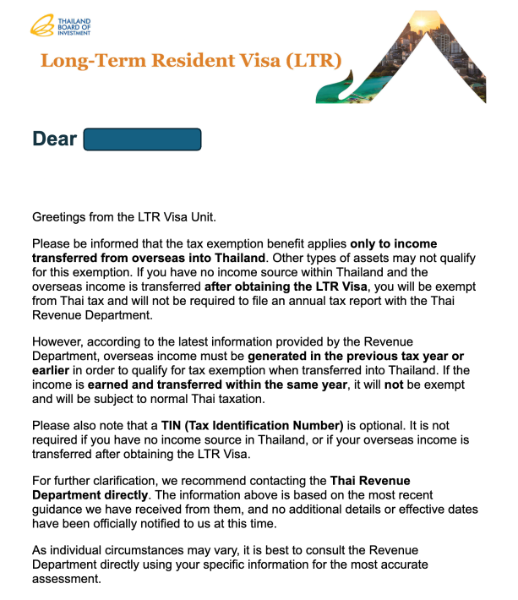
I’ve been reaching out to BOI with a few questions and have received the same response as the previous two posters. For context, I’ve included the central part of my email, which shows my questions I raised and their reply. As you can see from the response, they did not provide a specific date indicating when the change occurred. This information could be important, particularly in the event of a tax dispute. At this stage, I’m left wondering whether a change has actually taken place, or if it has always been BOI’s interpretation that income earned and remitted within the same tax year qualifies for tax exemption. On the other hand, the TRD might have been adhering to the Royal Decree from the outset, which is fairly clear in its wording. Has anyone come across any official documentation from sources such as the TRD, BOI quoting other official sources, or other government bodies that confirms that LTR WP visa holders [were] entitled to tax exemption on income earned and remitted within the same tax year? Again, this could be important in the event of a potential tax dispute.

-
Thanks for your message. The part of my message you quoted was just a simplified example to ask a different question: What would happen in 2027 if I were to remit money earned in 2027 from one account, while at the same time having the same amount of money earned the previous year sitting in a different account (like the $50,000 remittance from the previous year which would be money earned in 2025) and that I don’t want to move around for various reasons, as explained in my previous message, all with a paper trail. The previous poster mentioned it would depend on the Thai Revenue Department, which is probably correct. I’m just trying to get insights from anyone else who might be in a similar position.
-
Thanks for your thoughts! That's right, going down the DTA route may well nullify the Royal decree 743 protection good point! Something more to really look into. That said, my girlfriend just said she can help me by transferring $20,000 from her $ account to my $ account for a year (money I gave her a few years ago, just in case), giving me time to build up the cash reserve for the next tax year. With that, I could easily set aside another $15/20,000 right now to make up the total I normally spend annually. However, I’m wondering: in 2026, can I remit new money earned that year instead of using the dollars my girlfriend transferred to me? Or does it have to be the very money earned in the previous year and stored in a specific account that must be remitted? Does money sitting in accounts (both in Thailand and abroad) from previous years, but not remitted, still count toward the tax exemption? To simplify: If I deposit $50,000 in an account in 2026, either in Thailand or elsewhere, and willingly don’t use it, whether it sits there or, if allowed, is tied up in a 12-month fixed deposit with the principal accessible anytime, could I remit new money earned in the UK in 2027 instead and still meet the tax exemption requirements? Or does it have to be the actual money earned the previous year that must be remitted and only from the account it sits in?
-
One thing I both like and dislike about this forum is that unexpected news often comes up that makes my heart race for a minute! This time, it's the news about having to remit funds earned in a different tax year in order to be tax-exempt. I thought that was something that belonged to the past but it seems it’s not and just came out at the 11th hour for me! I’ve just rejigged my portfolio, and with only a couple of weeks left until the end of the year, I don’t have the $30,000 or $40,000, whatever the annual amount is that I typically remit to Thailand, sitting in an account to use solely for remittances throughout 2026. I would need to sell some assets, which would come at a high cost right now. Then I thought about the Double Taxation Agreement (DTA) between Thailand and the UK, and the income I remit is already taxed at the 40% rate which would far outweigh the Thai tax portion. So, do I still need to worry?
-
Just got back from holiday, so I finally had a chance to check my old passport the one where the original OA visa was stamped. When I wrote the earlier post mentioning that there were no comments or notes under the OA visa at the time the BOI stamped the new LTR in my new passport, I had only looked at the new passport, which I renewed in early 2023. Both the OA and the original LTR were actually first stamped in my old passport, which I had to renew because it was full with no pages left for stamps. I then remembered to check the old passport to see if any notes had been added and lo and behold, there is a note there under the OA visa. Strangely, when the BOI transferred the LTR to my new passport, they also transferred the old OA visa but didn’t add any cancellation note for it. That’s why I originally said there were no notes; I hadn’t checked the old passport at the time and frankly I completely forgot about the renewal that took place. Hope that clears things up!
-
When I visited the immigration office to inform them and to show them my newly stamped LTR visa in my passport, they didn't make any notations in my passport specifically, there was no cancellation mark over the OA visa I had obtained two months earlier. They simply told me everything was in order and that I was good to go. It’s possible they cancelled the OA visa in their system, but I’m not entirely sure.
-
A double page spread in word processing may mean a different thing but in this case they're just asking for a copy of your passport which is less technical so I think the google link I've provided explains it well.
-
It probably means you have to provide both passport pages in the same scanned copy https://www.google.com/search?q=passport+double+page+spread&sca_esv=5b730b024ba3a610&sxsrf=AHTn8zp0V2MB8j1HgpsZdZ6uNtAAN88i5A:1740462338274&source=hp&biw=1343&bih=829&ei=Alm9Z5SNDYPh2roPzYvf2AQ&iflsig=ACkRmUkAAAAAZ71nEuMSUjRB5UFyM-M_X4x8yJoYS4Gk&ved=0ahUKEwiUlqi7j96LAxWDsFYBHc3FF0sQ4dUDCBc&uact=5&oq=passport+double+page+spread&gs_lp=EgNpbWciG3Bhc3Nwb3J0IGRvdWJsZSBwYWdlIHNwcmVhZDIEEAAYHki0KFAAWMohcAB4AJABAJgBpgGgAdEXqgEFMTEuMTa4AQPIAQD4AQGKAgtnd3Mtd2l6LWltZ5gCG6ACpRjCAgcQIxgnGMkCwgILEAAYgAQYsQMYgwHCAg4QABiABBixAxiDARiKBcICCxAAGIAEGLEDGIoFwgIIEAAYgAQYsQPCAgUQABiABMICBxAAGIAEGArCAgYQABgKGB7CAgYQABgFGB7CAgYQABgIGB6YAwCSBwQ4LjE5oAeHaA&sclient=img&udm=2
-
That is my assumption. Thought it was clear in the message. If they decide to implement the newly modified income tax rule, there may be a good possibility that they'll enforce it in the borders to stop people getting out of the country without first paying the income tax on remittance and as a condition for returning. Since prevention is better than cure, the last thing anyone wants is to be in the middle of a dispute with an immigration officer concerning the LTR visa's income tax exemption right before their aircraft departs
-
Thai visa holders, including those with LTRs who have been in Thailand for more than 180 days in the past year, may be asked to provide documentation of having paid income tax on remitted income for the year 2024 when leaving or entering Thailand from April 1st 2025 onward, depending on the immigration officer's knowledge and other variables. If that's the case, what other papers do members of this group believe would be helpful to have in order to expedite the immigration process, beyond from having a hard copy of the RD 733 decrees in both Thai and English language showing that LTR holders are remitted income tax exempt?
-
That's right it's January 2028 which is five years away from when I first got the visa
-
Thanks for your input. When I reentered Thailand in January, the immigration officer stamped me in with a two-month validity which I didn't notice. However, when I reentered Thailand just a few days ago, the immigration officer pointed out to me that his colleague had made a mistake, and I was stamped in till January 28. I suppose that should resolve the issue.
-
It's odd that whereas e-gates are used to enter and exit in Malaysia and Singapore, as of a few days ago, Suvarnabhumi only allows e-gates for exiting, and as you mentioned, you would receive a stamp upon reentering. However, it appears that you can enter through e-gates if you have a passport from Hong Kong or Singapore. Other passports will eventually be able to enter through e-gates, I suppose. Additionally, I made the error of not informing the officer that I had an LTR the time before I entered Thailand, which resulted in a two-month validity stamp! 🙄
-
Has anyone in here participated in the tax-related Carl Turner Zoom call that was held a few days ago? Regarding the taxing of LTR visa holders, I wonder whether anything significant was mentioned.
-
Does anyone know if it's possible for an accompanying passenger to use the LTR visa's fast track option in Suvarnabhumi for both arrivals and departures when flying in economy class, or is it only available to the visa holder?
-
If I remember well, since I opened both THB and USD account at the same time, by handing them over a couple of thousand baht, they converted some of it into USD and they opened both accounts without me requiring to do anything else. Around 5 years ago one of the employee at the same branch, told me that the plan of having online banking transfer of USD going out of Thailand was on the pipeline and soon was going to be implemented for all the FCD holders. So no more trips to the bank spending 20 minutes to fill in forms should one require to transfer out of the country. Still waiting though! That would be putting BBL to a similar level of Western banks in terms of foreign cash transactions.