



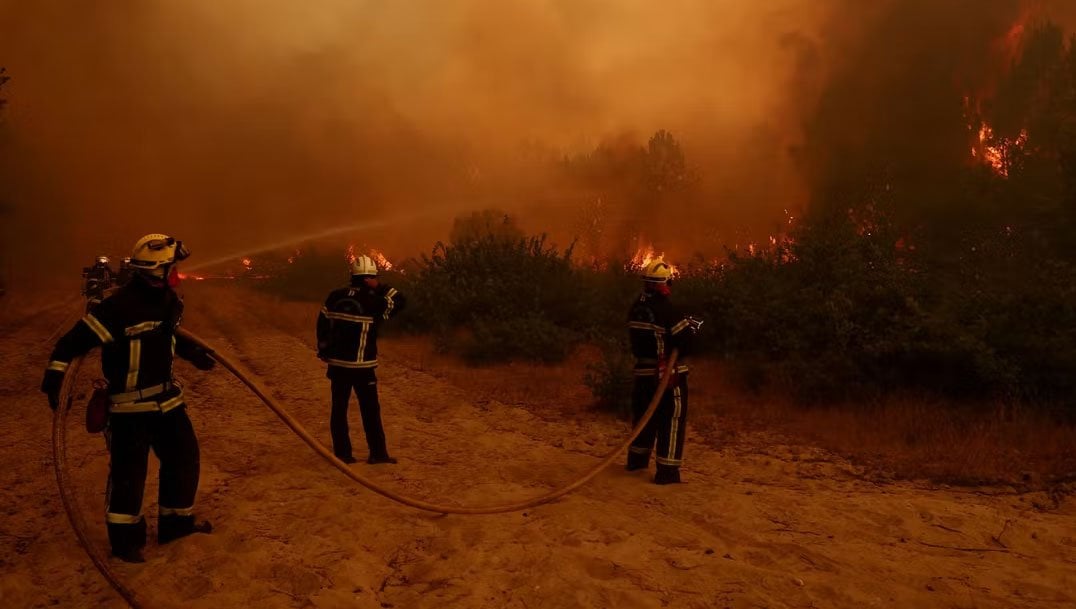

Tens of thousands of people fled wildfires in south-west France on Friday, while Spain declared a national emergency as several large fires merged outside Madrid and hot, dry conditions fuelled the blazes.
In France, authorities ordered the full evacuation of the Cap Ferret peninsula, an Atlantic Coast tourist hotspot. With two major fires threatening homes and campsites, emergency services sent boats to move people to safety.
France orders full evacuation
About 110,000 people, many of them visitors, were told to leave, officials said. Interior Minister Laurent Nunez said one of the fires was “convective”, meaning it could sustain itself, change direction and move mainly eastward, towards the Bordeaux metropolitan area.
A second major fire, which began near Saumos north of Cap Ferret, threatened to cut off the peninsula’s only road and was the largest blaze in France so far this season, Nunez said. France’s interior ministry said the fire had scorched more than 14,000 hectares of forest and destroyed more than 100 homes and one campsite.
Yoan Urien, who evacuated from Biscarrosse after police ordered his neighbourhood to leave late on Thursday, said he could see the fires from his home. “We could see the clouds becoming darker and darker,” he told Reuters. Marie Duelz, a Belgian tourist at Cap Ferret, said she saw a plume of ash that blocked the sun.
French President Emmanuel Macron asked for army support for firefighting, a source close to the president said. Both France and Spain, dealing with successive heatwaves and wildfires in recent years that scientists say are worsened by climate change, also sought assistance from the European Union as emergency services were stretched.
Spain declares national emergency
In Spain, more than 19,000 people were ordered to evacuate from towns in the mountains west of Madrid. Interior Minister Fernando Grande-Marlaska said over 2,000 personnel and 10 aircraft had been deployed in attempts to stop the fires from converging.
The national emergency was the first Spain had ever declared over a wildfire, and it allowed federal funding to be released to respond to the crisis. Madrid regional leader Isabel Díaz Ayuso said the fires had merged and called it “the worst wildfire in our region’s history”, blaming very high temperatures and winds that did not ease.
Evacuees described scenes of sudden danger. Enrique Martin, sheltering in Cebreros west of Madrid, said he had to run from his house after seeing “a ball of fire”. He added that taking only a few more minutes would have put his home at risk.
A third fire in Avila province was on the verge of joining, or may already have joined, the two major blazes near Madrid, Spain’s government representative for Castile and León, Nicanor Sen, said. Spanish police said they had arrested one person and were investigating another person suspected of starting that fire using heavy machinery in a prohibited area.
Grande-Marlaska said the government’s decision to declare an emergency was shaped by the dense population in the west of Madrid, where many residents have second homes. Díaz Ayuso said that in one development, 43 homes had been destroyed.
Regional help and worsening heat
After a short reprieve over the weekend, France’s temperatures are expected to rise sharply again next week, according to Meteo France. The high temperatures could warm rivers used to cool nuclear reactors, potentially leading to reduced power output. EDF data showed the Golfech 2 reactor in southern France has remained offline since July 7 due to heat-related restrictions.
The heat has also affected agriculture. Weeks of hot weather are taking a toll on the condition of the maize crop in France.
Across Europe, wildfires have already burned more land this year than the annual average over the past two decades, data shows, as the continent has endured three close together heatwaves. Scientists have said human-driven climate change increases the intensity of heatwaves, droughts and wildfires and can also create conditions for sudden, destructive storms.
Authorities said Greece was sending two firefighting aircraft to Spain, Croatia was providing a plane and staff to help France, and Italy was dispatching a firefighting plane to Tunisia, which is also dealing with wildfires.
Join the discussion? 

25 July 2026
Recommended Comments
Create an account or sign in to comment