



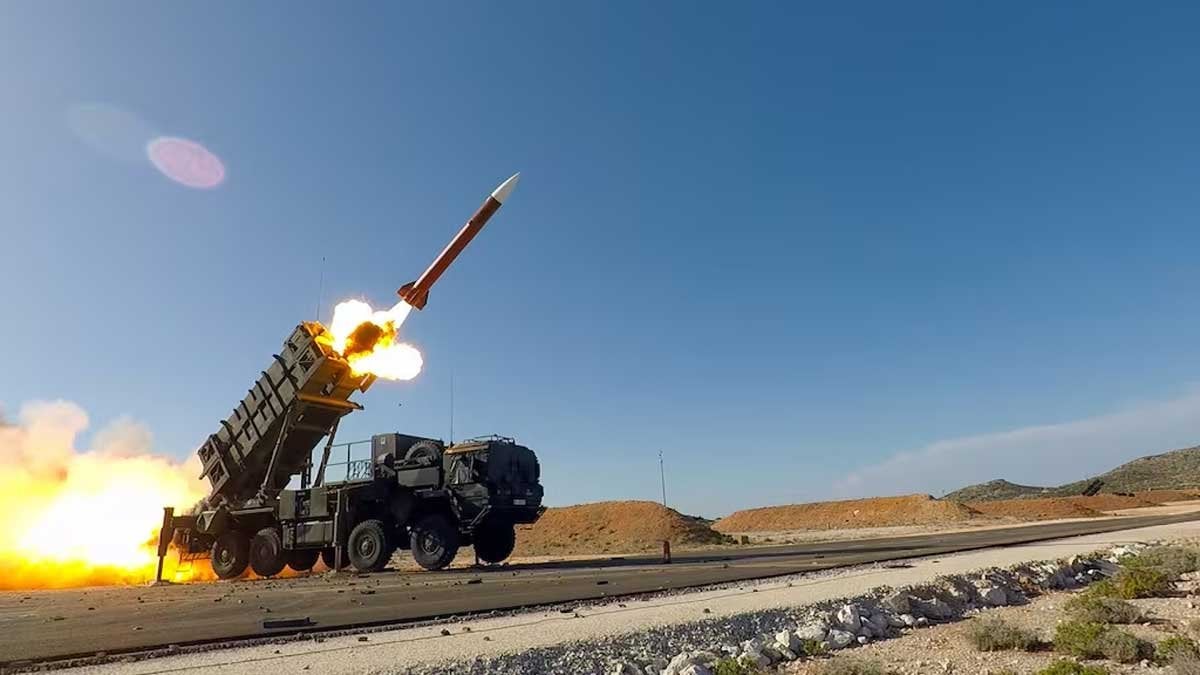

Donald Trump has retreated from a pledge to allow Ukraine to manufacture its own Patriot air defence interceptors, telling reporters during a cabinet meeting at Camp David that the underlying technology was difficult to share.
Speaking after the White House had described the meeting as “something different” for ministers to experience together, the US president said he had not agreed to licensing Ukraine’s domestic production. He made the comments as he appeared to loosen a commitment he had raised with Volodymyr Zelenskyy days earlier.
Patriot Technology Not Yet Licensed
Asked if he was ready to grant Kyiv a licence to build Patriots, Trump said the matter was not settled.
“We have not agreed to that,” he said. “We’re talking about it, but it’s a hard thing to give away that kind of technology.”
Trump also argued that transferring such technology could create security risks. “People that you give that technology, they can some day turn on you,” he said, adding that this was “possible”.
He said the interceptor’s speed underlined the sensitivity of the system, describing it as travelling at “8,600 miles an hour”. He added: “If you go 60, it gets to be a little fast.”
Trump further recalled what he characterised as an episode in which five missiles were fired “at Jordan” and shot down in sequence. He described the process using the sounds “bing bing bing bing”, and said he believed “nobody else has that capacity”.
Trump said the US would be “building many plants” to produce Patriots and Tomahawk missiles domestically, while indicating that this would not be happening in Ukraine “for now”.
Kyiv’s Search For Production Options
The reversal is likely to unsettle Ukraine, which has spent the past year pressing for more Patriot interceptors and the ability to produce them domestically, citing a global shortage.
That shortage has been worsened by the number of Patriot and Tomahawk munitions expended by Washington during its confrontation with Iran.
An expert analysis of the Pentagon’s own stocks, cited by the Center for Strategic and International Studies, said two-thirds of the department’s Patriot interceptors have been used. The analysis suggested that it may have contributed to a $58.6bn army contract with Lockheed Martin to rebuild supplies, as well as a recent White House request to Congress for tens of billions of dollars in emergency funding.
Camp David Also Focused On Gaza
The Camp David meeting came a day after Trump announced what he called a “historic” agreement involving Hamas disarming and Israeli forces withdrawing from Gaza. Israel has not confirmed the announcement.
When asked about the sequencing of the proposed arrangement—whether disarmament or withdrawal would come first, a point that has stalled negotiations for months—Trump declined to specify. He said Washington had “an understanding” with Israel and that the Israelis were “very happy about it”.
Pressed on whether the agreement would hold, Trump again offered limited detail. He said: “The people are very complex and difficult. In many cases wonderful, in many cases not so wonderful.”
The diplomatic context includes an outstanding International Criminal Court (ICC) arrest warrant for Benjamin Netanyahu, Israel’s prime minister, as well as an International Court of Justice (ICJ) case accusing Israel of genocide in Gaza. It also follows arms restrictions announced by several governments on how the war has been conducted, and a governing coalition in Israel that has repeatedly rejected any outcome short of Hamas’s total disarmament before any withdrawal.
An Israeli official has said that no withdrawal from the so-called Yellow Line would occur before Hamas fully disarms. Members of Netanyahu’s coalition have also expressed opposition to the plan, according to reporting, which Trump did not address.
Comments On Iran And US Military Effort
Trump also spoke about the conflict with Iran. He said the US would be “hitting them very hard” if talks broke down and described Iran’s military as hollowed out, complaining it had “no navy” and “no anti-aircraft”.
He compared what he called the controversial five-month campaign with US wars in Vietnam, Afghanistan and Korea, arguing those wars lasted “many years”, while his administration had achieved more “in less time”. His stated goals for the campaign have shifted repeatedly.
Join the discussion? 

1 August 2026
-
 1
1
Recommended Comments
Create an account or sign in to comment