



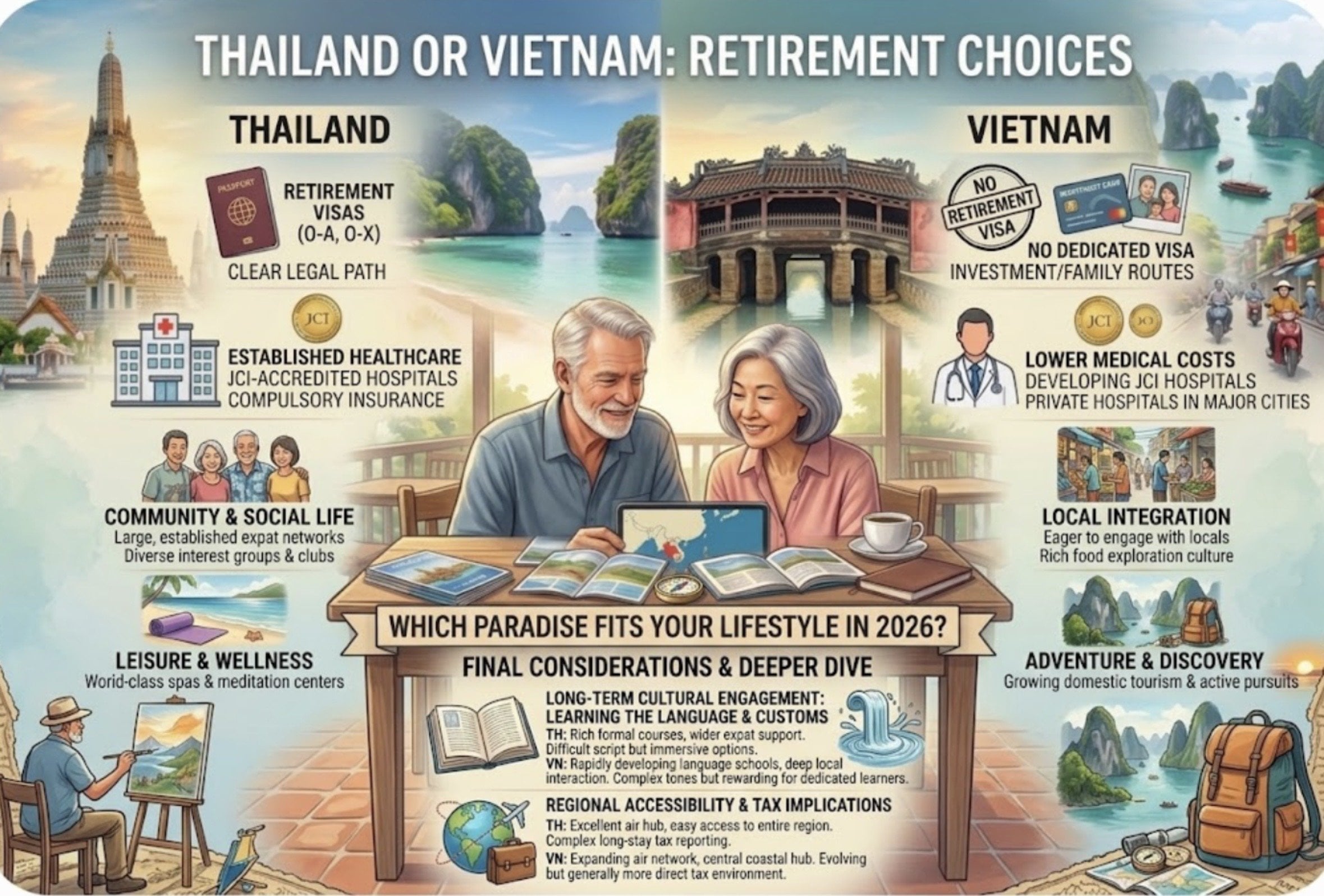

Thailand offers foreign retirees a clearer legal route to long-term residence than Vietnam, but Vietnam can cost considerably less for those able to manage more complicated visa arrangements. For people deciding where to spend retirement in Southeast Asia, the choice in 2026 often comes down to predictable paperwork and healthcare versus lower rent and daily spending.
Thailand has developed visa options specifically for retirement. The Non-Immigrant O visa allows foreigners aged 50 and above to stay for one or more years, when renewed, for retirement purposes.
Applicants generally need a valid passport, basic medical certificate and depending on initial visa, Thai-recognised health insurance. They must also show either 800,000 baht in a Thai bank account or a monthly income of 65,000 baht.
Vietnam has no retirement visa
Vietnam does not have a dedicated retirement visa, nor a visa category based only on a person's age, pension income or retirement status. Retirees seeking a long stay must instead pursue a Temporary Residence Card through eligible work, investment or family-tie routes, or use investment and family-reunion visas.
That can involve more legal complexity than a retirement move to Thailand. Investment-linked residence may require a compliant local company, along with continuing tax filings and audits, obligations that may not suit someone who has stopped working.
For foreigners who want an established route without relying on a job, investment or family sponsorship, Thailand's retirement visa framework is therefore a major practical advantage. Conditions, including financial evidence and insurance, should nevertheless be checked before applying.
Vietnam's advantage is everyday cost
Comparisons cited by Travelbinger put Vietnam around 20-30% cheaper than Thailand for a similar expat lifestyle. Rent is estimated to be roughly 40% lower on average.
Modern one-bedroom apartments are quoted at US$300-500 in Ho Chi Minh City and US$200-350 in Da Nang. Comparable rents are put at US$400-700 in Bangkok and US$350-550 in Chiang Mai.
A comfortable retirement budget is estimated at US$800-1,200 a month in Vietnam, compared with US$1,200-1,800 in Thailand. Annual estimates put comfortable expat spending at US$22,000-30,000 in Vietnam, against US$30,000-40,000 in Bangkok.
Street-food meals are estimated at US$1-3 in Vietnam and US$2-4 in Thailand, while restaurant dinners are US$5-12 and US$8-15 respectively. Domestic beer is also said to be cheaper in Vietnam.
The gap can narrow for retirees dependent on imported food and Western amenities, which can be significantly more expensive in Vietnam. Those happy with local food are likely to see the largest savings.
Healthcare, property and daily life
Thailand's established medical-tourism sector attracts more than two million medical tourists each year, including visitors from the United States, Australia, the Middle East and Europe. Its private hospital network includes JCI-accredited facilities, English-speaking staff and short waiting times.
Vietnam does not require health insurance for any visa category. Government figures put Vietnamese medical services at about 30-50% of the cost in Singapore or Thailand, but the country currently has four JCI-accredited hospitals. The health ministry aims for at least 15 internationally standard hospitals by 2030, including five public hospitals; retirees currently rely heavily on private hospitals in Hanoi and Ho Chi Minh City.
Neither country lets foreigners buy land outright. Vietnam permits foreign apartment purchases on 50-year leasehold terms, while Thailand has condominium ownership rules for foreigners and an established rental market.
Thailand has also applied tax rules since 2024 to foreign-source income brought into the country in the year it is earned. Retirees moving money to Thailand may need advice on tax exposure and their home country's double-taxation treaty.
Thailand offers more established expat infrastructure, English signage, public transport and retirement services. Vietnam offers lower costs, but busier traffic, less consistent English outside major cities and a more energetic pace. For many retirees, the decision is whether those savings outweigh Thailand's clearer long-term setup.
Join the discussion? 

18 August 2026
-
 1
1
-
 1
1
Recommended Comments
Create an account or sign in to comment