csp4me
Member
-
Joined
-
Last visited
Everything posted by csp4me
-
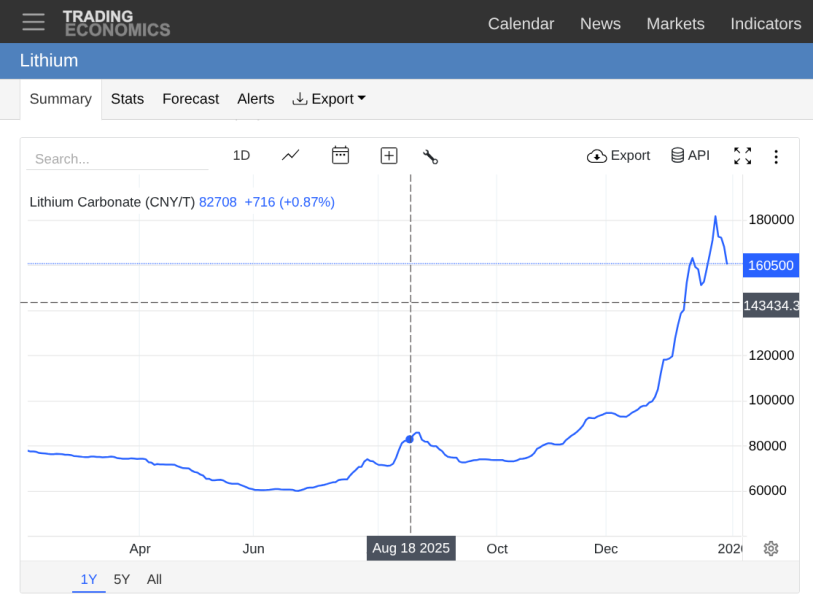
What recently has changed is that end of 2025 lithium carbonate prices have gone up to the roof, due to higher ESS demand and that mines have been closed due to the lower prices early 2025 [ Source https://tradingeconomics.com/commodity/lithium ]. I think that's one of the reasons that CATL is betting on sodium ion for ESS and city mileage EVs. Yes energy density is still an issue, but CATL will soon come with a hybrid LFP/sodium ion cells package to overcome this, until in gen 3/4 they think sodium ion's density will be on par with LFP. Besides the advantages that are being advertised like almost no loss in range in cold temps and better chemical stability will win over LFP in the gen 1 use cases. One advantage that is not advertised so well is the higher operating temps of sodium ion (+70C) vs LFP (+60C) and it also has an excellent high-rate discharge [https://carnewschina.com/2026/01/30/catls-sodium-ion-batteries-officially-enter-passenger-vehicles-report-says/: "at 5C charging, the cells increased 5C degrees in temp"]. This means that contrary to LFP, sodium ion can do with less sophisticated cooling than LFP and also less thermal runaway protection measures [https://www.catl.com/en/news/6401.html " the Naxtra Battery eliminates combustion-supporting factors at the material level, thus achieving a transformative breakthrough from "passive defense" to "intrinsic safety"]. Also higher operating temps means less prone to internal resistance degradation due to higher temps like fast driving/charging.
-
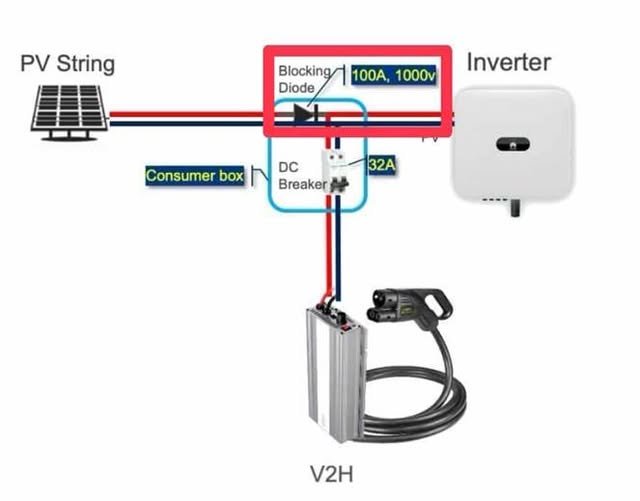
I think you miss a DC-DC converter between the EV and the inverter in the diagram. I have a few links of a few companies on facebook who sell such a solution. Only doubts I have are about compatibility and safety with the BMS of the EV. https://web.facebook.com/share/p/1ANqrdEYj5/ https://web.facebook.com/share/p/1CXKwd1wqy/ The solution is a bi-directional DC-DC charger [V2H] between the EV and a hybrid inverter like DEYE. And the trick is to feed the EV input into the solar array DC input of the inverter, while preventing the EV to feed the PV string using a blocking diode. During the day, when the solar array voltage is higher than the EV battery voltage, the EV will be charged. At times when the solar array voltage is lower than the EV battery voltage, the EV will feed into the inverter and thus the house. In Bangkok there is a second hand EV shop that has implemented this solution. See this vid https://youtu.be/9URhDCrIcpU?si=H-YSxFDc4Ff_YtG2. In this video you can see that some BYD and MG EV's work with this solution.