geovalin
Global Moderator
-
Joined
-
Last visited
Everything posted by geovalin
-
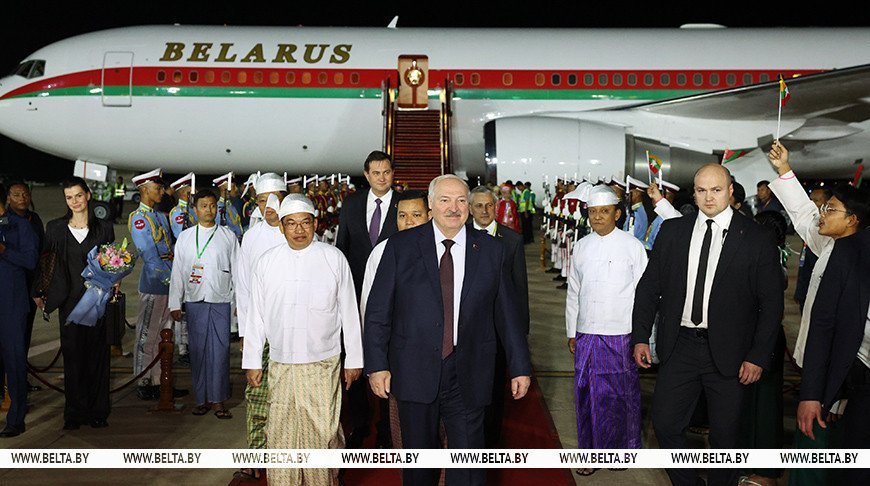
Belarusian President Aleksandr Lukashenko has arrived in Myanmar for a two-day state visit, the first by a foreign head of state since the military seized power in 2021. Invited by junta leader Min Aung Hlaing, the trip underscores the growing partnership between Minsk and Naypyitaw, extending beyond arms sales into trade, investment and political support. Belarusian state media said talks will focus on agriculture, food security, industry and pharmaceuticals, alongside the signing of new agreements, including a cooperation roadmap for 2026–28. The visit follows earlier meetings in Minsk this year, where both sides discussed closer ties and Myanmar officials studied Belarus’s voting systems. The timing is significant. Myanmar’s generals are preparing for elections in December and January, widely dismissed as a sham. Analysts say Lukashenko’s presence, along with Belarusian election observers expected later this month, is designed to lend credibility to the junta while reinforcing authoritarian solidarity. Days before the trip, Lukashenko approved draft deals with Myanmar, including a mutual visa waiver, a customs cooperation pact and a double-taxation agreement. These measures are seen as attempts to boost investment and cement bilateral relations. Min Aung Hlaing has already visited Belarus twice this year, with further meetings in Russia and China. Cultural exchanges and reciprocal visits have followed, highlighting the unusually close ties between the two leaders. Lukashenko, often labelled “Europe’s last dictator,” is the only head of state to receive an honorary title from the junta chief, setting him apart from other allies such as China and Russia, who have so far limited their engagement to ministerial visits. Belarus established diplomatic relations with Myanmar in 1999 and has long supplied fighter jets and weapons to its military. Since the 2021 coup, Minsk has stood firmly with Russia in backing the junta, even voting against UN resolutions condemning the regime. Lukashenko’s arrival in Naypyitaw signals not only Myanmar’s desperation for recognition but also the consolidation of an authoritarian bloc linking Moscow, Minsk and Myanmar—an alliance that critics say threatens to further isolate the country from the democratic world. -2025-11-28

-
AKP Cambodia’s cruise tourism industry received a major lift this week as two international liners docked in Sihanoukville, delivering nearly 4,000 visitors in a single day. The simultaneous arrival of the Westerdam and the Norwegian was hailed by officials as proof of the port city’s growing status as a regional maritime hub. Immigration Police confirmed that the disembarkation of passengers from both ships was handled smoothly, with safety and security protocols strictly observed. The Dutch-flagged Westerdam, arriving from Thailand, carried 1,896 passengers of 42 nationalities, supported by 800 crew. The largest groups were from the United States and Australia. Later in the day, the Bahamian-registered Norwegian arrived from China with 1,877 passengers representing 52 nationalities, alongside 864 crew. Once ashore, tourists dispersed across Preah Sihanouk province to explore beaches, markets and cultural attractions. In a sign of Cambodia’s wider appeal, five passengers chose to skip their ships’ onward journeys, travelling instead to Siem Reap to visit Angkor Wat. Local authorities staged a formal welcome, deploying staff and security forces to ensure order and a positive experience for guests. Officials said the successful handling of such large numbers underlined the port’s readiness to accommodate further growth in cruise tourism. The Westerdam is scheduled to depart for Vietnam later the same evening, while the Norwegian will sail for Thailand on 27 November. For Cambodia, the influx of visitors represents not only a boost to the local economy but also a clear signal that Sihanoukville is positioning itself as a key gateway for international travellers. With global cruise travel rebounding, Thursday’s arrivals highlight the sector’s potential to become a cornerstone of Cambodia’s tourism strategy, linking its coastal attractions with the country’s cultural treasures inland. -2025-11-28


-
Nop Vy Cambodia’s Ministry of Information has unveiled strict new qualification standards for journalists and media outlets, sparking warnings from press freedom advocates that the rules could stifle participation and force smaller newsrooms to close. Announced on 27 November, the regulations require editors-in-chief to be over 25, hold a recognised journalism degree or pass a ministry test, and have at least three years’ experience. Journalists and content creators must also hold a Bachelor’s degree and be over 20. Media companies will be obliged to maintain full staffing structures, including directors, editors, finance and marketing teams, before being allowed to operate. Minister Net Pheaktra said the measures aim to “strengthen journalism order” and improve information quality. But critics argue the rules are burdensome and risk undermining freedom of expression. Nop Vy, head of the Cambodian Journalists Alliance Association, warned the requirements could “negatively influence” the profession, adding that higher costs and stricter standards may push outlets out of business. Pa Chanroeun, President of the Cambodian Institute for Democracy, described the move as controversial, saying it hands the ministry excessive power to decide who qualifies as a journalist. He cautioned that investigative reporters, freelancers and younger journalists could be excluded, and urged the creation of an independent National Press Council to oversee ethics and training instead of government control. The debate comes as Cambodia prepares a consultation in Phnom Penh this week on protecting press freedom, journalist safety and access to information. Advocates say the new rules contradict constitutional guarantees and echo past concerns over licence revocations and restrictions on independent media. With more than 10,000 journalists working in the country, and 875 online outlets licensed last year, the new framework could reshape Cambodia’s media landscape. For now, stakeholders are calling for review and revision before the rules take effect, warning that the cost of tighter control may be paid in diminished press freedom. -2025-11-28


-
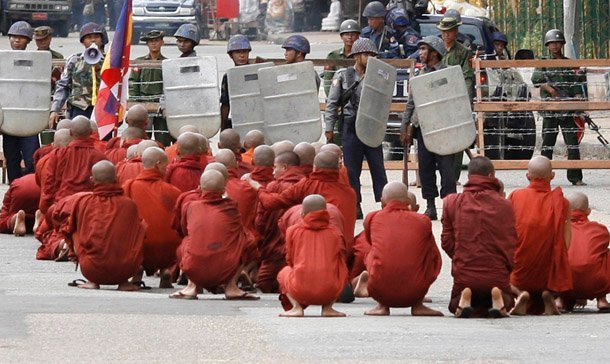
Monks against army. Old archive Myanmar’s military rulers have announced a sweeping amnesty for more than 3,000 political prisoners and dropped charges against over 5,500 others, just weeks before the country’s planned general election on 28 December. State broadcaster MRTV said the move was intended to ensure “all eligible voters do not lose their right to vote and can cast their votes freely and fairly.” The releases cover detainees convicted under Section 505(A) of the penal code, a law widely used to silence critics by criminalising comments deemed to incite unrest or spread false news. Among those freed are 724 prisoners granted conditional release, meaning any future offence will trigger both their original sentence and new penalties. A further 5,580 people facing prosecution or in hiding under the same charge will see their cases closed. It remains unclear whether the amnesty will extend to former leader Aung San Suu Kyi, who has been held incommunicado since the 2021 coup and is serving a 27-year sentence after convictions her supporters say were politically motivated. Rights groups caution that the gesture does little to alter the wider picture. The Assistance Association for Political Prisoners estimates more than 22,700 political detainees remain behind bars, including Suu Kyi and many leaders of her dissolved National League for Democracy party. Critics argue the election cannot be free or fair in the absence of independent media and with opposition figures jailed. The army’s takeover in 2021 sparked mass nonviolent protests that have since evolved into armed resistance, leaving swathes of the country locked in conflict. While the junta portrays the amnesty as a step toward democratic participation, observers see it as an attempt to bolster legitimacy ahead of a vote widely dismissed as lacking credibility. -2025-11-27

-
Zaw Min Tun, wiki Myanmar’s military regime has praised Washington’s decision to end temporary protected status (TPS) for its citizens living in the United States, even as rights groups warn the country remains unsafe. Around 4,000 Myanmar nationals currently benefit from TPS, which allows foreign residents from crisis-hit nations to stay and work legally in the US. The programme was extended to Myanmar after the 2021 coup plunged the country into civil war, sparking mass arrests and repression. On Monday, the Trump administration announced that Myanmar would no longer be eligible, citing “substantial steps toward political stability” including forthcoming elections and the lifting of emergency rule earlier this year. Homeland security secretary Kristi Noem declared it “safe for Burmese citizens to return home.” The junta swiftly welcomed the move. Spokesperson Zaw Min Tun described it as “a positive statement,” urging exiled citizens to return and take part in December’s general election. “You are all welcome to participate in building a modern and developed nation,” he said. But international monitors strongly dispute the US assessment. The UN’s Independent Investigative Mechanism on Myanmar reported rising evidence of “serious international crimes” in the run-up to the polls, including detentions of critics and airstrikes on contested areas. Nicholas Koumjian, head of the mechanism, warned such actions “may amount to crimes against humanity.” Conflict data suggests as many as 90,000 people have been killed since the coup. Civil society groups in the US condemned the TPS decision, with Me Me Khant of Students for Free Burma calling it “a slap in the face” to exiled communities. “It’s obviously really not safe to go back home,” she said. The military insists elections beginning on 28 December will mark a return to normality. Yet Aung San Suu Kyi’s party has been dissolved, dissent is criminalised, and large parts of the country remain under martial law. UN human rights chief Volker Turk said holding a vote under such conditions was “unfathomable.” -2025-11-27
.jpg.3a48a6feefaf41bf6724bdc22e4f79c9.jpg)

-
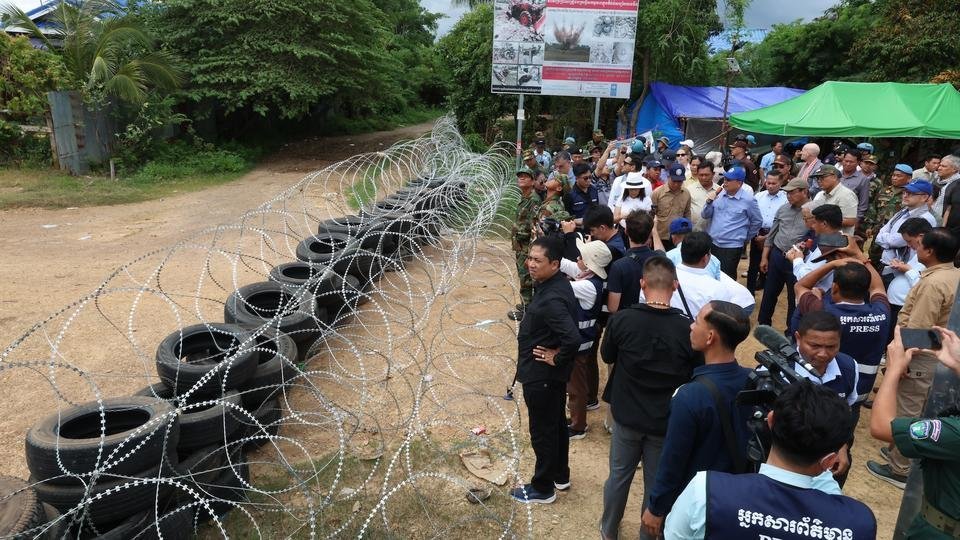
AKP, Kiripost Prime Minister Hun Manet has sought to calm public anxiety over Cambodia’s ongoing border demarcation with Thailand, stressing that the placement of temporary markers in Battambang and Banteay Meanchey provinces is a technical step rooted in historical agreements, not a surrender of land. Speaking on 25 November, Hun Manet acknowledged widespread concern on social media that the survey work was being rushed and might cost Cambodia territory. He insisted the process is a continuation of joint technical efforts dating back nearly two decades, guided by treaties and conventions inherited from the French protectorate era. “The border issue is a complex matter that has existed for hundreds of years,” he said. “Only peaceful means—based on convention, treaties and existing agreements—can ensure the desired outcome.” The Cambodia–Thailand Joint Commission on Demarcation for Land Boundary (JBC) has agreed to send survey teams to place markers between boundary pillars No. 42–47 in Banteay Meanchey and No. 52–59 in Battambang. These markers are intended to clarify the location of 74 concrete pillars first installed between 1919 and 1920. Hun Manet emphasised that the work is not about calculating land gain or loss but about establishing a precise and mutually recognised boundary line. He reaffirmed Cambodia’s commitment to protecting sovereignty while respecting Thailand’s territorial integrity. Concerns about transparency have been met with assurances that the process follows official records from the early 20th century and adheres strictly to international law. “The Royal Government of Cambodia and the JBC have always maintained the highest level of professionalism and responsibility,” Hun Manet said. Civil society voices echoed the need for a definitive settlement. Am Sam Ath of rights group Licadho noted that only a final, agreed demarcation can prevent disputes from dragging on. Delegates from 42 countries recently visited conflict-affected border areas, underscoring international interest in a peaceful resolution. For now, the government insists the temporary markers are a careful, step-by-step measure towards lasting stability. -2025-11-27

-
Cambodia has dramatically scaled back its participation in the upcoming 33rd Southeast Asian (SEA) Games in Thailand, citing concerns for athlete safety. The decision, announced by the National Olympic Committee of Cambodia (NOCC) and the Ministry of Education, Youth and Sports, comes just weeks before the Games open on 9 December in Songkhla and other venues. Originally, Cambodia planned to send 333 athletes across 21 sports. That figure has now been cut to around 150 competitors in 13 disciplines, following government guidance to minimise risks in flood-affected areas and reduce exposure to injury. In a formal statement, the NOCC stressed that “the safety of athletes and sportsmen is the top priority,” describing the move as a “difficult but responsible decision.” The announcement means Cambodia will withdraw from eight sports, including men’s and women’s football, judo, karate, wrestling, wushu, petanque, pencak silat and sepak takraw. Most of these are team-based events, where participation numbers are highest. The sudden withdrawal has immediate consequences for the Games schedule. Football fixtures, in particular, will need to be redrawn, as Cambodia had been due to face host nation Thailand. Thana Chaiprasit, head of the Thai athletes’ delegation, admitted the decision came with “virtually no prior warning,” leaving organisers scrambling to adjust tournament plans. Despite the setback, Cambodia will still compete in swimming, athletics, fencing, volleyball, bodybuilding, jiu-jitsu, e-sports, kickboxing, taekwondo, horse riding, jet skiing, triathlon and table tennis. Officials emphasised that the reduced delegation reflects a “proactive spirit” to ensure safe and meaningful participation, urging the public to understand the necessity of the move. The SEA Games, running from 9–20 December, remain a major regional sporting showcase. Cambodia’s scaled-down presence underscores the challenges of balancing ambition with athlete welfare in unpredictable conditions. -2025-11-27


-
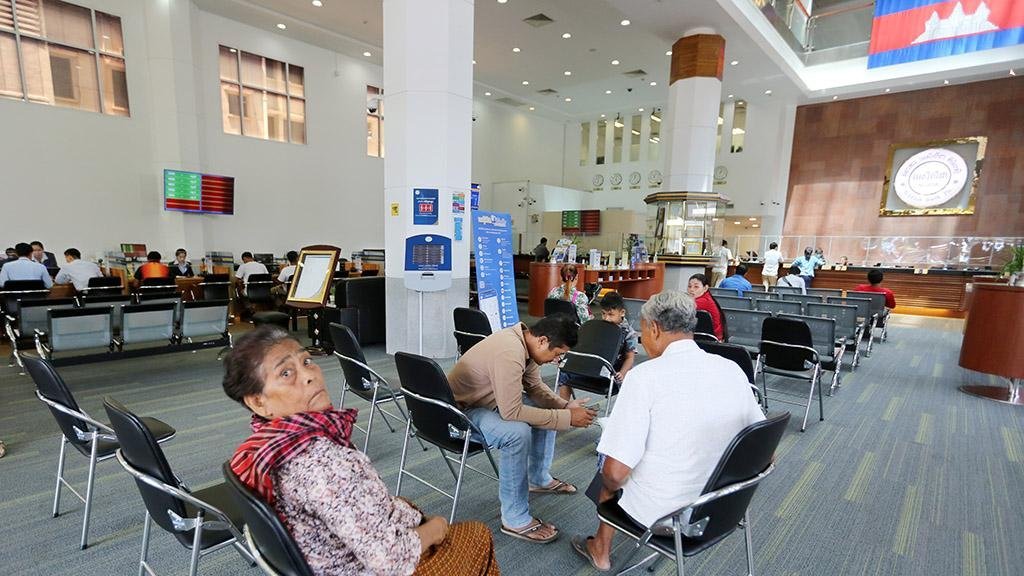
ADB Cambodia is set to accelerate its digital and financial transformation after the Asian Development Bank approved a US$50 million programme aimed at strengthening the country’s financial stability and modernising its digital infrastructure. Announced in Manila, the loan marks the first phase of the ADB’s Inclusive and Sustainable Finance Development Program — a multi‑year effort designed to upgrade Cambodia’s banking and non‑banking systems, expand digital finance, and build the regulatory foundations needed for a more resilient economy. The investment comes at a pivotal moment. Cambodia’s financial sector has grown rapidly in recent years, but remains hampered by weak digital infrastructure, limited market depth, patchy consumer protection and low financial literacy. These gaps have left millions without reliable access to modern financial services and have slowed progress toward the government’s ambition of becoming an upper‑middle‑income country by 2030. Anthony Gill, ADB’s Acting Country Director for Cambodia, said the programme aims to “boost the financial sector, lay the foundation for resilient growth, expand financial inclusion, and unlock private‑sector potential”. A central pillar of that effort is the digital transition — from secure payment systems to regulatory frameworks for emerging technologies. The first phase focuses heavily on building Cambodia’s digital finance architecture. This includes drafting national strategies for financial technology, creating rules for digital assets and cryptocurrencies, and establishing oversight for peer‑to‑peer lending platforms. The programme will also support financial education initiatives to help Cambodians navigate an increasingly digital economy. Beyond digital systems, the ADB package aims to strengthen financial stability, deepen capital markets and improve investor protection. It also introduces a sustainability dimension: a new green finance working group, guidelines for corporate sustainability reporting, and mechanisms to support future sovereign sustainable bond issuances. For Cambodia, the investment is both a technical upgrade and a strategic shift. Without stronger digital infrastructure, the country risks falling behind regional peers that are rapidly modernising their financial systems. The ADB’s support is intended to close that gap — enabling smoother digital payments, safer online transactions and broader access to financial tools for households and businesses. Founded in 1966, the ADB works with 69 member countries to promote inclusive and resilient development across Asia and the Pacific. Its latest programme signals a clear message: Cambodia’s financial future will depend not only on stability, but on how quickly and effectively it can build the digital backbone of a modern economy. -2025-11-26

-
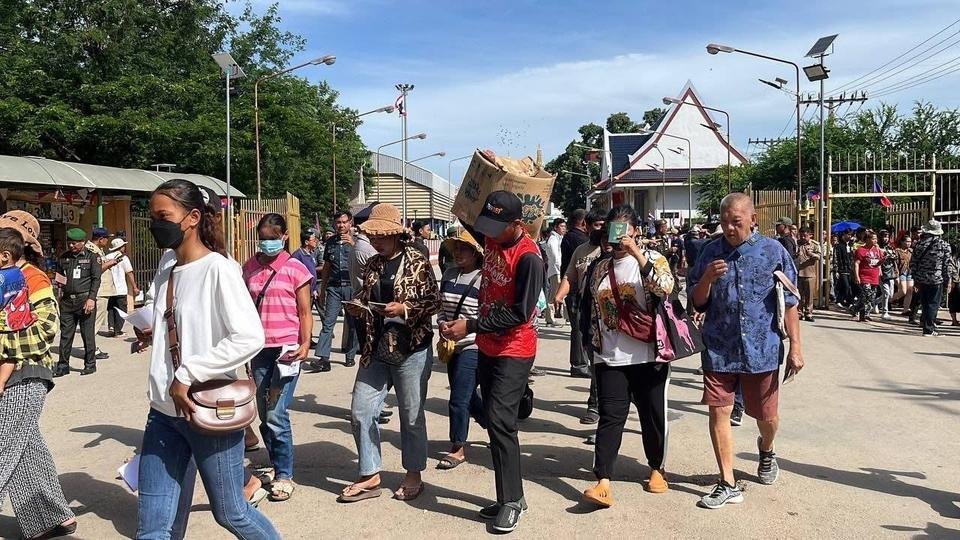
Kiripost Cambodia is grappling with a deepening social and economic emergency as migrant workers who fled Thailand earlier this year return to find no jobs, no support and debts they can no longer afford to repay. Rights groups say the government has abandoned the very people it urged to come home when border tensions escalated. From late July, officials warned Cambodian workers in Thailand of rising discrimination and possible violence, encouraging them to return before conditions worsened. More than 900,000 people crossed back into Cambodia. What they found, however, was not the promised safety net but hunger, unemployment and relentless pressure from microfinance lenders. Human Rights Watch, which interviewed dozens of returnees in Banteay Meanchey province, says the crisis merely exposed long‑standing failures. Cambodia already had the highest microcredit debt per capita in the world, pushing many families to migrate in the first place. With incomes gone, repayments have become impossible. The stories are stark. A 17‑year‑old who left school to help her mother repay a loan said she endured daily abuse from Thai employers once the border conflict erupted. Others described being refused service in markets, threatened by police or targeted by groups of Thai men. Back home, the situation is equally grim. Jobs are scarce, and those that exist often require skills migrants do not have. A woman who spent ten years in Bangkok’s construction sector said her family now survives on two meals a day while trying to meet monthly repayments of more than US$100. Missing a payment could cost them the land they used as collateral. Despite government promises of 70,000 jobs and economic support packages, little has materialised. Most vacancies are in Phnom Penh, far from border provinces, and too costly for returnees to reach. Even the government’s claim of 190,000 available jobs would still leave more than 700,000 workers without work. Debt dominates every conversation. Returned migrants describe credit officers visiting their homes, pressuring them to pay. Some say they fear lenders more than the police. With healthcare costs among the highest out‑of‑pocket rates in the region, families are cutting food, skipping treatment and sinking deeper into crisis. Rights groups are urging the government to act: restructure loans, curb abusive collection practices and invest in healthcare and education to ease the pressures driving families into debt. “The situation is dire,” said Bryony Lau of Human Rights Watch. “People are burning through their savings just to eat. The government needs to act — fast.” -2025-11-26

-
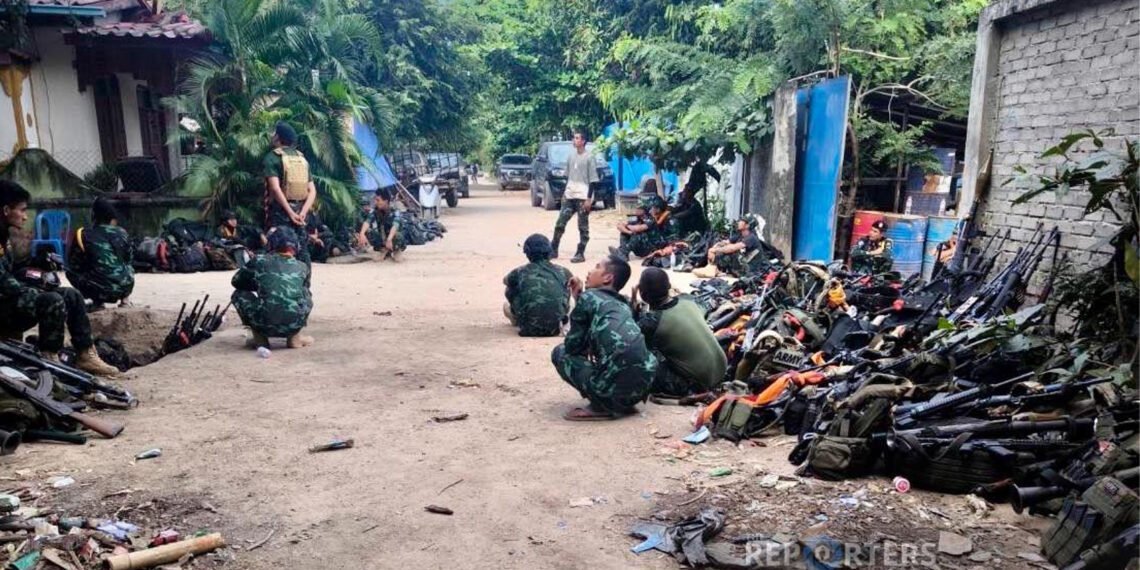
The Reporters via Tha Irrawaddy Rebel forces in Myanmar have uncovered yet another major scam centre after seizing a militia-controlled compound near the Thai border, exposing the scale of criminal operations protected by groups aligned with the junta. The Karen National Liberation Army (KNLA), the armed wing of the Karen National Union (KNU), captured the site last Friday during clashes with junta troops and the Democratic Karen Benevolent Army (DKBA) in Myawaddy Township, Karen State. The DKBA, long allied with the military regime, was sanctioned by the United States earlier this month for its involvement in transnational scam networks. Fighting erupted near Min Let Pan, a DKBA-held village south of Myawaddy, as junta forces attempted to push back into KNU territory. According to local sources, DKBA fighters joined regime troops in attacking the KNLA. Several mortar rounds reportedly landed across the border in Thailand, prompting the Thai army to fire a smoke round as a warning. Despite the pressure, KNLA units broke through and overran a DKBA compound. Dozens of militia members surrendered. What the KNLA found inside stunned even seasoned observers: a fully functioning scam hub employing more than 5,000 foreign workers from at least eight countries. The KNU is now working to identify the workers and prepare for their repatriation. Its spokesperson, Padoh Saw Taw Nee, declined to comment in detail, saying only that a public announcement would be made “when the time comes”. The DKBA, which split from the KNU in 1994, has long been linked to illicit operations in Myawaddy. Many of its members later joined the Karen State Border Guard Force (BGF), another militia operating under the Myanmar military. Scam centres protected by the DKBA and BGF have targeted victims worldwide; US authorities estimate Americans alone lost nearly US$10 billion to such schemes last year. Washington has stepped up pressure, launching a new Scam Center Strike Force and sanctioning four DKBA leaders. FBI agents have also been deployed to work with Thai police on cross-border investigations. Following the US crackdown, junta and BGF forces staged high-profile raids on the notorious Shwe Kokko scam hub, arresting more than 1,700 foreign nationals. Analysts, however, dismissed the operations as public relations theatre, noting that senior operators were once again untouched. The DKBA has since pledged to dismantle scam operations in its territory within two months — a promise many observers doubt will be kept. -2025-11-26

-
Phil Robertson, archive Rights organisations have sharply criticised the Trump administration for ending deportation protection for Myanmar nationals, arguing the decision ignores the brutal civil war still tearing the country apart. The Department of Homeland Security announced on Monday that Temporary Protected Status (TPS) for Myanmar would be terminated in January, citing what it described as “notable progress in governance and stability”. Homeland Security Secretary Kristi Noem pointed to the junta’s promise of “free and fair elections” in December and supposed ceasefire gains. Rights groups say this bears no resemblance to reality. Myanmar’s military, led by Senior Gen Min Aung Hlaing, seized power in 2021, jailed Aung San Suu Kyi, banned her party, and has since waged a nationwide campaign of airstrikes, forced conscription and mass arrests. UN investigators accuse the junta of war crimes, and prosecutors at the International Criminal Court have sought an arrest warrant for Min Aung Hlaing over atrocities against the Rohingya. Phil Robertson of Asia Human Rights and Labor Advocates said the decision would send people “back to prisons, torture and death”, calling Noem’s justification “deluded”. Human Rights Watch echoed the criticism, saying almost every claim in the DHS notice is contradicted by extensive reporting from the UN, foreign governments and the US State Department itself. The shadow National Unity Government, formed by elected lawmakers barred from office after the coup, said the move “does not reflect the reality in Myanmar”, where fighting has intensified ahead of the junta’s planned election. Large areas of the country are now controlled by resistance forces, and more than 3.5 million people have been displaced. Even the State Department’s own travel advisory warns Americans not to enter Myanmar due to armed conflict, landmines, arbitrary arrests and “wrongful detentions”. Rights monitors say more than 30,000 people have been jailed for political reasons since the coup, and nearly 7,500 killed. Despite this, Homeland Security maintains that conditions have “improved enough” for Myanmar nationals to return safely, and that extending TPS would be “contrary to the national interest”. Up to 4,000 people could now face deportation. Critics say the decision is so detached from the situation on the ground that it is unclear who was ever meant to believe it. -2025-11-26


-
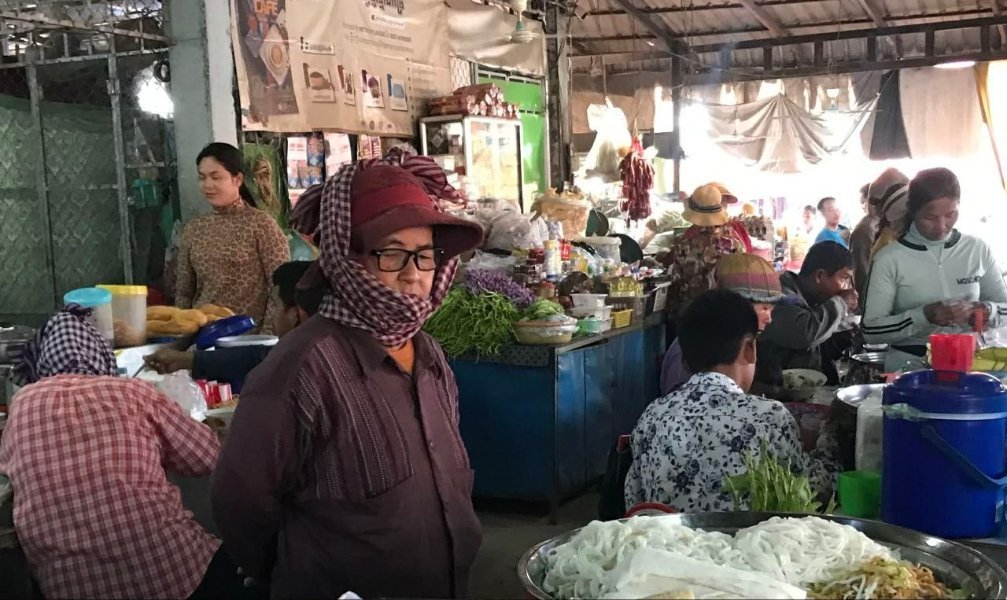
A sharp winter chill has swept across Cambodia, exposing the vulnerability of rural communities and leaving many elderly residents struggling to cope with falling temperatures. In Kandal province’s Rokarkoang Muoy Commune, 80-year-old grandmother Chin Sary said she had been layering clothes to keep warm but feared she would not withstand further drops in temperature. Already suffering from a heavy cold and cough, she explained that the chill made breathing more difficult. Her neighbour, Chen Chun, also 80, has been bedridden since a stroke left him paralysed. His son lights small fires beneath the family’s bamboo bedframe on cold nights, but Chun admits blankets alone are not enough. “When it’s cold like this, everything becomes harder,” he said. For fisherman Chan Ny, the cold is felt most acutely at dawn on the Mekong River. “No matter how cold it gets, I still have to work,” he said, describing how he carries rice wine to ward off the chill. Local officials acknowledge the hardship. Commune chief Men Sum said the area’s riverside location makes winters harsher. With more than 2,000 families, many elderly, the administration has distributed warm clothing to those unable to afford it. Children are also stepping in, buying jackets and scarves for ageing parents. The Ministry of Water Resources and Meteorology has issued a weather advisory, warning that the northeast monsoon will affect Cambodia until the end of November. Lowland provinces, including Battambang, Siem Reap and Phnom Penh, are expected to see temperatures between 22°C and 29°C, while highland regions may dip as low as 18°C. Coastal areas will range from 21°C to 31°C. Officials urged the public to take precautions against the cold, particularly the elderly and vulnerable. For many in Cambodia’s rural villages, however, coping with the chill remains a daily struggle, underscoring the fragility of communities when faced with even modest drops in temperature. -2025-11-25

-
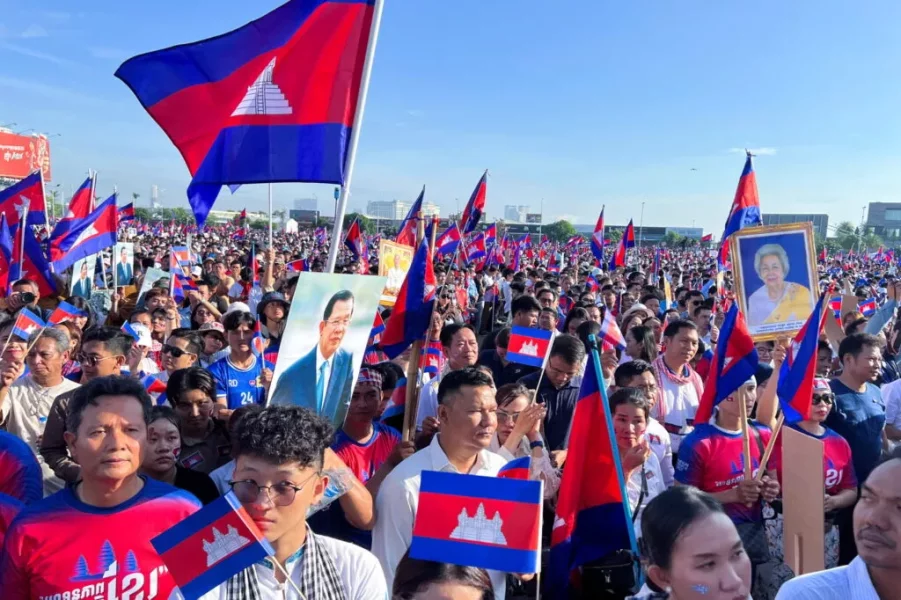
According to Scott Rawlinson, Cambodia’s Prime Minister Hun Manet has placed economic growth at the heart of his administration since succeeding his father Hun Sen in 2023. Yet his strategy of combining authoritarian developmentalism with surges of Khmer nationalism is beginning to show strain, particularly in the wake of violent border clashes with Thailand earlier this year. Hun Manet’s Pentagonal Strategy aims to lift Cambodia to upper-middle income status by 2030 and high-income status by 2050. Major infrastructure projects, including the expansion of Sihanoukville port and construction of the Funan Techo Canal, are designed to modernise the economy and attract foreign investment. Airports in Siem Reap and Phnom Penh have also been opened to boost tourism and project legitimacy at home. But cracks are emerging. A slowdown in China’s economy has hit investment flows, while questions over funding transparency for the Techo Canal have raised concerns. Construction and real estate downturns underline the fragility of growth, and the rise of cyber scams has damaged Cambodia’s reputation abroad, triggering sanctions. The Thai–Cambodia border conflict in July 2025 further disrupted stability. Nationalist fervour was stoked by Hun Sen and Hun Many, who led mass rallies and imposed bans on Thai imports. While this bolstered short-term unity, the Asian Development Bank cut Cambodia’s growth forecast from 6.1 to 4.9 per cent for 2025, citing border tensions and uncertainty in export markets. Tourism also suffered: international arrivals fell by up to 40 per cent in the months following hostilities, with Thai visitors down more than 28 per cent compared to last year. Hun Manet’s reliance on nationalism to consolidate legitimacy highlights the risks of authoritarian developmentalism. Economic growth is presented as the regime’s central promise, yet prolonged conflict undermines the peace and stability essential to delivering it. The Cambodian case shows that while nationalist mobilisation can provide a temporary boost in popularity, it jeopardises the very conditions needed for sustained development. Balancing the “runways” of growth with the “redlines” of nationalism may prove the defining challenge of Hun Manet’s rule. -2025-11-25

-
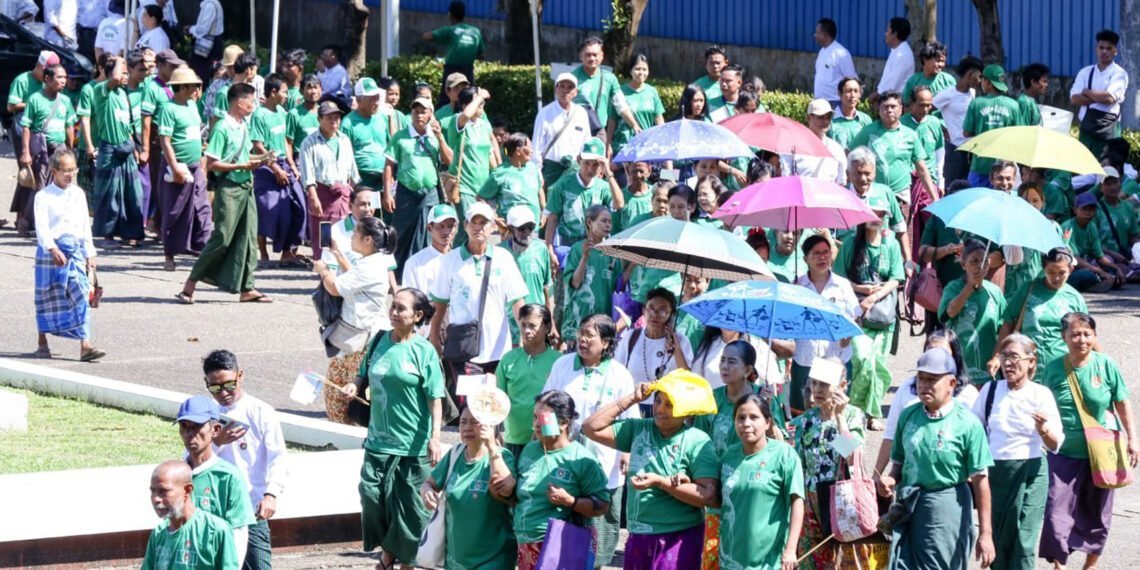
USDP Factory workers in Yangon say they are being pushed to support Myanmar’s military-backed Union Solidarity and Development Party (USDP) ahead of next month’s election. Reports suggest local administrators and employers are mobilising staff, raising concerns about coercion in the vote. Since October, junta-appointed ward officials have visited industrial zones to explain voting procedures and collect worker lists. Employees in Shwepyithar and Hlaing Tharyar townships told The Irrawaddy that factory owners are urging them to cast ballots for the USDP. Some workers have already been registered by local offices but are now required to complete additional voter application forms inside their workplaces. One worker, speaking anonymously for fear of reprisals, said: “They are doing it for the party they support, the USDP.” Others described employers being pressured to allow election preparations on-site, with staff obliged to submit registration forms. While overt intimidation has not yet been reported, workers fear threats could follow if they refuse to participate. Despite pledges from USDP chairman Khin Yi to raise wages and introduce new labour protections, many employees say they have little interest in voting. Ma Phyo Sandar Soe of the Confederation of Trade Unions Myanmar warned that ordinary people do not want to take part in the junta’s election. “Workers will try to avoid it as much as possible, but both employers and employees are under pressure,” she said. International labour federations have denounced the polls as a sham. On International Democracy Day in September, the Global Union Federation, representing more than 200 million workers worldwide, condemned the planned vote as a “dangerous mockery of democracy” designed to entrench military rule. The junta has scheduled the first phase of voting for 28 December in 102 townships, with a second round on 11 January covering another 100. For thousands of garment workers in Yangon, the election is less about choice than compliance, as pressure mounts from both administrators and employers to back the military’s proxy party. -2025-11-25

-
Secretary Kristi Noem, wiki The Trump administration has announced it will terminate Temporary Protected Status (TPS) for nearly 4,000 immigrants from Myanmar, a country still gripped by civil war and political turmoil. The decision, unveiled on Monday, marks the latest step in a broader rollback of humanitarian immigration programmes. TPS, created by Congress in 1990, allows migrants from countries facing armed conflict or natural disaster to live and work in the United States without fear of deportation. Successive administrations have used it to shield vulnerable groups, and the scheme was expanded under President Joe Biden. But the current administration argues the policy has been misused and extended beyond its intended “temporary” scope. Myanmar has been in crisis since a military coup in 2021, which triggered widespread fighting between the army and ethnic militias. The United Nations estimates that more than 6,500 civilians have been killed and 3.5 million displaced. Minority groups, including the Rohingya Muslim community, remain particularly at risk. Despite acknowledging ongoing humanitarian challenges, the Department of Homeland Security said conditions in Myanmar had shown “improvements in governance and stability.” In its official notice, signed by Secretary Kristi Noem, DHS claimed continuing TPS was inconsistent with U.S. national interests. It cited difficulties in vetting applicants, risks of visa overstays, and investigations into alleged security and fraud concerns among some TPS holders. The move follows similar revocations of TPS for migrants from Afghanistan, Haiti, Honduras, Syria, Sudan and Venezuela. Pro-immigrant advocates have condemned the campaign as the largest “de-documentation” effort in modern U.S. history, warning that thousands could now face arrest and deportation. Unless blocked by the courts, Myanmar’s TPS designation will expire in late January. For the 3,969 people currently enrolled, the end of protections could mean returning to a country still scarred by violence and instability. -2025-11-25
.jpg.2a41c1d20745fc7ff368be10ff2538af.jpg)

-
Myanmar’s military has announced the arrest of nearly 1,600 foreign nationals in a sweeping crackdown on internet fraud centres along the Thai border, underscoring both the scale of the illicit industry and mounting pressure from China to rein it in. According to state media, raids between 18 and 22 November targeted Shwe Kokko, a notorious gambling and scam hub in Myawaddy township. Officials reported that 1,590 foreigners who had entered Myanmar illegally were detained, alongside the seizure of thousands of devices: 2,893 computers, more than 21,000 mobile phones, and over 100 Starlink satellite receivers. The junta has faced long‑standing accusations of tolerating scam compounds that have proliferated in Myanmar’s borderlands since the 2021 coup. These centres, often staffed by trafficked workers, generate billions of dollars annually through online romance and business cons. Analysts say the latest raids are partly choreographed to appease Beijing, a key military backer increasingly angered by scams targeting Chinese citizens. On Saturday alone, 223 suspects were detained, including 100 Chinese nationals. Local media broadcast footage of a steamroller crushing rows of confiscated computer monitors and mobile phones at Shwe Kokko. The crackdown follows an AFP investigation revealing widespread use of Starlink satellite receivers at scam compounds. Elon Musk’s company has since disabled more than 2,500 devices in the area. While the junta has trumpeted its campaign as a decisive move against organised fraud, monitors warn that the operations may be more symbolic than substantive, designed to relieve diplomatic pressure without dismantling the lucrative networks that enrich militia allies. A UN report estimated victims across Southeast and East Asia lost up to USD $37 billion in 2023, with global losses likely far higher. The raids highlight both the human toll of trafficking and the international scale of Myanmar’s scam industry. -2025-11-24

-
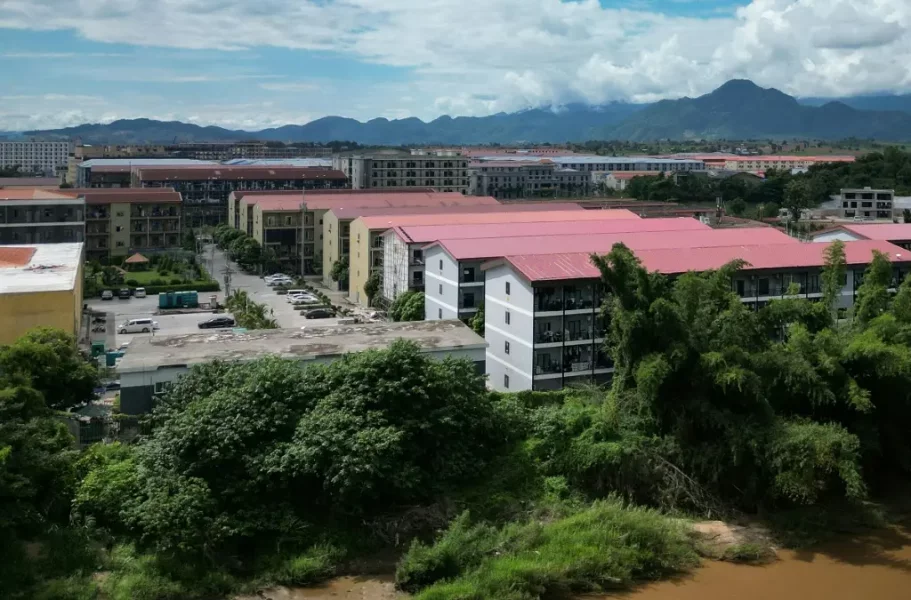
Heavy clashes between Myanmar’s military and ethnic armed groups near Myawaddy on 21 November spilled across the frontier, with a stray shell landing inside Thai territory and prompting a swift response from Thai forces. According to reports from the Rachamanu Task Force, the fighting erupted late at night in Myawaddy district, opposite Thailand’s Mae Sot. At around 11 p.m., a single heavy round crossed the border and struck a vegetable plot in Ban Mae Kon Ken, Mahawan subdistrict. The blast damaged a vehicle and part of a house but caused no casualties. The shell was believed to have come from exchanges between Myanmar government troops and ethnic fighters, who have been engaged in intense battles across Karen State. The conflict has escalated in recent weeks, with armed groups pressing offensives against military positions close to the Thai border. In response to the stray round, Thai forces fired a single 120mm mortar into an open area on the Myanmar side at 11:05 p.m. Officials described the shot as a formal warning under the Rules of Engagement, intended to signal both sides to prevent further fire crossing into Thailand. For Myanmar, the incident underscores the volatility of the border conflict and the risks of spillover into neighbouring countries. While no injuries were reported in Thailand, the clashes highlight the intensity of fighting in Myawaddy and the potential for regional repercussions. The Royal Thai Army has assured residents of Mae Sot that its units remain on high alert. Meanwhile, Myanmar’s military continues operations against ethnic armed groups, with the situation along the frontier closely monitored by both sides. -2025-11-24


-
A Thai non‑government organisation has reported the death of another man in Poipet, Cambodia, amid mounting concerns over violence linked to scam compounds in the border town. The Immanuel Foundation Thailand announced on Sunday that Mr Narong Kam, also known as Don, from Mae Ai district in Chiang Mai province, was tortured and electrocuted in the Bua Lai area of Poipet. The group said it received confirmation of his death at 5 p.m. on 22 November, but his body has yet to be located. Narong’s death follows a string of recent tragedies involving Thai nationals in Poipet. On 18 November, Mr Sarawut — known as Toto, from Samut Prakan — was reportedly tortured to death at a similar complex. Earlier this month, two young women also lost their lives under suspicious circumstances: Ms Suthatip, 28, was found hanged in her room on 3 November, while Ms Kanokwan, 27, allegedly fell from a third‑floor window on 29 October. The foundation said it had obtained permission from Narong’s family to release his photograph in the hope of gathering more information. It urged anyone who knew him or had worked with him to come forward. A close friend of Narong, who was also assaulted, has since disappeared from the same area, leaving his fate unknown. Authorities in both Thailand and Cambodia have yet to clarify the circumstances surrounding these deaths. The Immanuel Foundation described the situation as deeply troubling and called for urgent attention to the safety of Thai citizens caught up in cross‑border criminal networks. -2025-11-24


-
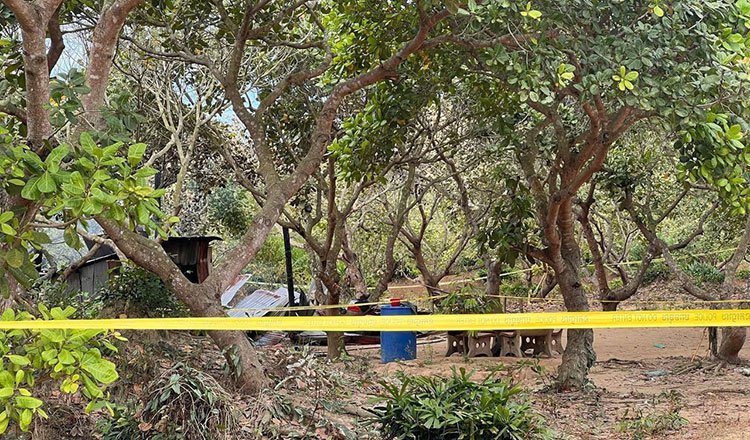
KT A young man has been arrested in Cambodia after allegedly killing nine members of his wife’s family in a devastating arson attack that has shocked Kampong Cham province. Authorities say 21‑year‑old Soben Minea set fire to his in‑laws’ home in Pon village, Tuol Sambuor commune, Stung Trang district, at around 5:30 a.m. on Sunday, 23 November. Eight victims — seven women and one man — were trapped inside and perished in the blaze. A ninth relative was found murdered nearby, about 100 metres from the burning house. All were blood relatives of Minea’s wife. Police launched a rapid manhunt and arrested the suspect just four hours later in O’Hah, Kilo 10 village, also in Stung Trang district. Officers reported that Minea appeared mentally unstable, though initial drug tests were negative. Further medical and psychiatric examinations are under way. Investigators say Minea confessed to the killings, citing ongoing domestic disputes with his wife. His statement indicated he intended to kill his mother‑in‑law, wife, brother‑in‑law and several young nieces and nephews. Provincial officials condemned the attack as “savage and unforgivable,” describing it as one of the most extreme acts of domestic violence in recent memory. They offered condolences to the surviving relatives and urged law enforcement to pursue the case with full rigour. Authorities stressed that preliminary findings point to an internal family conflict rather than a wider criminal dispute. Forensic teams continue to examine the scene, while prosecutors interrogate the suspect and assess his mental state. Officials have appealed to the public and media to rely on verified information as investigations progress, warning against speculation in the face of such a grave tragedy. -2025-11-24

-
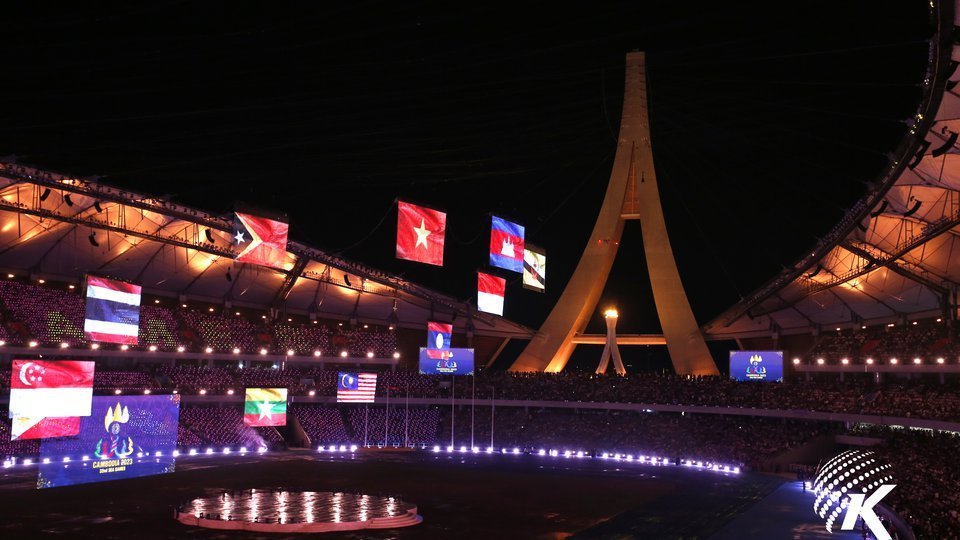
Kiripost Cambodia has confirmed it will send a 333-member delegation to the 2025 Southeast Asian (SEA) Games in Thailand, competing across 21 sports. The event runs from 3 to 20 December, with the official opening ceremony scheduled for 9 December in Bangkok. The National Olympic Committee of Cambodia (NOCC) announced that athletes will take part in disciplines ranging from athletics, swimming and gymnastics to martial arts such as judo, taekwondo, karate and jiu-jitsu. The line-up also includes football, volleyball, wrestling, pencaksilat, kickboxing, petanque, sepaktakraw, chinlone, jet ski, wushu, table football and e-sports. Vath Chamroeun, Secretary General of the NOCC, said Cambodia’s delegation will receive special support from the host nation, with athletes and officials accommodated together in Bangkok. He stressed that, despite ongoing border tensions between Cambodia and Thailand, the Games should be seen purely as a sporting event. “Competitions are not political platforms, but technical contests that create peace and harmony,” he reminded. Cambodia enters the Games with confidence after a strong showing in 2023, when it hosted the event and finished fourth overall. That year, the country secured 81 gold, 74 silver and 127 bronze medals, totalling 282. The 2025 SEA Games will be staged across ten Thai provinces: Bangkok, Nonthaburi, Pathum Thani, Samut Prakan, Nakhon Pathom, Chonburi, Rayong, Songkhla, Chiang Mai and Ratchaburi. Bangkok, Chonburi and Songkhla will serve as the main hubs for competition. For Cambodia, the Games represent both a sporting challenge and a chance to showcase its athletes on a regional stage. With 333 competitors and officials preparing to cross the border, the delegation is one of the largest the country has ever sent. As the countdown begins, organisers in Thailand are finalising venues and logistics, while Cambodian athletes continue their preparations. The NOCC insists the focus will remain firmly on performance, unity and respect for the Olympic spirit, hoping to build on the momentum of recent success. -2025-11-23

-
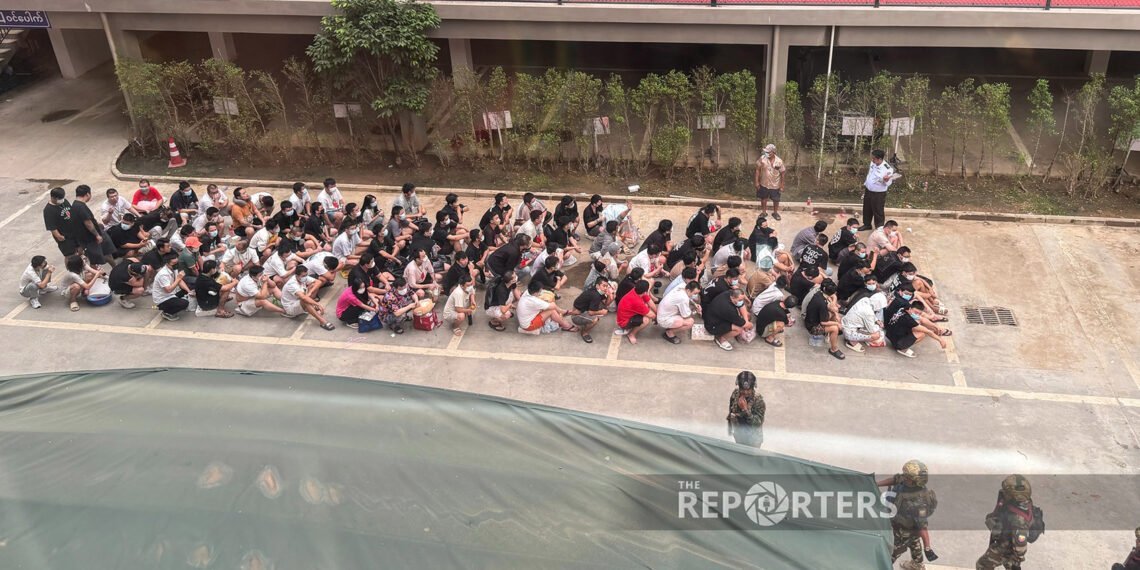
The Irrawaddy Myanmar’s military regime has launched a sweeping crackdown on scam centres along the Thai‑Myanmar border, demolishing more than 180 buildings and detaining over 1,000 foreign nationals. The move follows mounting international pressure, with both the United States and China demanding action against sprawling criminal networks that have flourished in the region. Sources told Reuters that the order came directly from junta chief Min Aung Hlaing, who warned senior officers that the scam compounds were severely damaging the country’s reputation. At a meeting in Hpa‑An last week, army officials instructed the Karen National Army (KNA) militia to act immediately. The KNA, sanctioned by Washington earlier this year for facilitating cyber scams and trafficking, has long been linked to the operations. The urgency appears tied to fears of U.S. intervention. Washington recently announced a multi‑agency “Scam Centre Strike Force” involving the FBI and Secret Service, raising concerns in Naypyidaw that American teams could cross the border to investigate. “We must solve the problem ourselves,” one military official reportedly said. By Tuesday, joint operations between the military and the KNA began around Myawaddy, a notorious hub for online fraud and human trafficking. State media reported the seizure of more than 2,600 computers and 21,000 mobile phones. Yet militia leaders insisted they were leading the raids, with the army joining later. Scam centres in Southeast Asia have grown rapidly since the 1990s, initially linked to loosely regulated casinos and online gambling. The COVID‑19 pandemic accelerated their expansion, with criminal groups exploiting lockdowns and border closures. Myawaddy’s Shwe Kokko compound, established in 2017 by Hong Kong‑registered Yatai International Holdings, became emblematic of the problem. The issue gained global attention earlier this year after the abduction of a Chinese actor in Thailand exposed the scale of the networks. Last week, Thailand extradited She Zhijiang, a gambling kingpin tied to Shwe Kokko, to China. Analysts say the junta’s sudden zeal reflects pressure from two global powers. “The Myanmar military now sees clearly that more and more members of the international community are mobilising to address the massive threat to global security that the scam centres present,” said Jason Tower of the Global Initiative against Transnational Organised Crime. Critics, however, warn that raids may be cosmetic. Both Shwe Kokko and KK Park, another compound in Myawaddy, have long operated under the protection of the Border Guard Force, raising doubts over whether the crackdown will dismantle the networks or simply appease foreign governments. -2025-11-23

-
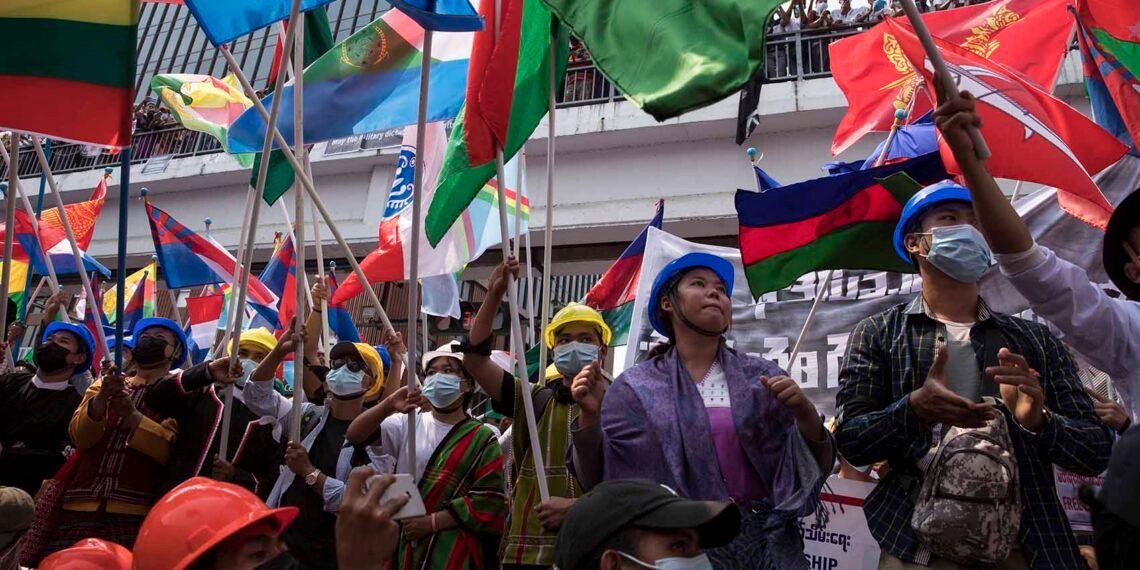
The Irrawaddy In a guest column published this week, veteran journalist Khin Maung Win argues that Myanmar is undergoing a profound and irreversible transition towards a federal democracy, despite the ongoing conflict sparked by the military coup of February 2021. What began as peaceful protests against the junta quickly escalated into armed resistance, often described as civil war. Yet, Win contends that this framing misses the deeper reality: the collapse of central authority and the rise of decentralised, federal structures. Since the coup, the Civil Disobedience Movement has paralysed public administration, with teachers, doctors and civil servants refusing to serve the junta. Resistance forces have attacked police stations and supply lines, leaving the military focused on survival rather than governance. This erosion of state control, Win notes, is the hallmark of political transition. The military’s dominance, enshrined in the 2008 Constitution, has also been shaken. Operation 1027, launched in late 2023 by the Brotherhood Alliance of ethnic armies, exposed the junta’s inability to defend key towns and border crossings. Loss of trade routes and revenue has further weakened its grip. Meanwhile, parallel institutions are taking shape. The National Unity Government (NUG) and the National Unity Consultative Council (NUCC) have drafted a Federal Democracy Charter, committing to self‑determination and decentralisation. In resistance‑held areas, local councils, schools and clinics are emerging, replacing the junta’s administration and courts. Ethnic armed organisations such as the Karen National Union, the Kachin Independence Army and the Arakan Army have consolidated “liberated areas” with their own governance systems, tax collection and justice. This exercise of sovereignty, Win argues, makes federalism not just an ideology but a lived reality. Crucially, the coup has fostered unprecedented cooperation between Bamar resistance groups and ethnic armies. This coalition, structurally federal in nature, decentralises command while uniting around the goal of dismantling the junta. Win concludes that the ideological paradigm of a centralised, Bamar‑dominated military state has already been defeated. The Federal Democracy Charter envisions a multi‑ethnic union built on equality, fiscal federalism and fair representation. Even if the junta clings to power, he insists, the political imagination of Myanmar’s people has irreversibly shifted towards federal democracy. -2025-11-23

-
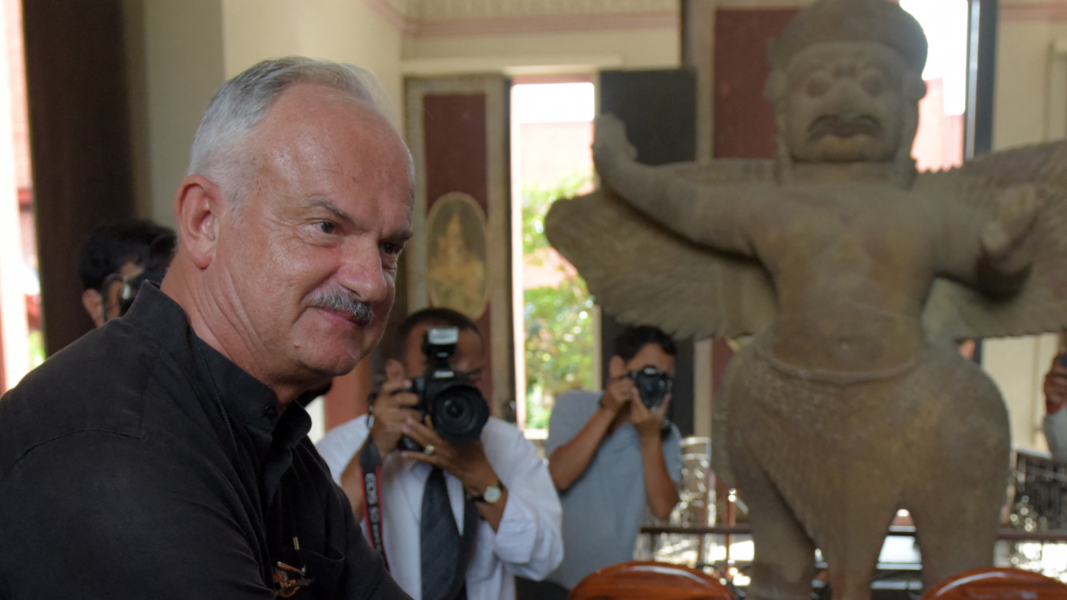
Cambodia has announced a major breakthrough in its long campaign to recover cultural treasures looted during decades of conflict. On Friday, officials in Phnom Penh confirmed that Istvan Zelnik, a Hungarian private collector, has agreed to hand back a large collection of Khmer artefacts following years of negotiations. The Ministry of Culture and Fine Arts said the agreement covers 183 pieces of Khmer silk textiles alongside prehistoric items including coins, beads, jewellery and objects fashioned from precious metals, bronze, stone and clay. The return also features significant collections from both the Pre‑Angkor and Angkor periods, regarded as central to Cambodia’s cultural identity. Many of these artefacts were stolen during the civil wars that ravaged the country in the latter half of the 20th century. Cambodia has long sought to reclaim heritage objects dispersed across the globe, arguing that they were removed illegally and form part of the nation’s historical fabric. Zelnik, who has previously repatriated Khmer artefacts, is credited with supporting archaeological research and publishing scholarly works on inscriptions and contemporary Khmer art. His latest decision, officials say, marks one of the most substantial voluntary returns of Cambodian antiquities to date. Culture Minister Phoeurng Sackona hailed the move as a model for others. “The repatriation of Khmer cultural heritage is regarded as a noble and honourable gesture that reflects a profound sense of ethical responsibility in safeguarding a nation’s identity and contributes meaningfully to the preservation of humanity’s shared cultural legacy,” she said. Cambodia’s cultural heritage has been heavily targeted by traffickers since the 1970s, when temples and archaeological sites were plundered amid political turmoil. Many statues, carvings and sacred objects ended up in private collections or museums abroad. In recent years, the government has stepped up efforts to recover them, working with international partners and collectors willing to cooperate. The latest agreement underscores the growing momentum behind these campaigns. It also highlights the wider debate over looted antiquities worldwide, as countries from Greece to Nigeria press for the return of cultural property taken during colonial or conflict periods. For Cambodia, the recovery of these artefacts is more than symbolic. It represents a tangible restoration of heritage, a chance to reconnect with traditions fractured by war, and a reminder that cultural identity cannot be bought or sold. -2025-11-23

-
The Irrawaddy Myanmar’s shadow National Unity Government (NUG) has seen its cryptocurrency soar in value after being listed on the global exchange MEXC. The Spring Development Bank (SDB) token, launched on 14 November, rose almost fivefold in just six days, underscoring the growing role of digital finance in the country’s political struggle. The NUG created the bank in July 2023 to establish a financial system outside the junta’s control and to fund resistance efforts. It is Myanmar’s first institution to operate entirely on crypto and blockchain. Since listing, the SDB token’s market capitalisation has climbed from US$500 million to more than $724 million, with prices jumping from $0.0012 to $0.0072. “The values are based on demand and supply in the free market,” said SDB chief executive Kelvin T. at an online press conference. He added that the surge reflected both “revolutionary momentum” and confidence in the system. The bank has already channelled nearly $30 million into supporting the resistance and aims to help rebuild the country once the junta is defeated. SDB is also preparing to expand, with plans to list on larger exchanges and partnerships with Binance, Bybit and Bitget. Fundraising campaigns in 2023 and 2024 mined tokens and attracted millions of shares, laying the groundwork for a broader fintech ecosystem. NUG minister Tin Tun Naing stressed that the bank is “owned by the Myanmar people and shareholders,” and licensed by the Interim Central Bank of Myanmar, set up as an alternative to the junta‑controlled institution. The military regime has reacted angrily. Two days after the listing, the Central Bank declared digital currencies illegal, warning they could fuel trafficking and scams. Yet the junta itself is testing China’s e‑CNY and its own digital currency, highlighting a contradiction in its stance. The NUG previously launched the Digital Myanmar Kyat and NUGPay app in 2022, and hopes to expand into e‑commerce and other fintech services. Australian economist Sean Turnell said the listing strengthens the financial foundations of the resistance by creating transparency and trust. “Wars are won on the ground,” he noted, “but they are shaped by the finances of the contending parties.” -2025-11-21


-
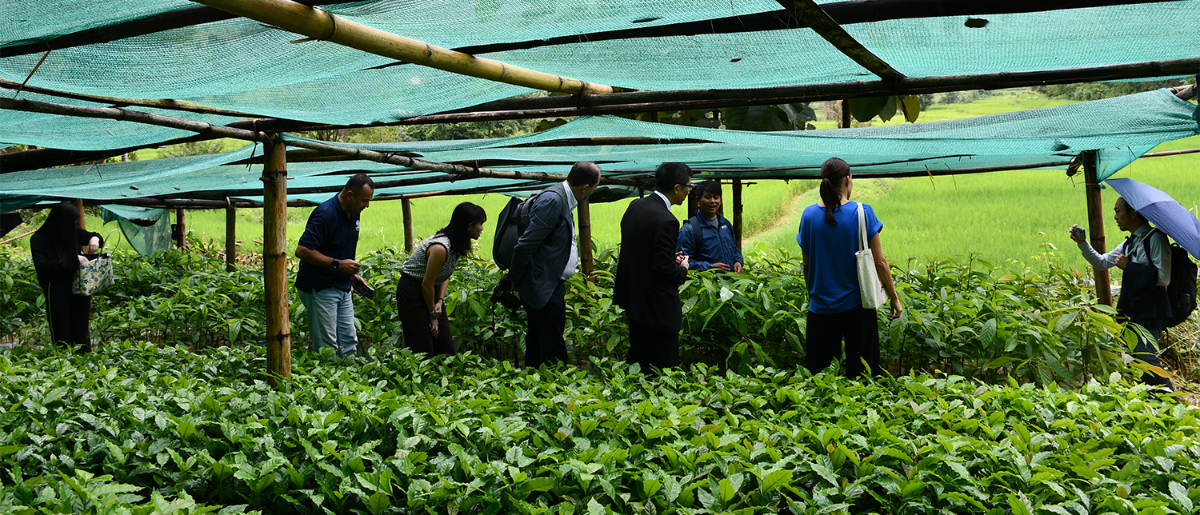
Myanmar has marked a milestone in its fight against illicit crop cultivation with the inauguration of a central coffee processing plant in southern Shan State. The facility, run by the Green Gold Cooperative (GGC), symbolises a decade‑long transformation for communities once reliant on opium poppy. The cooperative began in 2015 when 530 farmers took the bold step of replacing poppy fields with coffee plants. Today, more than 1,000 producers across 48 villages are part of GGC, which has become a regional model for sustainable development. In 2019, it became Myanmar’s first Fairtrade‑certified coffee organisation, using the social premium to fund community projects and purchase land for the new plant. Built with international backing — Switzerland supported the first phase, while Japan financed the final stage — the facility now allows farmers to process, roast and package coffee independently. It also houses a laboratory for quality analysis and a modern space for training and innovation, reducing reliance on third parties and opening new market opportunities. “This achievement reflects the communities’ commitment to creating real alternatives to illicit economies,” said Yatta Dakowah, UNODC Country Manager, at the inauguration. Between 2018 and 2024, GGC exported over 1,000 tonnes of green coffee, generating $5.48 million in income and earning recognition for quality and sustainability. The launch was celebrated in September with more than 250 participants, including farmers, government officials and international partners from Finland, Italy and Japan. Finland’s Elina Korhonen praised GGC’s gender‑balanced governance, while Italy’s Nicolò Tassoni hailed the project as “a symbol of friendship” and a beacon of hope for South Shan farmers. For members of GGC, the plant is more than infrastructure. It represents trust, cooperation and a shared vision for a future free from the vulnerabilities of the opium economy. As Myanmar remains the world’s largest producer of illicit opium, the cooperative’s success stands as a powerful example of how alternative development can deliver sustainable livelihoods and reshape rural life. -2025-11-2