




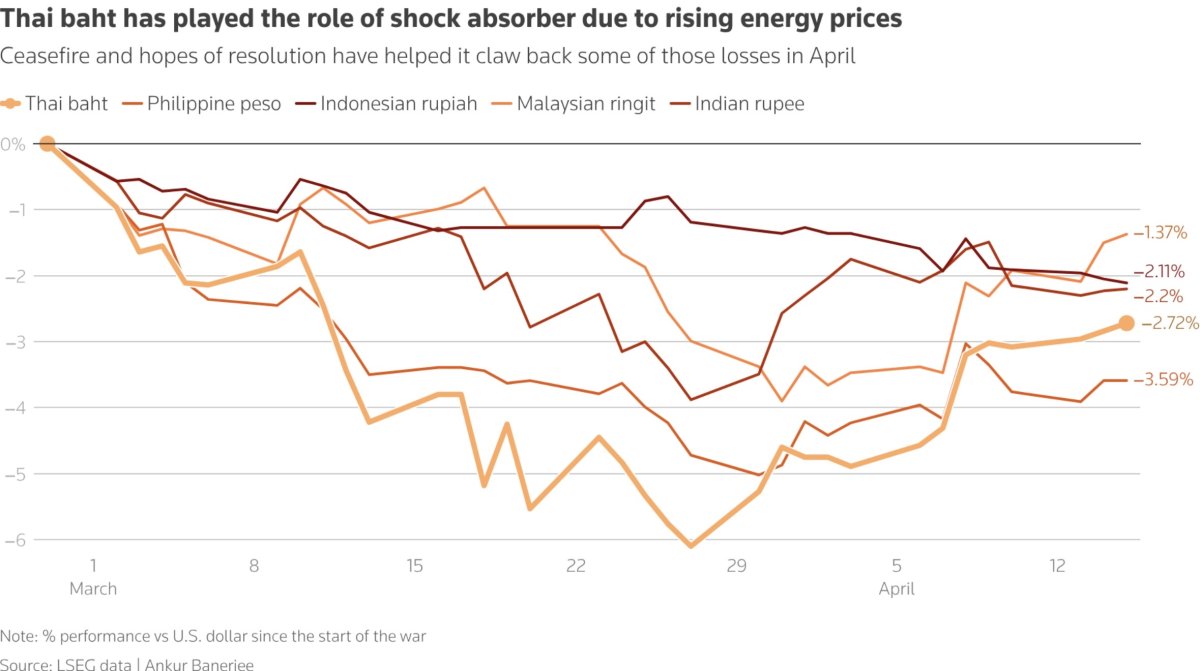
Foreign investors are pulling out of Thai assets as an energy shock linked to the U.S.-Israeli war on Iran threatens economic recovery, with equities and bonds seeing their largest combined outflows since October 2024. The Thai baht has also weakened, falling about 2.8% since the conflict began, reflecting pressure on the economy. Rising global oil prices, have exposed Thailand’s heavy reliance on Middle East energy supplies.
Get today's headlines by email 
The sell-off follows a brief period of optimism after Prime Minister Anutin Charnvirakul’s February election victory, which had sparked hopes of political stability and economic reform. Foreign investors had bought $1.7 billion in Thai stocks in February, but sentiment reversed sharply after the war began at the end of that month. In March, equities saw an $823 million net sell-off, while bond outflows reached $705 million.
Thailand’s vulnerability stems from its dependence on imported energy, with nearly half of its oil and gas sourced from the Middle East and over half of its electricity generated from gas. Liquefied natural gas imports are also rising, increasing exposure to global price shocks. The economy was already weak, growing just 2.4% last year, while inflation had contracted for 12 consecutive months before the conflict triggered a shift in the outlook.
Analysts warn the country faces a policy bind, with limited room to adjust interest rates without harming growth. “The central bank has limited room to hike without derailing the recovery, but little urgency or space to ease,” said Gary Tan of Allspring Global Investments. Higher fuel costs are expected to weigh on consumption, exports, and tourism, while complicating inflation and currency stability.
A two-week ceasefire in April has provided some relief, with Thai stocks and the baht recovering slightly, but uncertainty remains high. Inflation is now projected to rise as much as 3.5% this year, a sharp reversal from a 0.54% contraction in the first quarter. Public debt stands at 66% of GDP, close to the government’s 70% ceiling, limiting fiscal flexibility.
Reuters reported that the government has ruled out fuel subsidies for now but plans to absorb some costs to keep electricity tariffs stable during the summer. Officials acknowledge limited capacity to respond if the energy shock persists. Analysts caution that if elevated oil prices continue beyond April, the impact will deepen, affecting daily business operations and broader economic stability.
Picture courtesy of Reuters
Join the discussion? 
Already a member? 
 Adapted by ASEAN Now Reuters 17 Apr 2026
Recommended Comments
Create an account or sign in to comment