



Skip to content
View in the app

A better way to browse. Learn more.

ASEAN NOW

A full-screen app on your home screen with push notifications, badges and more.

To install this app on iOS and iPadOS
  1. Tap the Share icon in Safari
  2. Scroll the menu and tap Add to Home Screen.
  3. Tap Add in the top-right corner.
To install this app on Android
  1. Tap the 3-dot menu (⋮) in the top-right corner of the browser.
  2. Tap Add to Home screen or Install app.
  3. Confirm by tapping Install.

Become a member

Become a member

Overnight Strikes Kill 12 as Russia-Ukraine War Escalates

Overnight strikes killed 12 people across Russia and Ukraine, authorities said on Sunday, as waves of drones and missiles hit civilian areas and infrastructure on both sides.

Fighting along parts of the front has been largely at a standstill and peace talks have stalled, while both countries have stepped up long-range attacks deep behind enemy lines, pushing the civilian death toll to its highest level since the early months of the war in 2022.

Dead In Russia

In Russia’s southern Rostov region, Ukrainian drones killed five people in a residential area, regional governor Yuri Slusar said. Two other people were reported killed in strikes in the Belgorod and Moscow regions.

Moscow said it countered the assault with large-scale air defences. The Russian defence ministry stated that 822 drones were intercepted across the country overnight.

Russian officials also described the attacks as among the largest drone strikes in recent memory.

Strike Hits Kryvyi Rih

In Ukraine, a barrage of Russian drones and missiles struck ArcelorMittal’s steel plant in Kryvyi Rih, Zelensky’s hometown, killing two people and wounding 14, according to Ukrainian officials.

The company said the strike forced it to partially halt operations after damage to core production facilities. Further attacks were reported elsewhere: two people were killed in the southeastern Zaporizhzhia region, and one person was reported dead in the border region of Sumy.

In Kyiv, an outdoor book market at Pochaina was hit. Bookseller Dmytro Semenukha said all four of his stalls burned down during the raid.

Kyiv Warns Of Civilian Infrastructure Attacks

In an overnight statement, President Volodymyr Zelensky said Russian ballistic missiles were used to target civilian infrastructure wherever they could be reached.

He renewed an appeal to allies for more air defences, saying that over the previous week Ukrainian cities were hit by more than 1,550 attack drones, nearly 1,560 guided aerial bombs, and 62 missiles.

Zelensky also said European countries should not allow interceptors to remain unused in storage, arguing that Russia’s use of harder-to-intercept ballistic missiles risks further damage to civilian targets across Europe. Kyiv has recently renewed claims that Moscow is receiving missiles and troops from North Korea.

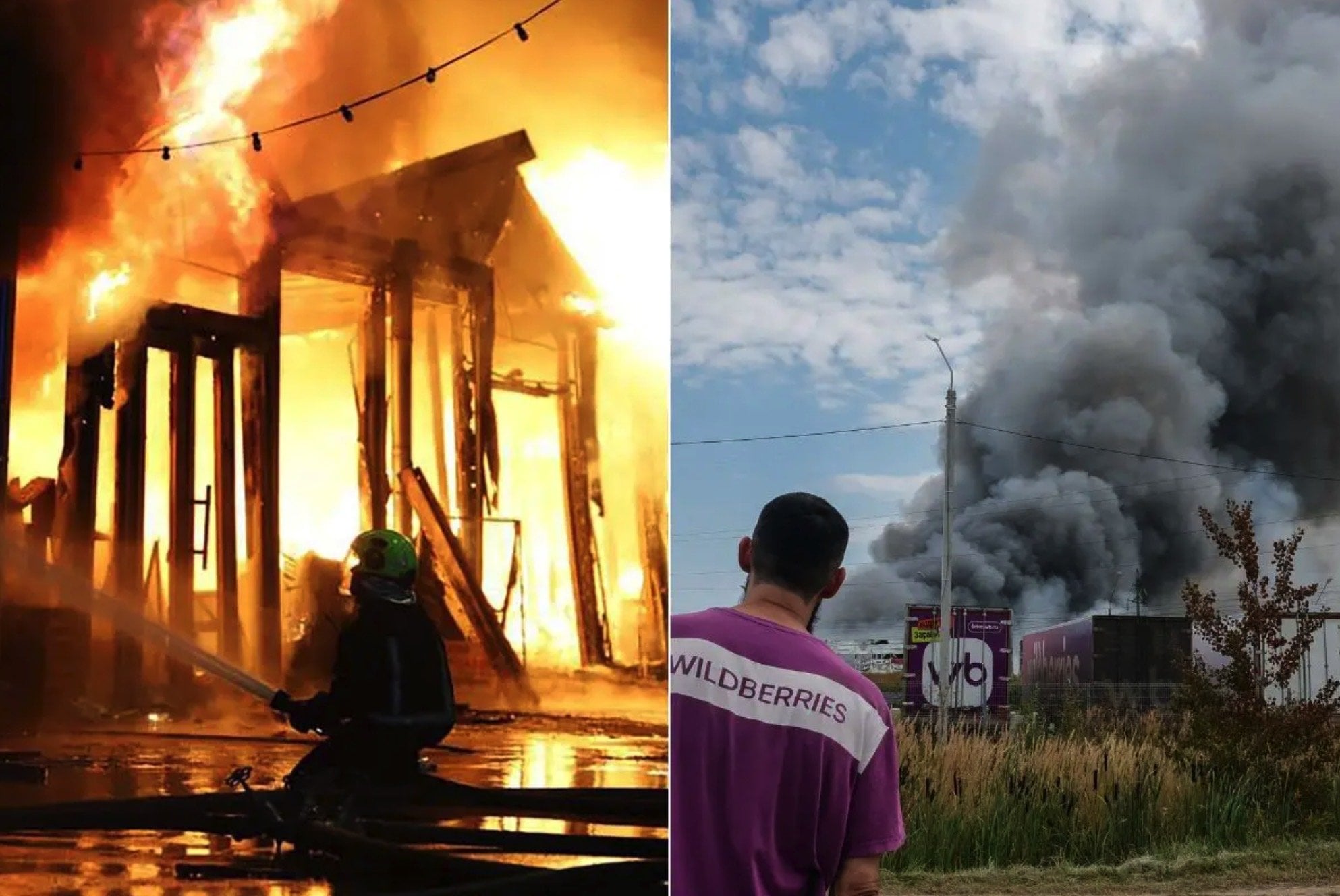
Ukraine’s attacks have increasingly focused on facilities it says support Russia’s war effort, including warehouses linked to Wildberries, Russia’s biggest online retailer. Zelensky said such strikes, along with attacks on oil refineries, aim to undermine Russia’s war economy.

Ukraine said another Wildberries warehouse near Moscow was set ablaze overnight. Since mid-July, it has claimed strikes on about 20 warehouses and related buildings connected to the company.

Spillover Into Europe

The drone war has also affected countries bordering the conflict. Romania’s defence ministry said a Spanish F-18 fighter jet shot down a drone that entered Romanian airspace near borders with Ukraine and Moldova after the overnight raid.

NATO said on Friday that fighter jets shot down a drone that entered Latvian airspace, the second such incident in a week, according to Latvia’s defence ministry.

Civilian Toll

The United Nations reported that 437 civilians were killed in Ukraine in July, the highest monthly toll since May 2022. Russian authorities separately reported that 79 civilians were killed on their side in July, an increase from the previous month.

Join the discussion? Create account. orange.png


image.png

16 August 2026

User Feedback

Recommended Comments

jippytum Platinum Member

jippytum

Advanced Member

So glad the Russian's are having some payback with loses resulting in attacks on Russia's mainland.

spidermike007 Star Member

spidermike007

Advanced Member

Putin is absolutely desperate, he never expected Ukraine to step up in the manner that they have and show not only tremendous creativity but also great resourcefulness and incredible heroism.

Zelensky is a modern-day hero as are his people and the bold soldiers that are fighting this war.

If he was even moderately smart Trump would hire some Ukrainian consultants to help him with his failed war on Iran.

Robert Brovdi, known as Magyar, the charismatic commander of Ukraine’s drone forces, is one of the most striking examples of the Ukrainian army’s transformation into a modern technological force. His influence is already clearly visible and is likely to grow even further in the future, according to Ukrainian military expert Viktor Kevlyuk.

When the full-scale war with Russia began in February 2022, he volunteered for the Ukrainian defense forces. For people of his wealth and social status, such a step was rather exceptional.

The unit he created, Magyar’s Birds, gradually grew into a regiment and is now the 414th Strike Drone Brigade. This brigade was, and remains, one of the most effective units carrying out attacks on Russian territory.

As commander of Ukraine’s Unmanned Systems Forces — the so-called drone forces — Magyar undoubtedly plays a key role in carrying out drone missions.

Major Robert Brovdi, call sign Magyar, is a controversial figure. From 2010 to 2015, he was a successful businessman active in grain trading, real estate and construction. He was also a member of the Transcarpathian Oblast Council and had political connections.

The unit he created, Magyar’s Birds, gradually grew into a regiment and is now the 414th Strike Drone Brigade. This brigade was, and remains, one of the most effective units carrying out attacks on Russian territory. As commander of Ukraine’s Unmanned Systems Forces — the so-called drone forces — Magyar undoubtedly plays a key role in carrying out long-range strikes on Russian territory.

After becoming commander of the force, Magyar received broader authority to coordinate the activities of all unmanned systems — aerial, ground and naval drones. This made it possible to systematize long-range strikes against Russian oil refineries, airfields, warehouses, defense-industry facilities and logistics centers. Many of the attacks carried out in the Moscow region were directly led by him.

Since being appointed commander of all drone forces a year ago, he has become one of the main architects of systematic long-range strike campaigns. He is not the only one — the HUR, Ukraine’s military intelligence; the SBU, Ukraine’s Security Service; the Special Operations Forces and others also have their roles — but it is the Unmanned Systems Forces under his command that have given these attacks scale, regularity and a focus on strategic targets. He has spoken publicly about intensifying such attacks and turning Moscow into “a city that no longer sleeps.”

Magyar is a classic example of a new type of “military entrepreneur.”

From the first days of the full-scale invasion, he began experimenting with commercial drones at his own expense, despite bureaucratic obstacles. He quickly grasped the potential of the mass use of FPV drones and UAVs not only as reconnaissance tools, but as a main strike force.

His effectiveness can be explained by several factors. The first is practical experience: Magyar did not simply inherit a structure, but built one from scratch. What began as a small group under his command grew into a brigade and later started to influence an entire branch of the armed forces.

Equally important is his focus on results rather than procedures. He introduced a system for measuring battlefield effectiveness through points awarded for destroyed targets. This created a clear incentive structure for soldiers and helped set ambitious goals, including the aim of destroying more Russian personnel each month than Russia is able to mobilize — more than 30,000 people a month.

Magyar’s command style is also marked by an innovative approach and a capacity for fast learning. The evolution of his forces from simple FPV drones to sophisticated long-range systems, combined operations and mass attacks shows how quickly battlefield experience has been turned into new tactics. His personal qualities have mattered as well: charisma, strong media skills and a willingness to take responsibility. Crucially, he has not been afraid of conflict with the system. As a result, he has become a symbol of a new generation of commanders breaking with the Soviet legacy.

His most important achievements include the creation of the world’s first separate branch of the armed forces focused exclusively on unmanned systems — in the air, on land and at sea. He has also promoted a strategic focus on wearing down the Russian army, including an order to direct more than 30 percent of strikes against personnel rather than only against equipment or infrastructure.

https://balticsentinel.eu/8496687/magyar-the-controversial-commander-behind-ukraine-s-drone-revolution

v97pq7m88vsg1.jpeg

Create an account or sign in to comment

Account

Navigation

Search

Search

Configure browser push notifications

Chrome (Android)
  1. Tap the lock icon next to the address bar.
  2. Tap Permissions → Notifications.
  3. Adjust your preference.
Chrome (Desktop)
  1. Click the padlock icon in the address bar.
  2. Select Site settings.
  3. Find Notifications and adjust your preference.
