



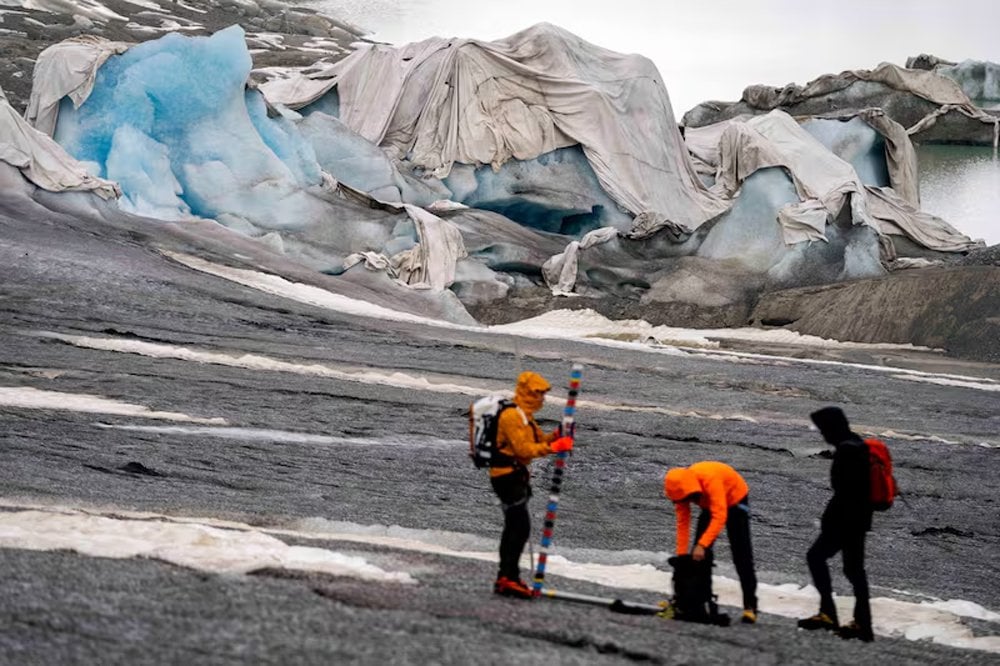

Swiss glaciers lost 5.5% of their ice volume this year, with three Alpine glaciers showing the second-biggest percentage decline on record, according to monitoring experts in Switzerland.
The Swiss glacier monitoring service GLAMOS and the Swiss Academy of Sciences said the drop was driven by heat waves and low winter snowfall, which left glaciers exposed to warmer conditions for longer.
GLAMOS head Matthias Huss said Alpine glaciers face an outlook that is increasingly difficult to change under current conditions. He said warming now is linked to human-driven climate change and that, without emissions from fossil fuels, temperatures would not be rising in the same way.
Ice Loss Second-Highest On Record
This year’s overall loss follows a worsening trend in recent seasons. Over the past five years alone, the experts said the volume of ice in Switzerland has fallen by nearly a fifth.
The monitoring update comes after record retreat in 2022, when summer heat, low winter snow and a light dusting of reddish material blown in from the Sahara darkened glacier surfaces, increasing their absorption of heat.
GLAMOS said the latest measurements underline concerns that global warming is intensifying impacts across Europe, a region it described as warming faster than most elsewhere.
Snow Cover And Accelerated Thaw
In an interview at ETH Zurich’s Federal Institute of Technology, Huss said winter snow matters for two reasons: it shields ice from melting and helps replenish glacier mass during colder periods.
“On the one hand, it protects the bare ice from melting,” he said. “The longer you have snow, the longer you avoid the loss of old ice.”
He also said snow provides the raw material from which new ice can form. “The more snow you have, the higher the potential to keep some of the snow at high elevation and to form new ice,” Huss added.
Experts said this year’s melt included a decrease in the average thickness of individual glaciers of between 2.5 and 4 metres. On the tongues of some glaciers, they reported reductions of up to 10 metres.
Runoff And Wider Water Effects
Although the absolute amount of ice lost this year was less than in 2003, the percentage decline was greater because total glacier volume is now roughly a third of what it was 23 years ago. In 2003, the relative loss was 3.5% of the total ice volume in Swiss glaciers.
The experts said the effects extend beyond glacier mass. From July to September, the loss amounted to 2.2 trillion litres of water, which they said is four times the annual water consumption of Switzerland’s roughly 9.1 million people. Switzerland generates more than half of its electricity from hydropower.
They added that Switzerland’s glaciers feed major European river systems, including the Danube, Po, Rhine and Rhone.
‘Almost Too Late’ For The Alps
Teams working with GLAMOS have been assessing meltwater flows, including runoff through crevasses, and have carried out field tests by adding red dye to streams to track where the water travels.
Among the glaciers affected, the Allalin, Clarident, Rhone and Aletsch glaciers recorded some of their biggest melt on record. Aletsch, they said, is the largest glacier in the Alps.
Huss said stabilising the climate by reducing CO2 emissions would help slow further losses, but he described action as “almost too late” for glaciers in the Swiss Alps. He said polar ice sheets are still more likely to be protected and that limiting sea level rise is important for communities living along coastlines.
Join the discussion? 

1 October 2026
Recommended Comments
Create an account or sign in to comment