



Skip to content
View in the app

A better way to browse. Learn more.

Thailand News and Discussion Forum | ASEANNOW

A full-screen app on your home screen with push notifications, badges and more.

To install this app on iOS and iPadOS
  1. Tap the Share icon in Safari
  2. Scroll the menu and tap Add to Home Screen.
  3. Tap Add in the top-right corner.
To install this app on Android
  1. Tap the 3-dot menu (⋮) in the top-right corner of the browser.
  2. Tap Add to Home screen or Install app.
  3. Confirm by tapping Install.

Become a member

Become a member

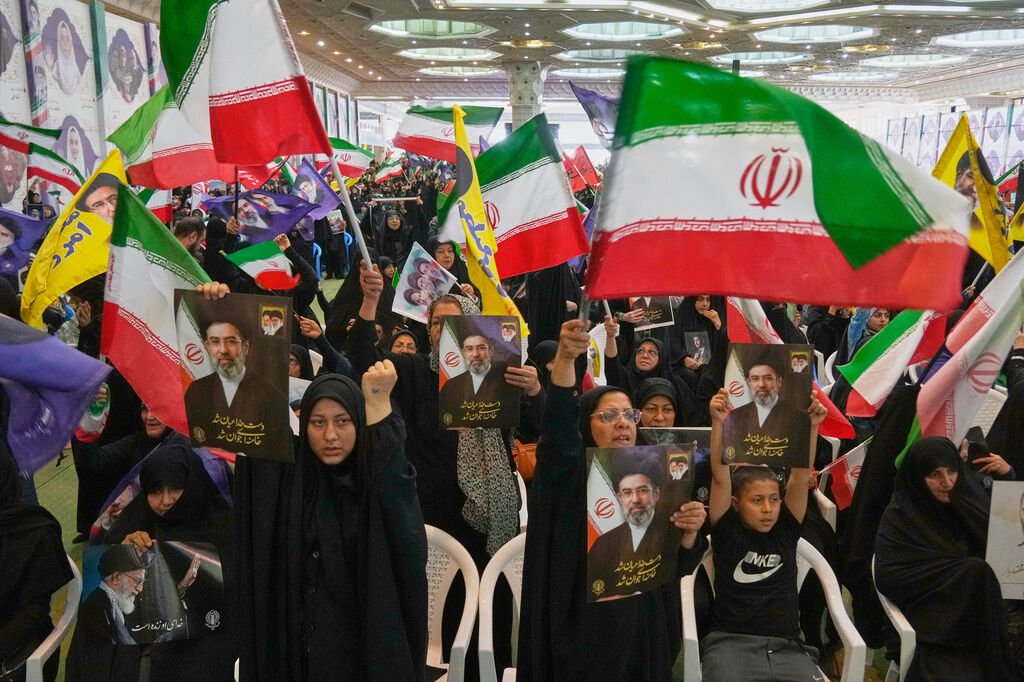
Trump Weighs Final Approval on Iran Ceasefire Deal

US President Donald Trump said he had convened a meeting in the White House Situation Room to make a “final determination” on a proposed agreement aimed at extending a ceasefire with Iran and restarting negotiations over Tehran’s nuclear programme.

Get today's headlines by email image.png

In a post on Truth Social on Friday, Trump said Iran would have to agree never to obtain a nuclear weapon and ensure the reopening of the Strait of Hormuz to “unrestricted shipping traffic” in both directions. He also demanded that any mines placed in the strategic waterway be destroyed.

The meeting came after US officials said Washington and Tehran had agreed to a framework for a memorandum of understanding, pending approval from Trump and Iran’s leadership.

Under the reported proposal, the current ceasefire would be extended for 60 days while negotiations continue over the future of Iran’s nuclear activities.

Strait of Hormuz at centre of talks

Trump also said he was prepared to lift the US blockade of the Strait of Hormuz, adding that ships trapped in the area could begin “heading home”.

He further insisted that Iran allow the US to remove and destroy its stockpile of enriched uranium, a longstanding demand from Washington.

“No money will be exchanged, until further notice,” Trump wrote. “Other items, of far less importance, have been agreed to.”

A White House official later confirmed to the BBC that the Situation Room meeting had ended, but declined to provide further details.

The Strait of Hormuz remains a critical global shipping route for oil exports, and tensions in the area have contributed to sharp increases in energy prices since fighting escalated earlier this year.

Iran rejects nuclear negotiations claim

Iranian officials appeared to push back against parts of Trump’s account.

Iran’s Fars news agency, citing informed sources, described Trump’s comments as a “mixture of truth and lies” and said the reported memorandum contained no provision for destroying nuclear materials.

Meanwhile, foreign ministry spokesman Esmaeil Baqaei told Iranian state television that Tehran remained focused on ending the conflict and was not negotiating over its nuclear programme.

Iran has consistently maintained that its nuclear activities are for peaceful purposes and denies seeking nuclear weapons.

The US has long demanded that Iran halt the production of highly enriched uranium and dispose of existing stockpiles that could potentially be used in weapons development.

Ceasefire remains fragile

Despite repeated statements from Trump since the ceasefire began on 8 April suggesting progress towards a deal, no final agreement has yet been reached.

US Vice-President JD Vance said on Thursday that negotiators were still discussing “a couple of language points”, including issues surrounding uranium enrichment.

“We’re not there yet, but we’re very close,” Vance said.

Iran’s chief negotiator Mohammad Baqer Qalibaf said Tehran did not trust promises alone.

“No action will be taken before the other side acts,” he wrote on social media. “The winner of any agreement is the one who is better prepared for war the day after.”

The current conflict began after US and Israeli strikes on Iran on 28 February. Iran responded with attacks on Israel and Gulf states allied with Washington, and effectively shut down the Strait of Hormuz.

Both sides have since accused each other of violating the ceasefire. On Thursday, Iran’s Islamic Revolutionary Guard Corps said it had targeted a US air base in Kuwait that it claimed was linked to earlier strikes on Bandar Abbas, a key Iranian port city near the strait.

US Central Command described the attack as an “egregious ceasefire violation”.

Join the discussion? Create account. orange.png

Already a member? haveyr-say.png


image.png
Adapted by ASEAN Now. Source 30 May 2026

User Feedback

Recommended Comments

Smokey and the Bandit Gold Member

Smokey and the Bandit

Advanced Member
53 minutes ago, jts-khorat said:

Is this not the exact and usual modus operandi of the USA when they go looking for Weapons of Mass Destruction?

So far: zero of them found, but thousands of innocent women and children massacred (a large multiple of those, that Iranian terorrism has killed, BTW).

No, this is not the same as the Iraq WMD debacle.

In 2003, the U.S. invaded Iraq based on flawed, exaggerated, and in some cases fabricated intelligence claiming Saddam had active nuclear, chemical, and biological weapons programs. No such active programs were found after the invasion

In the current case with Iran, the situation is fundamentally different:

  • Iran was openly enriching uranium to 60% (extremely close to weapons-grade 90%).

  • The IAEA repeatedly reported Iran hiding nuclear activities and blocking inspectors.

  • Iran had accumulated enough enriched material for multiple nuclear weapons if further enriched.

  • Iranian leaders have openly called for Israel’s destruction for decades while funding terrorist proxies that have killed thousands.

This was not based on “outdated pamphlets.” It was based on observable, verifiable actions by Iran — sprinting toward nuclear breakout capability.

Iran’s regime and its proxies (Hamas, Hezbollah, Houthis) have deliberately targeted civilians for years — October 7 alone killed 1,200 Israelis in the worst massacre of Jews since the Holocaust.

Civilian deaths in war are tragic, but there is a massive difference between a regime that intentionally uses human shields and targets civilians, and one that tries (imperfectly) to avoid them while striking military targets.

Blaming the U.S. and Israel for finally acting against a regime racing toward nuclear weapons — while excusing that regime’s terrorism and aggression — is not serious analysis. It’s revisionism.

The comparison to Iraq 2003 is lazy and dishonest. The threat from Iran was real and growing.

bannork Star Member

bannork

Newsman

We need a new acronym for Trump.

There's TACO for his backing out of the tariffs, but we need something new for his constant announcements a deal with Iran is just around the corner, and then of course it isn't.

MikeandDow Ruby Member

MikeandDow

Advanced Member
8 minutes ago, Smokey and the Bandit said:

You are telling me to "read the news," but your Scientific American link is an article from 2018 discussing the fallout of the original JCPOA withdrawal. You are unironically using opinions from nearly a decade ago to describe a kinetic military theater in 2026.

Yes, back when Iran was strictly restricted to 3.67% enrichment under a fully monitored treaty, they were a year or more away. But guess what? Time moved on, the treaty died, and they spent the last several years spinning advanced IR-6 centrifuges completely unhindered. Citing a 2018 article today is like looking at a weather report from last decade to see if it’s raining outside right now.

Uranium Hexafluoride (UF6) gas is never, under any circumstances, stored in a 10,700 kg ŠKODA spent-fuel cask.

Those massive ŠKODA casks are massive, heavily shielded blocks of steel and concrete designed to contain the intense, lethal gamma radiation of solid, highly radioactive spent fuel rods cooling down after years inside a nuclear reactor core.

Enriched UF6 is a gas. It is kept in standard, industrial Type 30B cylinders (roughly 2.2 metric tons full) or even smaller Type 12B cylinders for highly enriched material.

They are thin-walled steel containers because fresh uranium gas has very low radioactivity before it goes into a reactor. You do not need a 200-ton gantry crane to move a Type 30B cylinder; a basic warehouse forklift handles it. The IRGC doesn't have a logistical nightmare moving these; they’ve been trucking them across the desert on standard flatbeds for fifteen years.

No one said it happens in five minutes. But you are hallucinating a timeline where they have to start from scratch.

Transforming UF6 gas into a weapon core requires three steps: converting the gas to uranium tetrafluoride (UF4), reducing it to uranium metal, and casting/machining that metal into a hemispherical core.

Western intelligence agencies didn't launch a massive pre-emptive campaign because they thought Iran would start reading a textbook on Monday morning. They struck because international inspectors confirmed Iran had already built and operated uranium metallurgy lines years ago. They already know how to cast the metal.

You confidently stated that Iran does not have Uranium-Deuteride (UD3) initiators.

Except the IAEA literally found the blueprints and the high-explosive testing data for them. In the IAEA's formal documentation of Iran's "AMAD Plan," they uncovered specific evidence that Iran had conducted hemisphere-focused explosive experiments designed to compress a neutron initiator. They aren't trying to invent the concept; they did the explosive physics testing at the Parchim military complex over a decade ago.

You keep insisting that it takes 1 to 3 years to miniaturize a warhead to fit onto a ballistic missile re-entry vehicle.

Correct! If you want to put it on a precise, long-range missile, it takes a long time. But you are completely missing the tactical reality of a cornered regime facing an imminent strike. They don’t need to fit it onto a sleek missile to have a usable weapon. A crude, heavy, un-miniaturized atomic device built into the back of a standard commercial shipping container or loaded onto a heavy transport plane is still a functional nuclear threat.

You can keep pasting that 2022 Congressional Research document and those civilian power plant cask specifications as much as you like, but it doesn't change the hard math. The 60% gas is highly mobile, the metallurgy blueprints are already in their hands, and the idea that the IRGC is defeated because they can't find a big enough crane is a comforting fiction that doesn't match the hardware currently deployed in the Gulf.

Links proof Oh None !! what a shame !!

https://thebulletin.org/2026/03/analysis-iran-likely-transferred-highly-enriched-uranium-to-isfahan-before-the-june-strikes/

If you read it shows storage of the material the only thing you are correct is about the weight it can not be transported easily

MikeandDow Ruby Member

MikeandDow

Advanced Member
5 minutes ago, Smokey and the Bandit said:

No, this is not the same as the Iraq WMD debacle.

In 2003, the U.S. invaded Iraq based on flawed, exaggerated, and in some cases fabricated intelligence claiming Saddam had active nuclear, chemical, and biological weapons programs. No such active programs were found after the invasion

In the current case with Iran, the situation is fundamentally different:

  • Iran was openly enriching uranium to 60% (extremely close to weapons-grade 90%).

  • The IAEA repeatedly reported Iran hiding nuclear activities and blocking inspectors.

  • Iran had accumulated enough enriched material for multiple nuclear weapons if further enriched.

  • Iranian leaders have openly called for Israel’s destruction for decades while funding terrorist proxies that have killed thousands.

This was not based on “outdated pamphlets.” It was based on observable, verifiable actions by Iran — sprinting toward nuclear breakout capability.

Iran’s regime and its proxies (Hamas, Hezbollah, Houthis) have deliberately targeted civilians for years — October 7 alone killed 1,200 Israelis in the worst massacre of Jews since the Holocaust.

Civilian deaths in war are tragic, but there is a massive difference between a regime that intentionally uses human shields and targets civilians, and one that tries (imperfectly) to avoid them while striking military targets.

Blaming the U.S. and Israel for finally acting against a regime racing toward nuclear weapons — while excusing that regime’s terrorism and aggression — is not serious analysis. It’s revisionism.

The comparison to Iraq 2003 is lazy and dishonest. The threat from Iran was real and growing.

Again this is just drivel without links or proof try again !!!

bannork Star Member

bannork

Newsman
4 minutes ago, Smokey and the Bandit said:

No, this is not the same as the Iraq WMD debacle.

In 2003, the U.S. invaded Iraq based on flawed, exaggerated, and in some cases fabricated intelligence claiming Saddam had active nuclear, chemical, and biological weapons programs. No such active programs were found after the invasion

In the current case with Iran, the situation is fundamentally different:

  • Iran was openly enriching uranium to 60% (extremely close to weapons-grade 90%).

  • The IAEA repeatedly reported Iran hiding nuclear activities and blocking inspectors.

  • Iran had accumulated enough enriched material for multiple nuclear weapons if further enriched.

  • Iranian leaders have openly called for Israel’s destruction for decades while funding terrorist proxies that have killed thousands.

This was not based on “outdated pamphlets.” It was based on observable, verifiable actions by Iran — sprinting toward nuclear breakout capability.

Iran’s regime and its proxies (Hamas, Hezbollah, Houthis) have deliberately targeted civilians for years — October 7 alone killed 1,200 Israelis in the worst massacre of Jews since the Holocaust.

Civilian deaths in war are tragic, but there is a massive difference between a regime that intentionally uses human shields and targets civilians, and one that tries (imperfectly) to avoid them while striking military targets.

Blaming the U.S. and Israel for finally acting against a regime racing toward nuclear weapons — while excusing that regime’s terrorism and aggression — is not serious analysis. It’s revisionism.

The comparison to Iraq 2003 is lazy and dishonest. The threat from Iran was real and growing.

Prior to the June 2025 US-led military strikes, Iran possessed the materials to quickly enrich weapons-grade fuel but was months away from assembling a deployable nuclear weapon, according to nuclear experts and international monitors.

Possessing enriched gas is not the same as having an atomic weapon. Experts from the James Martin Center for Nonproliferation Studies emphasized that Iran was missing key mechanical components:

  • Metallurgy: Iran needed to convert its highly enriched uranium gas into a solid metal core.

  • Triggering Systems: Designing and manufacturing the conventional high-explosive lenses required to detonate a nuclear core takes precise engineering.

  • Delivery Platforms: While Iran possessed advanced ballistic missiles, shrinking a nuclear device into a warhead that could survive re-entry was a capability experts believed Iran had halted back in 2003 and had not fully mastered.

Independent assessments concluded that actually engineering, assembling, and testing a deliverable missile warhead would have taken Iran several months to a year and a half.

how near to making a nuclear bomb were iran before us attacked? - Google Search

Hegseth and Trump both claimed that following the June 2025 attacks, Iran's nuclear ability had been 'obliterated'. In fact this was total nonsense.

The core components of the bomb-making process survived the strikes. Intelligence trackers noted that Iran moved significant amounts of its highly enriched uranium (HEU) stockpile out of the facilities before the bombings commenced. Commentators from the Centre for Strategic and International Studies (CSIS) noted that Iran retains roughly 400 kilograms of 60% enriched uranium, keeping its latent bomb-making capability alive.

was iran's nuclear bomb programme obliterated after the june 2025 attacks? - Google Search

So, what now?

Iran would need to convert gaseous uranium hexafluoride into solid metal, machine it into a precise spherical core, and integrate a complex explosive triggering system.

Nuclear experts note that Iran could likely construct a large, un-missilised "crude" atomic device within two to six months. This device would be heavy—movable by truck or ship rather than a missile—but capable of producing a full-scale nuclear explosion.

Deliverable Warhead (1–2 Years): Designing a miniaturised warhead sturdy enough to survive the vibration and heat of being launched on a ballistic missile would take significantly longer, likely up to a year or more.

how near to making a nuclear bomb is iran today? - Google Search

Apparently Iran is open to the possibility of transferring the enriched uranium to China, seen as a neutral actor in this sorry saga.

Surely that would be a satisfactory solution all round. Trump could claim he had defanged Iran, the Strait of Hormuz could be reopened and world prices for oil, fertiliser and many other products could come down.

MikeandDow Ruby Member

MikeandDow

Advanced Member
10 minutes ago, MikeandDow said:

Links proof Oh None !! what a shame !1

3 minutes ago, bannork said:

Prior to the June 2025 US-led military strikes, Iran possessed the materials to quickly enrich weapons-grade fuel but was months away from assembling a deployable nuclear weapon, according to nuclear experts and international monitors.

Possessing enriched gas is not the same as having an atomic weapon. Experts from the James Martin Center for Nonproliferation Studies emphasized that Iran was missing key mechanical components:

  • Metallurgy: Iran needed to convert its highly enriched uranium gas into a solid metal core.

  • Triggering Systems: Designing and manufacturing the conventional high-explosive lenses required to detonate a nuclear core takes precise engineering.

  • Delivery Platforms: While Iran possessed advanced ballistic missiles, shrinking a nuclear device into a warhead that could survive re-entry was a capability experts believed Iran had halted back in 2003 and had not fully mastered.

Independent assessments concluded that actually engineering, assembling, and testing a deliverable missile warhead would have taken Iran several months to a year and a half.

how near to making a nuclear bomb were iran before us attacked? - Google Search

Hegseth and Trump both claimed that following the June 2025 attacks, Iran's nuclear ability had been 'obliterated'. In fact this was total nonsense.

The core components of the bomb-making process survived the strikes. Intelligence trackers noted that Iran moved significant amounts of its highly enriched uranium (HEU) stockpile out of the facilities before the bombings commenced. Commentators from the Centre for Strategic and International Studies (CSIS) noted that Iran retains roughly 400 kilograms of 60% enriched uranium, keeping its latent bomb-making capability alive.

was iran's nuclear bomb programme obliterated after the june 2025 attacks? - Google Search

So, what now?

Iran would need to convert gaseous uranium hexafluoride into solid metal, machine it into a precise spherical core, and integrate a complex explosive triggering system.

Nuclear experts note that Iran could likely construct a large, un-missilised "crude" atomic device within two to six months. This device would be heavy—movable by truck or ship rather than a missile—but capable of producing a full-scale nuclear explosion.

Deliverable Warhead (1–2 Years): Designing a miniaturised warhead sturdy enough to survive the vibration and heat of being launched on a ballistic missile would take significantly longer, likely up to a year or more.

how near to making a nuclear bomb is iran today? - Google Search

Apparently Iran is open to the possibility of transferring the enriched uranium to China, seen as a neutral actor in this sorry saga.

Surely that would be a satisfactory solution all round. Trump could claim he had defanged Iran, the Strait of Hormuz could be reopened and world prices for oil, fertiliser and many other products could come down.

Sensible post !

BarraMarra Ruby Member

BarraMarra

Advanced Member

I'm not a believer that WMD were there but, Saddam did unleash a Nerve agent on a village killing men woman and children so he had it, but chose not to use it on Coalition forces.

MikeandDow Ruby Member

MikeandDow

Advanced Member
11 minutes ago, BarraMarra said:

I'm not a believer that WMD were there but, Saddam did unleash a Nerve agent on a village killing men woman and children so he had it, but chose not to use it on Coalition forces.

Correct happened in 1988 mixture of mustard gas and nerve agents and was classed as a WMD

cdulaney Advanced Member

cdulaney

Member
On 5/30/2026 at 8:58 AM, cdulaney said:

YOU must be referring to Joe Biden.

WOW, I have 8 Thumbs Down from EU Liberals. Thanks for participating.

BLMFem Star Member

BLMFem

Advanced Member
2 hours ago, Smokey and the Bandit said:

No, this is not the same as the Iraq WMD debacle.

In 2003, the U.S. invaded Iraq based on flawed, exaggerated, and in some cases fabricated intelligence claiming Saddam had active nuclear, chemical, and biological weapons programs. No such active programs were found after the invasion

In the current case with Iran, the situation is fundamentally different:

  • Iran was openly enriching uranium to 60% (extremely close to weapons-grade 90%).

  • The IAEA repeatedly reported Iran hiding nuclear activities and blocking inspectors.

  • Iran had accumulated enough enriched material for multiple nuclear weapons if further enriched.

  • Iranian leaders have openly called for Israel’s destruction for decades while funding terrorist proxies that have killed thousands.

This was not based on “outdated pamphlets.” It was based on observable, verifiable actions by Iran — sprinting toward nuclear breakout capability.

Iran’s regime and its proxies (Hamas, Hezbollah, Houthis) have deliberately targeted civilians for years — October 7 alone killed 1,200 Israelis in the worst massacre of Jews since the Holocaust.

Civilian deaths in war are tragic, but there is a massive difference between a regime that intentionally uses human shields and targets civilians, and one that tries (imperfectly) to avoid them while striking military targets.

Blaming the U.S. and Israel for finally acting against a regime racing toward nuclear weapons — while excusing that regime’s terrorism and aggression — is not serious analysis. It’s revisionism.

The comparison to Iraq 2003 is lazy and dishonest. The threat from Iran was real and growing.

Iran has been two weeks away from obtaining a nuclear bomb since the time of Moses. That is, until their nuclear program was completely eradicated less than a year ago, remember?😆

PS. Copying and pasting AI written content without saying so is against forum rules.

mikeymike100 Platinum Member

mikeymike100

Advanced Member
11 hours ago, Smokey and the Bandit said:

So if you can't be bothered with a rebut to the salient points, why bother replying? Nonsensical!

Exactly, which proves they can't, speaks volumes!

Smokey and the Bandit Gold Member

Smokey and the Bandit

Advanced Member
42 minutes ago, MikeandDow said:

Links proof Oh None !! what a shame !!

https://thebulletin.org/2026/03/analysis-iran-likely-transferred-highly-enriched-uranium-to-isfahan-before-the-june-strikes/

If you read it shows storage of the material the only thing you are correct is about the weight it can not be transported easily

You are heavily clinging to this idea that the uranium is some immovable, monolithic object trapped under mountains of rubble. But look at the literal title of the article you just linked: "Iran Likely Transferred Highly Enriched Uranium to Isfahan..."

If the highly enriched material is so impossibly heavy, dangerous, and logistically unmovable without a 200-ton Škoda gantry crane, how on earth did Iran successfully transfer it to Isfahan before the strikes even happened?

The very premise of the article completely blows up your "trapped under the rubble" theory. It proves exactly what Western intelligence has been warning about: the IRGC didn't leave their precious 60% gas cylinders sitting around waiting for a Tomahawk missile to hit them. They loaded those highly transportable cylinders onto standard vehicles and dispersed them to hardened facilities like Isfahan before the hammer fell.

You started your prompt mocking me with "Links proof Oh None !!" right before providing a link that validates the exact mobility I just explained to you.

Uranium Hexafluoride (UF6) gas—even 440 kg of it—does not occupy a massive volume. When compressed into industrial cylinders like the Type 30B or the smaller Type 12B used for highly enriched material, the entire stockpile fits into a handful of containers that can easily fit onto the bed of a few standard commercial flatbeds or even heavy-duty pickup trucks. The article you cited is literally an analysis of how Iran successfully executed that exact logistical operation to evade destruction.

Why Isfahan? Because that is the exact location of Iran's Uranium Conversion Facility (UCF) and their Fuel Fabrication Plant.

If the material was moved to Isfahan, it wasn't moved there to sit in a parking lot. Isfahan is where Iran houses its infrastructure for uranium metallurgy—the exact equipment needed to turn that UF6 gas into uranium tetrafluoride (UF4) and then reduce it into metallic uranium hemispheres.

By citing an article showing the material was successfully shifted to Isfahan, you aren't proving they are trapped; you are providing the evidence that they positioned the material exactly where the machining equipment is located.

Thank you for providing the link. It perfectly demonstrates that:

The material is highly mobile and was successfully moved despite intense surveillance.

It is not trapped under Natanz's rubble because it was transferred to Isfahan.

The IRGC's logistical network is perfectly capable of moving their nuclear assets without needing a massive, fictional 12-ton civilian power plant cask.

You tried to use a 2026 article to prove a logistical paralysis, but the headline itself confirms the IRGC's assets are mobile, decentralized, and exactly where they need to be.

mikeymike100 Platinum Member

mikeymike100

Advanced Member
22 hours ago, BLMFem said:

Iran has been two weeks away from obtaining a nuclear bomb since the time of Moses. That is, until their nuclear program was completely eradicated less than a year ago, remember?😆

PS. Copying and pasting AI written content without saying so is against forum rules.

PS. Copying and pasting AI written content without saying so is against forum rules.

mmm interesting does that go for images and profile pics too??ermm

Create an account or sign in to comment

Account

Navigation

Search

Search

Configure browser push notifications

Chrome (Android)
  1. Tap the lock icon next to the address bar.
  2. Tap Permissions → Notifications.
  3. Adjust your preference.
Chrome (Desktop)
  1. Click the padlock icon in the address bar.
  2. Select Site settings.
  3. Find Notifications and adjust your preference.

