



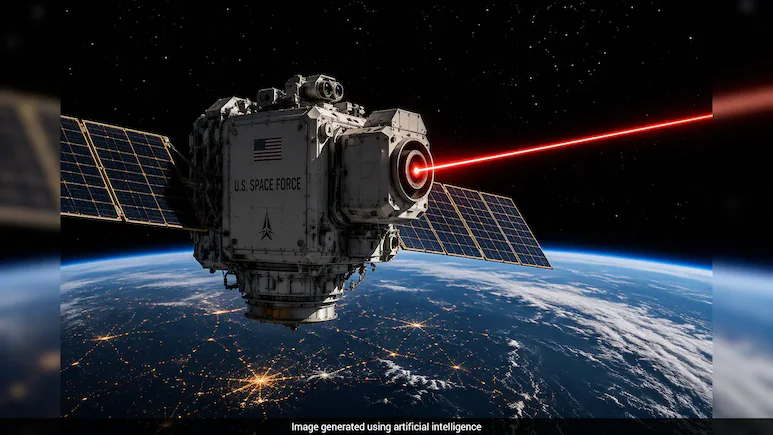

The US has confirmed that it deployed a space weapon in Earth’s orbit, marking the first time it has acknowledged such offensive capability.
Speaking at the Air, Space and Cyber Conference on Monday, US Secretary of the Air Force Troy Meink said the weapon, which he described as being “on orbit”, was needed to help safeguard US forces from hostile action. Meink did not provide details on what the system can do, or when it was placed in orbit.
On Orbit Weapon Confirmed
The announcement follows broader US warnings that military capabilities in space are likely to expand, as adversaries develop ways to target satellites and reduce the effectiveness of space-based services used by armed forces.
Meink’s comments did not describe the weapon’s operational role beyond the aim of protecting US forces against threats originating in space.
Space Threats And Defence Plans
Senior military leaders have previously said the US planned to strengthen its space posture, pointing to Russian and Chinese programmes that could be used to attack or disrupt US satellites during a future conflict.
The Trump administration has said space-based capabilities, along with interceptor missiles, are central to its planned “Golden Dome” defence system, intended to protect the US from missiles and other airborne threats.
The US and other major powers have also operated within the framework of the 1967 treaty banning weapons of mass destruction in orbit. Since then, they have explored other approaches that do not fall under that prohibition, including ways to target or interfere with satellites used for military communications, surveillance and navigation.
Space Force Role And Posture
Last year, President Donald Trump issued an executive order highlighting the US Space Force’s role not only in defending assets but also in carrying out attacking operations.
The Space Force, launched in 2019 as the newest branch of the US military in more than 70 years, was created to protect American space assets, including hundreds of satellites used for communication and surveillance.
A Space Force spokesperson said the service’s mission involves contesting and controlling the space domain, using both “kinetic” and “non-kinetic” means to affect an opponent’s capabilities. The spokesperson added that these actions are aimed at disrupting, degrading and potentially destroying adversary capabilities, if necessary, and are carried out at the direction of combatant commands.
Satellite Incidents And Counterspace Claims
The wider debate has been shaped by reports of satellite interference. In early February, it was reported that two Russian satellites have likely intercepted the communications of at least a dozen European satellites since Russia’s invasion of Ukraine in 2022. Such interceptions could enable intelligence services to access sensitive transmitted data, and, hypothetically, may also allow control of the affected satellites.
In 2024, the US said Russia had launched a satellite it believed may be capable of attacking other similar space-based probes. Russia did not publicly comment on that claim.
The Space Force has said China develops and operates space and counterspace capabilities as part of a military modernisation strategy. It has also said Russia views space as a warfighting domain and believes dominance in space would be a decisive factor in future conflicts.
Join the discussion? 

15 September 2026
Recommended Comments
Create an account or sign in to comment