



Skip to content
View in the app

A better way to browse. Learn more.

Thailand News and Discussion Forum | ASEANNOW

A full-screen app on your home screen with push notifications, badges and more.

To install this app on iOS and iPadOS
  1. Tap the Share icon in Safari
  2. Scroll the menu and tap Add to Home Screen.
  3. Tap Add in the top-right corner.
To install this app on Android
  1. Tap the 3-dot menu (⋮) in the top-right corner of the browser.
  2. Tap Add to Home screen or Install app.
  3. Confirm by tapping Install.

Become a member

Become a member

US Votes Against UN Slavery Resolution at General Assembly

The United Nations General Assembly has adopted a resolution declaring the trafficking of enslaved Africans the gravest crime against humanity and calling for reparations to address historical injustices.

Get today's headlines by email image.png

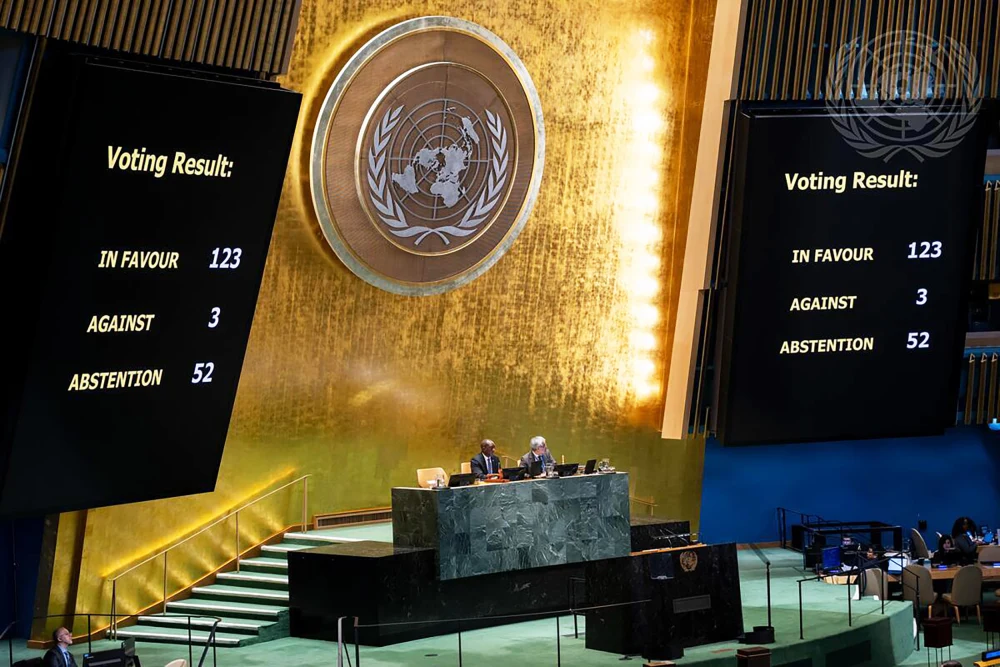
The measure passed with 123 votes in favour in the 193-member body. Three countries — the United States, Argentina and Israel — voted against it, while 52 states abstained.

UN approves resolution on slavery and reparations

All members of the European Union, along with the United Kingdom, were among those that did not support the measure.

The resolution describes the transatlantic slave trade as a historic injustice and calls for reparatory measures as a step toward addressing its lasting consequences. It also urges the return of cultural items such as artworks, monuments, museum objects, documents and archives to their countries of origin without charge.

US opposition over reparations language

Before the vote, Dan Negrea, deputy US ambassador to the United Nations, said Washington rejects the legal basis for reparations tied to historical events.

He said the United States condemns the transatlantic slave trade and all forms of slavery but does not recognise a legal right to reparations for actions that were not illegal under international law when they occurred.

Negrea also criticised wording that labels the slave trade the “gravest” crime against humanity. He said creating a hierarchy among such crimes risks diminishing the suffering of victims of other atrocities.

Resolutions adopted by the General Assembly are not legally binding but reflect the views of the international community.

Supporters stress historical justice

Supporters of the measure said the resolution aims to acknowledge the scale of the transatlantic slave trade and its enduring impact.

John Dramani Mahama, president of Ghana and a key supporter of the initiative, said the vote recognised the suffering of millions enslaved over centuries.

Speaking before the vote, he described the resolution as a step toward healing and reparative justice and said it would help ensure the history of slavery is not forgotten.

The vote took place on the International Day of Remembrance of the Victims of Slavery and the Transatlantic Slave Trade, which honours the estimated 13 million Africans who were enslaved and transported across the Atlantic.

Diplomats applauded the adoption of the measure after the vote was confirmed.

Western nations voice concerns

Western governments that abstained said they share the condemnation of slavery but raised concerns about aspects of the text.

James Kariuki, acting UN ambassador for the United Kingdom, said the history and lasting consequences of slavery must never be forgotten. He added that countries should address ongoing issues linked to discrimination, racism and intolerance.

He also pointed to modern forms of exploitation — including trafficking, forced labour and sexual exploitation — as issues requiring continued global attention.

Representing the European Union, Gabriella Michaelidou said the bloc objected to language that could suggest a ranking among crimes against humanity. She also questioned legal references in the resolution that imply international rules could apply retroactively to historical events.

The resolution calls on countries to engage in discussions on reparatory justice, including formal apologies, restitution, compensation, rehabilitation and legal reforms aimed at addressing racism and systemic discrimination.

It also encourages cooperation between the African Union, the Caribbean Community and the Organization of American States to advance reconciliation efforts and education about the transatlantic slave trade.

Join the discussion? Create account. orange.png

Already a member? haveyr-say.png


image.png
Adapted by ASEAN Now. Source 27 March 2026

User Feedback

Recommended Comments

Jim Waldron Silver Member

Jim Waldron

Advanced Member

The U.S. vote against the UN slavery resolution is getting strong reactions, but their stated reasoning is quite specific.

The U.S. deputy ambassador said Washington cannot support language suggesting a legal obligation for reparations tied to actions that were not considered illegal under international law at the time.

I think the U.S. is worried that it will set a precedent they’re unwilling to accept, even while acknowledging the historical reality and ongoing impact of slavery.

This really comes down to the long‑standing divide between moral responsibility, political commitments, and legally enforceable obligations. It seems that while some see reparations as essential, others are wary of the legal implications for a wide range of historical events.

It’s certainly an emotional issue, but I believe the U.S. position appears driven by legal interpretation rather than a denial of the past.

unblocktheplanet Diamond Member

unblocktheplanet

Advanced Member
7 minutes ago, Jim Waldron said:

The U.S. vote against the UN slavery resolution is getting strong reactions, but their stated reasoning is quite specific.

The U.S. deputy ambassador said Washington cannot support language suggesting a legal obligation for reparations tied to actions that were not considered illegal under international law at the time.

I think the U.S. is worried that it will set a precedent they’re unwilling to accept, even while acknowledging the historical reality and ongoing impact of slavery.

This really comes down to the long‑standing divide between moral responsibility, political commitments, and legally enforceable obligations. It seems that while some see reparations as essential, others are wary of the legal implications for a wide range of historical events.

It’s certainly an emotional issue, but I believe the U.S. position appears driven by legal interpretation rather than a denial of the past.

Paying reparations to the entire Black population of the US and UK sounds more reasonable than putting that money into wars.

What do you expect? Brothers-in-arms: US, UK, Israel!

philipsharpe Senior Member

philipsharpe

Member

The UN is a bull-dog with rubber teeth that should be dismantled.

IsmeUno Platinum Member

IsmeUno

Advanced Member
21 hours ago, Jim Waldron said:

The U.S. vote against the UN slavery resolution is getting strong reactions, but their stated reasoning is quite specific.

The U.S. deputy ambassador said Washington cannot support language suggesting a legal obligation for reparations tied to actions that were not considered illegal under international law at the time.

I think the U.S. is worried that it will set a precedent they’re unwilling to accept, even while acknowledging the historical reality and ongoing impact of slavery.

This really comes down to the long‑standing divide between moral responsibility, political commitments, and legally enforceable obligations. It seems that while some see reparations as essential, others are wary of the legal implications for a wide range of historical events.

It’s certainly an emotional issue, but I believe the U.S. position appears driven by legal interpretation rather than a denial of the past.

40 acres and a mule... things we read whilst still at school.

wwest5829 Platinum Member

wwest5829

Advanced Member

In retirement and with a background in the study of/teaching of history, I have been working on learning about my DNA/ paper trail family tree. What a ride! European Royal line connections (yes, I realize this knowledge and cash is needed for a cup of coffee) but also small farmers in the British American colonies. Documented cases of holding slaves (and Quakers to boot!). Absolutely, I condemn slavery/trafficking BUT ... no, I do not have responsibility for what my ancestors did in their time.

Watawattana Gold Member

Watawattana

Advanced Member
22 hours ago, unblocktheplanet said:

Paying reparations to the entire Black population of the US and UK sounds more reasonable than putting that money into wars.

I'd rather neither. The money could be used for dozens of more worthwhile reasons than either of these.

Watawattana Gold Member

Watawattana

Advanced Member
1 hour ago, philipsharpe said:

The UN is a bull-dog with rubber teeth that should be dismantled.

No way! If all that hot air being produced stopped then global warming might get reversed! And then Greta would be out of a job! Can't have that... 🤪

KhunLA Star Member

KhunLA

Advanced Member

So my tax dollars are to pay for someone who wasn't a slave, who's ancestors may have never been slaves. Or, they may have been slave traders themselves.

When I never owned slaves, my ancestor didn't own slaves, lived in a state (PA) that helped & protected escaped slaves, and fought in a war against slavery.

OK, makes perfect sense to me. Any children out there you'd like me to pay child support to, who's mother I never had sex with.

Watawattana Gold Member

Watawattana

Advanced Member
13 minutes ago, wwest5829 said:

In retirement and with a background in the study of/teaching of history, I have been working on learning about my DNA/ paper trail family tree. What a ride! European Royal line connections (yes, I realize this knowledge and cash is needed for a cup of coffee) but also small farmers in the British American colonies. Documented cases of holding slaves (and Quakers to boot!). Absolutely, I condemn slavery/trafficking BUT ... no, I do not have responsibility for what my ancestors did in their time.

Totally agree. Not meant to be a trolling question, but would be interesting to hear what historical lessons you learnt from your research, and if that has changed how you view the world now, and your fellow humans. No issue if you chose not to answer of course.

Dionigi Silver Member

Dionigi

Advanced Member

Goody Goody. I think one of my ancestors was taken from a merchant ship and enslaved in Algeria, another was taken and enslaved in China, Now I can roll in luxury.

Thingamabob Diamond Member

Thingamabob

Advanced Member

Totally ridiculous to demand reparations from people who have never had anything to do with slavery.

Roadsternut Gold Member

Roadsternut

Advanced Member
6 hours ago, Watawattana said:

Totally agree. Not meant to be a trolling question, but would be interesting to hear what historical lessons you learnt from your research, and if that has changed how you view the world now, and your fellow humans. No issue if you chose not to answer of course.

I've traced my family to about 1580. Its not a very remarkable history; on the one side, a family that literally never left the same village for about 300 years, and when they did, it was to a place 20 miles down the road. The other half is harder to trace, because its London. I know there are Irish connections, Devonian connections. Knowing about Irish immigration in the 1850s doesn't really make me change my views on the famine. I don't feel a connection to Ireland, in the way immigrant societies in North America and Australasia do. Mainly because I don't think of Ireland as a normal country. Its just another place in the British Isles (when the Mannixes left Cork, they weren't emigrating, they were moving house).

But the more recent family history did make me change my views. Nothing in the family happened much until about 1919. 300 years of basically poverty, either farm labouring, orm working in the London leather trade.

After 1919, you see changes happen. My maternal great grandfather was born in a workhouse, out of wedlock to a 17 year old chambermaid, who herself was also born out of wedlock (bang goes a Victorian stereotype). She married, and he had step brothers. His stepdad beat him black and blue, so he ran off and joined the army at 13. By the start of WW1, he was a 10 year veteran of the army, based in Egypt, in the Dragoons. He had gotten out and seen something of the world. Being in the army was likely the first time he had met someone from outside his county, but he would still have been a relatively uneducated bloke. He was in the first cavalry charge of the war, and the last, in 1918. He survived, posted to Ireland for a bit. Came back, and got a job as a labourer at the local iron works; I have a suspicion working for the same man him mum was in service to. That seems a minor step, but it set the path for him getting jobs for his sons as engineers at the works. And my grandfather becoming the County Civil Defence Coordinator. That's social movement.

On my father's side, in London, still a <deleted> life in 1920s London. The main significance was a collapse in the leather trade forced a move from Southwark to Hackney. My paternal grandfather worked as a printer for a bit, then on the buses, before the depression forced him to join the army, end up on the beach at Dunkirk, then in Singapore, and to a Japanese prison camp, where he learnt to speak Japanese, and pretend to be a bus machanic. Post war, he became a man from the Pru, got enough money to buy a small shop in Hackney. My dad joined the army after failing is A-Levels, stayed in 25 years, saw the world, and then me.

Along the way, I see ancestors emigrating to Australia, Canada, US. One became a bigamist and married her brother in law in Canada. Another somehow got into the RFC, war ended just as he finished his flying lessons, then he got into being a "trader" in Nigeria, learned how to farm cattle after a course in Devon, and wound up in Zambia/Northern Rhodesia in the 1950s. Another spent all his life telling the family he was a conscientious objector in ww1, when in fact he was rejected from the army due to poor eyesight.

The details don't really matter, but what I see was the destruction of a ruling class in WW1 opened up opportunity. The revelation is my ancestors were much like me; what I am today is down to their genetic inheritance. They were as capable as me, but lacked the opportunity. I've been lucky that I was able to access higher education, go to university, gain a PhD, the grandson of a boilermaker and bricklayer. And when you think why they, and their predecessors, lacked the opportunity to get on in life, that can leave you feeling a bit angry about all that lost potential. And I get annoyed when some politicians today try and denigrate higher education. I feel in someways, they want to turn back the clock, and put us back in our places. Overall, expanding access to the universities was not a bad thing.

And I vote Tory, each time and every time. I think at times Maggie thought about her family history from Lincolnshire at times, and that energised her in seeking opportunity for all.

Roadsternut Gold Member

Roadsternut

Advanced Member
5 hours ago, Thingamabob said:

Totally ridiculous to demand reparations from people who have never had anything to do with slavery.

It is, but our taxes are used to pay for the actions of people who went before us.

Its not just the examples like paying for WW1 and WW2. Every time any government decides on a major capital project, they borrow the money, and the money paid back over generations.

In some cases, the promise of these projects, these investments, win parties elections. Great, who doesn't want a new high speed train line. Your grandkids are paying for it though.

Sometimes its foisted on a population. The decisions of governments around the wolrd during COVID-19 will still be paid for 50-100 years from now. Like war, there wasn't much choice in the matter. Mostly, we accept that the dues must be paid.

You can go around the major cities in the UK, and marvel at the Victorian architecture. Even Belfast, which is a <deleted>hole, the City Centre is magnificent. This was a wealthy place one. But how was all this paid for. Basically on the backs of others, and those others include those without much choice in the matter. The debate in the UK these days is often about the crumbling infrastructure, the declining strength of the armed forces, that the government should spend more. I'm not sure they could, we are already taxed to the hilt. Its possible that the slavery bonus has now more or less been spent, and the decline is more in line with the country reverting to what it should have been all along, before it punched above its weight.

Slavery resulted in a massive transfer of wealth from one part of the world to another. In the 18th Century, India was the richest country in the world, nd then it was asset stripped.

Imported finished goods changes the direction of wealth transfer, so that the wealth is returned to the countries it came from. That in a way is reparations. But, that is not what is happening. A disportionate part of that wealth is not going back to Africa, to India, but its going to Arab Sheikhs to spend of fast girls and hookers, and to China, where they stash it in a bank. So that perpetuates the genuine feelings of hurt.

The approach to reparations should be through trade policy. Which is not the same as America, who has misread things. America was to reshore wealth that wasn't theirs to start with. Yes, buy less from China, but buy more, lots more, from Africa. And that can include investments in Africa (though don't forget, the American rail network, which enabled the industrialisation of the US, and made possible even the idea of a coast to coast United States, was built using cheap labour from Ireland and China). Strangely, America basically surrendered the entire continent of Africa to others, such as the Soviet Union, who had no such historic links. Instead, it spaffed up huge amounts in countries where there was zero historic relationship, such as Vietnam. France benefited from Vietnam, not the US. And this is the problem with trading blocs based on geography not historic legacy.

Overseas aid is a more tactical way of directing that wealth, because a government has much more control on where the money goes. But Overseas Aid can also be used as a means to direct private money.

Trade should be aligned based on shared history, not geography. In that way, reparations naturally happen as a virtuous circle.

Caldera Ruby Member

Caldera

Advanced Member

A few warm words would be in order, but what would be the point of paying the descendants of trafficked slaves reparations?

They're better off in the countries their ancestors were trafficked to.

Roadsternut Gold Member

Roadsternut

Advanced Member
7 hours ago, wwest5829 said:

In retirement and with a background in the study of/teaching of history, I have been working on learning about my DNA/ paper trail family tree. What a ride! European Royal line connections (yes, I realize this knowledge and cash is needed for a cup of coffee) but also small farmers in the British American colonies. Documented cases of holding slaves (and Quakers to boot!). Absolutely, I condemn slavery/trafficking BUT ... no, I do not have responsibility for what my ancestors did in their time.

Arguably, the reason you were able to enjoy a career teaching history was because of what your ancestors did, and what they bequeathed you, in terms of social mobility. You may have been left some money in a will that traces its way back to those slave farms. You might have benefited from access to a scholarship fund that directly relates to someone benefiting from a hideous activity (we know the number one name in that regard, but there are a few other Industrailist names there as well).

I too have studied family history, going back to the 16th Century. Possibly some disgraced royalty, but the thing is, these Royals spread their seed so much, there are a lot of people related. The last of the Plantagenets is a Canadian carpenter (who donated DNA to confirm King Richard's remains). Matthew Pinsent, the Olympian, is a direct descendant of Catherine Howard, one of Henry VIII's wives, which means he's descended from King Edward I, who, to claim legitimacy, had to show descent from King David, basically right hand of God etc.

But where do you, as an historian, stand on the Smithsonian collection and other American museum collections? does it all belong to America. The same question about the British Museum etc. The question of repatriating collections has positives and negatives. The question that these are collections to be enjoyed by the world is rather specious. If they can be enjoyed in London. Washington, New York, they can be enjoyed in Lagos, Harare, Cairo. Tourists can hope on a plane. The places might not be safe right now for such collections, but the principle should remain.

You might say to those African descendants "I can't pay you because I don't have the money, but I can buy things from you", that've they've added value to. ie manufactured goods. What that means, is USAid investing in entrepreneurial projects in these countries, with no strings (no expectation of a return on investment, just a friendly good luck). Whats happened; the US government sunk billions into a South African Anglo-Canadian, to import raw materials from Africa, to build up a Nevada business that enabled a Chinese government subsidised investment to build a car factory, to sell electric cars to oil Sheikhs.

Just think how Africa would have benefited if those batteries were made in Africa; they add value, through their labour. It is quite possible if Lagos, Capetown and Kinshaha had been turned into EV battery capitals, there wouldn't even be a UN debate on reparations. Instead, American money goes to pay them to fight over extract of raw materials for export. South Africa ships to China iron ore, and at the time, they thought they were getting a pretty sweet deal. China sends back cars. Who had the better deal.

The irony is that American money built on a combination of stolen English inventions (Slater the Traitor) and African slavery enriched Chinese corporations to go and build highways and railways in Africa, and then they claim the credit. After taking their cut.

nick supreme Gold Member

nick supreme

Advanced Member

I am deeply troubled by the US's decision to vote against this resolution. A yes vote could transform our understanding of history.

Roadsternut Gold Member

Roadsternut

Advanced Member
34 minutes ago, Caldera said:

A few warm words would be in order, but what would be the point of paying the descendants of trafficked slaves reparations?

They're better off in the countries their ancestors were trafficked to.

Sierra Leone is proposing a restitution fund, that would not mean Bill Cosby, Tiger Woods, Will Smith or Beyonce getting a payout.

When Germany paid reparations, the money didn't appear as a cheque to the widowed Mrs Jones left with 5 kids to raise after her husband was killed at Vimy Ridge.

Should Japan have paid more for the mistreatment of POWs and civilan internees. Japan paid £76 to each POW, and £49 to each internee in 1951. Many decades later, court cases compelled the descendants of those Japanese to pay more. Was that court action wrong and unfair?

pacovl46 Platinum Member

pacovl46

Advanced Member
On 3/27/2026 at 6:33 AM, Jim Waldron said:

The U.S. vote against the UN slavery resolution is getting strong reactions, but their stated reasoning is quite specific.

The U.S. deputy ambassador said Washington cannot support language suggesting a legal obligation for reparations tied to actions that were not considered illegal under international law at the time.

I think the U.S. is worried that it will set a precedent they’re unwilling to accept, even while acknowledging the historical reality and ongoing impact of slavery.

This really comes down to the long‑standing divide between moral responsibility, political commitments, and legally enforceable obligations. It seems that while some see reparations as essential, others are wary of the legal implications for a wide range of historical events.

It’s certainly an emotional issue, but I believe the U.S. position appears driven by legal interpretation rather than a denial of the past.

Makes sense! Also, obviously this would open the door for claims from the Native Americans, which they clearly do not want either.

BritManToo Star Member

BritManToo

Advanced Member

I'd suggest paying them reparations, but only if they return to their country of ethnic origin and agree to stay there.

Then all the white people should leave the USA, Canada, Australia and New Zealand, and return to their countries of ethnic origin.

Not to forget all the Latinos, departing Mexico and South America.

nick supreme Gold Member

nick supreme

Advanced Member
10 minutes ago, Roadsternut said:

Japan paid £76 to each POW, and £49 to each internee in 1951

This is a sum of money that can truly transform your life. It is not just a number on paper or a figure in an account—it represents possibility, freedom, and the chance to make meaningful choices about your future. With this kind of financial resource, you gain options that might once have felt out of reach. It can provide stability where there was uncertainty, and open doors that were previously closed.

For many people, money on this scale means security. It can eliminate debt, reduce stress, and create a cushion against unexpected challenges. Instead of worrying about day-to-day expenses, you can begin to think long term—about where you want to live, how you want to spend your time, and what truly matters to you. Financial pressure often limits decision-making, but with this kind of sum, those constraints begin to loosen.

Beyond security, it also creates opportunity. You might choose to invest in education, start a business, or pursue a passion that never seemed practical before. It allows you to take calculated risks, knowing you have a foundation beneath you. That freedom can be just as valuable as the money itself. It shifts your mindset from survival to growth, from reacting to circumstances to actively shaping them.

There is also the potential for impact beyond your own life. With careful planning, this money can support family members, contribute to causes you care about, or create something lasting that benefits others. Whether it is helping loved ones, funding charitable work, or building something meaningful, the reach of this sum can extend far beyond your personal needs.

At the same time, it is important to approach it with intention. A life-changing amount of money can disappear quickly without a clear plan. Thoughtful decisions—such as budgeting, investing wisely, and seeking good advice—are essential to making it last and grow. The goal is not just to have money, but to use it in a way that aligns with your values and long-term vision.

Ultimately, this is more than just a financial windfall. It is a turning point, an opportunity to redefine what your life can look like. It gives you the ability to focus less on limitations and more on possibilities. Handled wisely, it can bring not only comfort and security, but also purpose and direction.

Roadsternut Gold Member

Roadsternut

Advanced Member
15 minutes ago, nick supreme said:

This is a sum of money that can truly transform your life. It is not just a number on paper or a figure in an account—it represents possibility, freedom, and the chance to make meaningful choices about your future. With this kind of financial resource, you gain options that might once have felt out of reach. It can provide stability where there was uncertainty, and open doors that were previously closed.

For many people, money on this scale means security. It can eliminate debt, reduce stress, and create a cushion against unexpected challenges. Instead of worrying about day-to-day expenses, you can begin to think long term—about where you want to live, how you want to spend your time, and what truly matters to you. Financial pressure often limits decision-making, but with this kind of sum, those constraints begin to loosen.

Beyond security, it also creates opportunity. You might choose to invest in education, start a business, or pursue a passion that never seemed practical before. It allows you to take calculated risks, knowing you have a foundation beneath you. That freedom can be just as valuable as the money itself. It shifts your mindset from survival to growth, from reacting to circumstances to actively shaping them.

There is also the potential for impact beyond your own life. With careful planning, this money can support family members, contribute to causes you care about, or create something lasting that benefits others. Whether it is helping loved ones, funding charitable work, or building something meaningful, the reach of this sum can extend far beyond your personal needs.

At the same time, it is important to approach it with intention. A life-changing amount of money can disappear quickly without a clear plan. Thoughtful decisions—such as budgeting, investing wisely, and seeking good advice—are essential to making it last and grow. The goal is not just to have money, but to use it in a way that aligns with your values and long-term vision.

Ultimately, this is more than just a financial windfall. It is a turning point, an opportunity to redefine what your life can look like. It gives you the ability to focus less on limitations and more on possibilities. Handled wisely, it can bring not only comfort and security, but also purpose and direction.

£76 in 1951 didn't transform my grandfather's life in 1951. In 2026 money, that would be £2100, for 3 years of torture and abuse, loss of pay. I think he spent it on a second hand car.

Here's how that compensations was paid:

Japan paid in total £1.6m to the UK government for the suffering of POWs. This amounted to £25 per prisoner

Thailand provided compensation, through the sale of the Burma-Siam Railway, of £3 per prisoner

The remainder was through the sale of Japanese assets in the UK by the UK government.

You are arguing that £76 is or was ever a "life changing amount"?

The reality was Japan never compensated the POWs. They compensated a government. The government decided what to do with that money.

Roadsternut Gold Member

Roadsternut

Advanced Member
37 minutes ago, BritManToo said:

I'd suggest paying them reparations, but only if they return to their country of ethnic origin and agree to stay there.

Then all the white people should leave the USA, Canada, Australia and New Zealand, and return to their countries of ethnic origin.

Not to forget all the Latinos, departing Mexico and South America.

Didn't know Nick Griffin had an active account on Aseannow. So when are you packing your bags? And where do the descendants of Caractacus go, in your fantastic "send them home " wet dream?

And where in the British Isles do they go? Where does Elon Musk go? Cut off an arm, and leave it in one spot?

And why are you giving a bye to German diaspora in South America? Or are you only suggesting the descendants of the white slaves in America, plus all the Australian crims should go home?

emptypockets Platinum Member

emptypockets

Advanced Member
1 hour ago, nick supreme said:

I am deeply troubled by the US's decision to vote against this resolution. A yes vote could transform our understanding of history.

Why? History tells us that the slave traders were other black Africans. The US and others reaped the benefits but the originators were Africans and possibly Arabs. Continues to this day in places like Saudi Arabia, as much as this upsets our western fragility.

There were plenty of white European slaves back in the day.

Roadsternut Gold Member

Roadsternut

Advanced Member
1 hour ago, emptypockets said:

Why? History tells us that the slave traders were other black Africans. The US and others reaped the benefits but the originators were Africans and possibly Arabs. Continues to this day in places like Saudi Arabia, as much as this upsets our western fragility.

There were plenty of white European slaves back in the day.

Obviously you need to go back to school if you think that slavery orginated only in Africa and "possibly" Arabia.

European and American slave traders existed. They dealt with other slave traders in buying and selling human chattal. Sounds like you are implying that's a-ok because they weren't running into the bush to directly catch people.

The resolution was whether the Transatlantic Slave Trade was the Gravest Crime Against Humanity. You disagree with that, meaning either you consider that the transatlantic slave trade was not a crime at all OR you have something worse in mind. Without actually being forthcoming about what that was.

To argue that the Transatlantic Slave Trade is the gravest crime against humanity is to stress its unparalleled fusion of scale, duration, and design: for four centuries it commodified millions, imposed hereditary, racialised bondage, and embedded human exploitation at the core of a global economic system. Unlike the Arab Slave Trade or the enslavement of Slavic peoples, it fixed entire populations as permanent property across generations. And while atrocities such as the Holodomor, the Armenian Genocide, the mass campaigns under Mao, and even the The Holocaust were devastating in their intensity and loss of life, they were comparatively time-bound catastrophes. The Atlantic system, by contrast, was a transnational order that normalised dehumanisation over centuries, shattered cultures, enriched empires, and whose consequences still shape the modern world—making it not a single rupture, but an enduring architecture of injustice.

So what's your worst crime against humanity?

JonnyF Star Member

JonnyF

Advanced Member

Great to see the UN embarrassing itself again.

TedG Ruby Member

TedG

Advanced Member
8 hours ago, Roadsternut said:

The resolution was whether the Transatlantic Slave Trade was the Gravest Crime Against Humanity. You disagree with that, meaning either you consider that the transatlantic slave trade was not a crime at all OR you have something worse in mind. Without actually being forthcoming about what that was.

WW2 was a the gravest crime against humanity. The death toll was between 60 and 70 million people.

metisdead Legendary Member

Low value posts have been removed:

  1. Low-Value Posts - Posts that add no written contribution are not allowed.

    This includes emoji-only replies, very short comments, memes, GIFs, screenshots, or embedded social media posts without explanation or opinion.

wwest5829 Platinum Member

wwest5829

Advanced Member
On 3/28/2026 at 10:59 AM, Watawattana said:

Totally agree. Not meant to be a trolling question, but would be interesting to hear what historical lessons you learnt from your research, and if that has changed how you view the world now, and your fellow humans. No issue if you chose not to answer of course.

My genealogy view approach has been to find out where I was and when (my DNA). This within the larger background study as a history generalist. I liken it to being a medical GP. If my students asked for more depth than within my broad background knowledge, then I pointed the way to a specialist dealing in depth in the subject/time period being studied. I taught the American general studies courses in American and "Western Civilization" (also referred to as European History although starting in pre-history). So my post-graduate view has been reinforced rather than changed as I already knew the general historical roadmap. I did discover new revelations unknown previously concerning specific parts played in history ... the Quaker background fleeing England as religious refugees, the slave holding, 15+ forbears documented as helping found the country (DNA being in the British colonies since the 1600s, then there were the 3 marriages to Native Americans - Shinnecock, Lenni Lenape, Cherokee). And then another hung as a Loyalist. Both Southern New Jersey and deeper Southern branches so both side personalities represented in our Civil War. Mostly small farmers, craftsmen, up to my life raised blue collar union. If nothing else I have a deep appreciation of our American roots.

(and a growing intolerance with those few who attempt to tell me what it means to be an American), keeps my mind active in my 80th year.

On 3/28/2026 at 10:59 AM, Watawattana said:

Totally agree. Not meant to be a trolling question, but would be interesting to hear what historical lessons you learnt from your research, and if that has changed how you view the world now, and your fellow humans. No issue if you chose not to answer of course.

Create an account or sign in to comment

Account

Navigation

Search

Search

Configure browser push notifications

Chrome (Android)
  1. Tap the lock icon next to the address bar.
  2. Tap Permissions → Notifications.
  3. Adjust your preference.
Chrome (Desktop)
  1. Click the padlock icon in the address bar.
  2. Select Site settings.
  3. Find Notifications and adjust your preference.

