



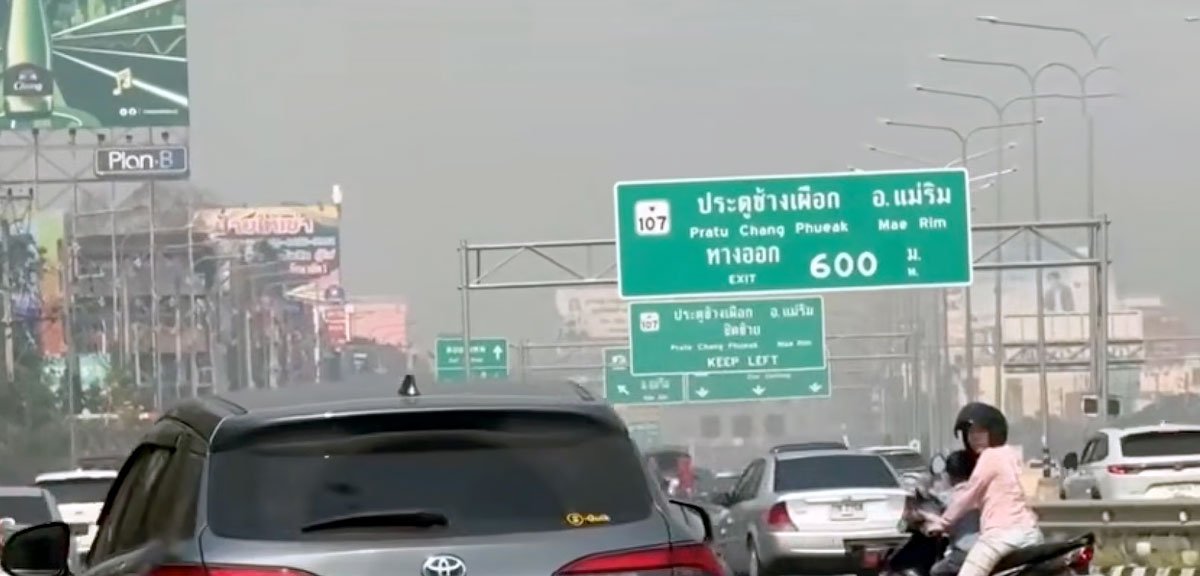

Tirayut Wongsantisuk moved to Chiang Mai with his wife in the 2010s, drawn by the region’s cooler climate and green mountains. More than a decade later, worsening seasonal pollution has made the family question whether they should stay.
Get today's headlines by email 
Their two daughters have suffered repeated nosebleeds during periods of heavy haze. Tirayut says the health problems have forced him to consider leaving the city during the peak pollution months.
“If something serious happened to our child, we would regret it forever,” said the 41-year-old.
Smoke from widespread fires has blanketed large parts of northern Thailand in recent days. Air monitoring group IQAir ranked Chiang Mai among the most polluted cities in the world during the past week.
Families rethink life in the north
When BBC Thai visited families in the city, a thick haze covered the skyline, hiding the mountain views that usually surround the area. The smell of burning lingered across neighbourhoods.
Satellite monitoring recorded 4,750 fire hotspots across Thailand on Tuesday, most of them in forested areas.
Hazardous air during fire season
By Wednesday morning, Chiang Mai’s level of PM2.5 — fine particles small enough to enter the bloodstream — was classified as “very unhealthy”.
Northern Thailand experiences its worst pollution from November to March. During this period, farmers burn fields to clear land before planting new crops. Dry conditions also trigger wildfires in forests and farmland.
Images shared by local media show mountainsides covered in flames, with some residents comparing the fires to erupting volcanoes.
Authorities have closed parks considered at high risk of fire and warned that anyone entering protected areas to start fires will face arrest.
Thailand’s laws impose severe penalties for illegal forest burning. Those convicted can face prison sentences of up to 20 years and fines reaching two million baht.
Health experts say prolonged exposure to polluted air can trigger a range of problems, from eye irritation and nosebleeds to more serious conditions such as heart attacks.
Children sent away from the city
Parents say children appear especially vulnerable to the pollution.
Tirayut says his six-year-old daughter developed repeated nosebleeds, skin rashes and severe eye irritation. At times, her eyelids became swollen due to allergic reactions.
Another resident, Benjamas Jaiparkan, has temporarily sent her children to stay with relatives in neighbouring Phayao province, where the air is cleaner.
The 35-year-old public school teacher says she fears the long-term impact on her four-year-old son, who began experiencing nosebleeds last year.
“I feel sorry for him because I don’t know how much more his lungs can handle,” she said.
Some families now see relocation as the only way to protect their children.
Legal pressure on the government
Public concern over air pollution has grown steadily in recent years. Residents and environmental activists have filed legal cases demanding stronger government action.
In July 2023, about 1,700 Chiang Mai residents sued former Prime Minister Prayut Chan-o-cha and two government agencies. The group argued authorities failed to use existing powers to address the pollution crisis, which they say could shorten local life expectancy by about five years.
A court in Chiang Mai later ruled that the government must produce an emergency plan to tackle air pollution within 90 days.
The haze problem is not limited to Thailand. Recent satellite data shows rising fire activity across Southeast Asia, with the highest number of hotspots in seven years recorded in Malaysia and Indonesia.
Join the discussion? 
Already a member? 
 Adapted by ASEAN Now. Source 1 April 2026
Recommended Comments
Create an account or sign in to comment