



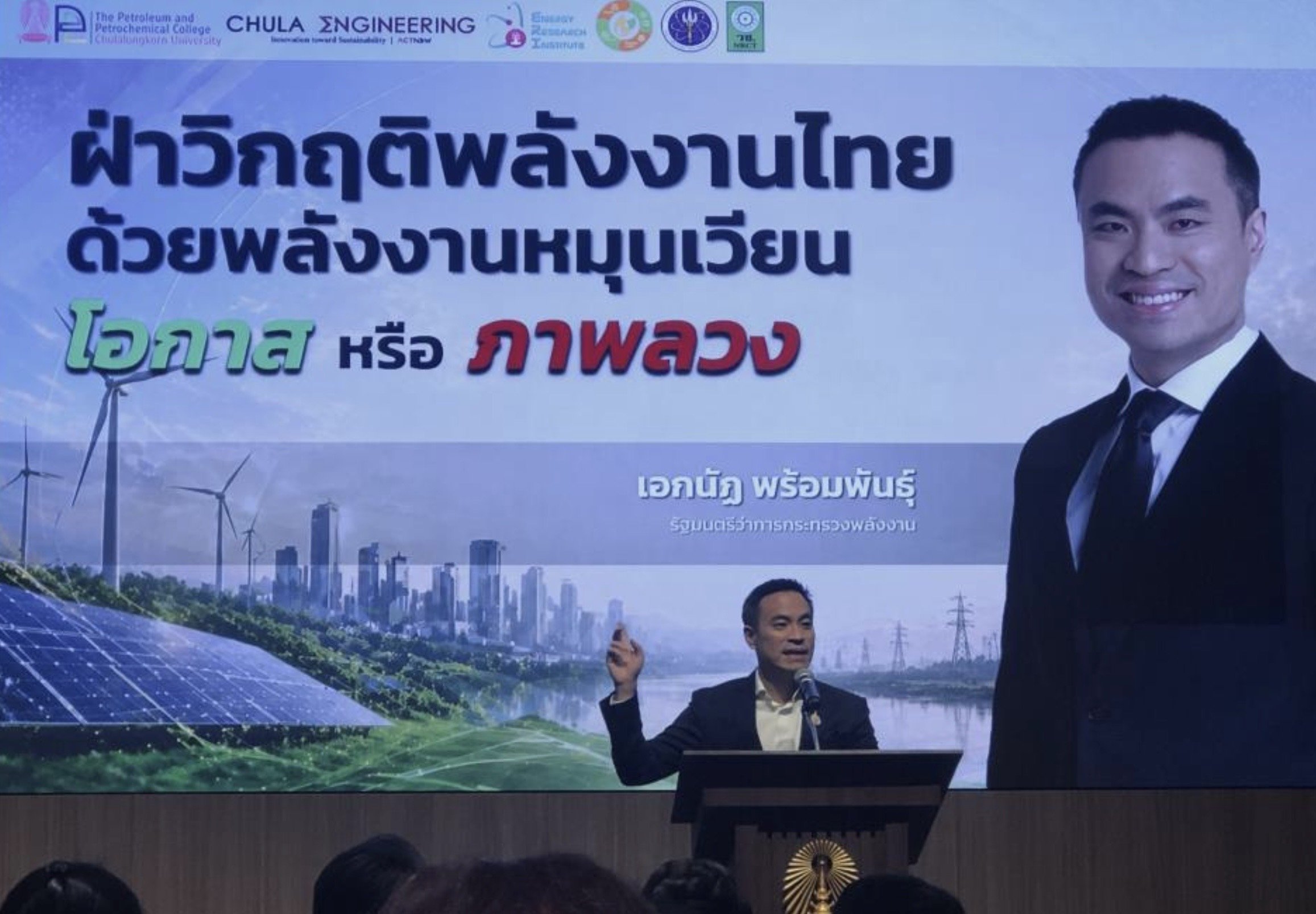

Thailand’s energy minister Ekanat Promphan has proposed developing oil storage and pipeline systems within the Land Bridge project, while also seeking legal changes to continue subsidies for biofuels beyond September 24, 2026. The move aims to reduce reliance on imported crude oil, support farmers, and position Thailand as a regional oil trading and storage hub.
Get today's headlines by email 
Speaking at an academic seminar titled “Overcoming Thailand’s Energy Crisis with Renewable Energy: Opportunity or Illusion?” at Chulalongkorn University, Ekanat said Thailand must urgently restructure its energy system. Although the country has six refineries capable of producing more refined fuel than domestic demand, it still imports over 90% of its crude oil needs while producing less than 10% locally.
He highlighted renewed interest in establishing a Strategic Petroleum Reserve (SPR), noting that earlier proposals were rejected due to reliable imports from the Middle East. However, conflicts involving Iran, the United States and Israel, along with disruptions such as the closure of the Strait of Hormuz and risks in the Red Sea, have exposed vulnerabilities in Thailand’s energy security.
Ekanat said the Land Bridge project should expand beyond road and rail transport to include oil storage facilities and pipeline networks. He suggested attracting investors to store oil in Thailand instead of Singapore, creating opportunities for oil trading while strengthening national reserves during global energy crises.
The minister also addressed the government’s support for biofuels, including biodiesel and ethanol, which are currently subsidised by the Oil Fuel Fund. Under the 2019 Oil Fuel Fund Act, subsidies for biofuels such as B20 diesel and gasohol E20 and E85 are set to end on September 24, 2026, a move expected to impact farmers.
To counter this, the ministry is considering amending the law or issuing an emergency decree to extend subsidies. Ekanat said continued support would help reduce crude imports and sustain the agricultural sector during ongoing energy challenges.
He added that Thailand has strong potential in renewable energy, particularly solar power, which could reduce reliance on expensive liquefied natural gas for electricity generation. The government plans to streamline regulations for rooftop solar installations and offer low-interest loans, allowing households to generate their own electricity and sell surplus power back to the grid at 2.20 baht per unit.
Mnger Online reported that the government will also push for liberalisation of the electricity sector to improve efficiency, expand consumer choice, and attract foreign investment. These measures are part of a broader strategy to enhance competitiveness and support Thailand’s goal of achieving carbon neutrality by 2050.
Join the discussion? 
Already a member? 
 Adapted by ASEAN Now MGRonline 5 May 2026
Recommended Comments
Create an account or sign in to comment