



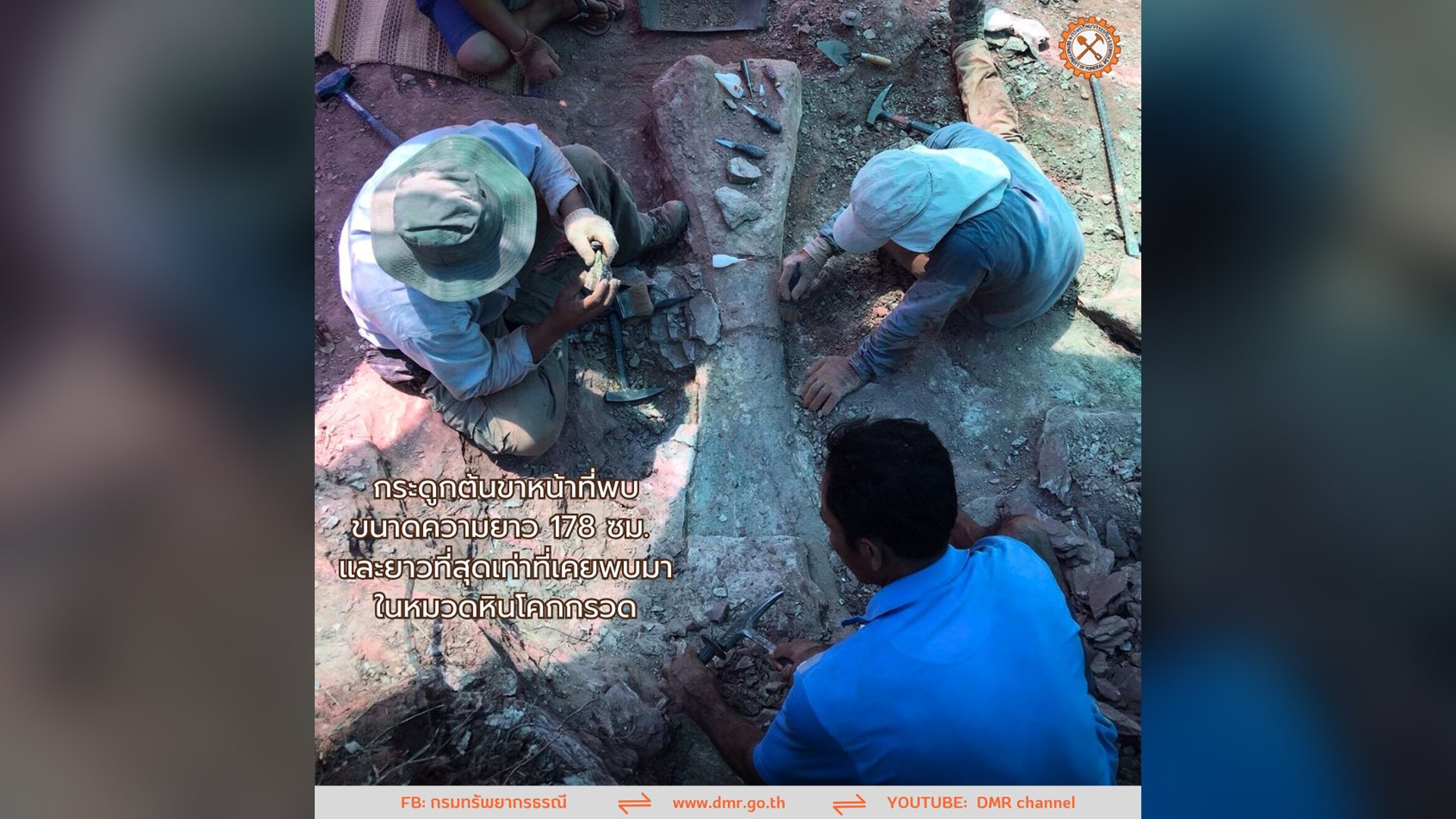

Thai and British palaeontologists have unveiled a new species of long-necked dinosaur in Chaiyaphum province, northeastern Thailand. Named Nakha Titan Chaiyaphumensis, this discovery is believed to represent the largest dinosaur species found in Thailand and Southeast Asia. The plant-eating sauropod spans an estimated 27 to 30 meters in length and weighs over 26 tonnes.
Get today's headlines by email 
The announcement came from Sita Manitkul of Mahasarakham University's Palaeontological Research and Education Centre, spearheading the study. The identified fossils include more than 20 pieces, such as a 178-centimeter right upper arm bone, ribs, and leg bones over 2 meters long. Nakha Titan belongs to the Titanosauriformes, a group of giant sauropods from the Early Cretaceous period, living approximately 100 to 115 million years ago.
The species' name derives from "Nakha," linked to a mythical Thai serpent, and "Titan," from Greek mythology. The discovery credits Chaiyaphum province, where locals first found the fossils in 2016, leading to government-led excavations that revealed key pieces like vertebrae and an unusually large humerus.
Parts of the fossils are displayed at the Sirindhorn Dinosaur Museum, with the original site now serving as a local educational center. Supported by the National Geographic Society, this project enhances understanding of prehistoric ecosystems, biodiversity, and the evolution of giant land animals, contributing to community education through Chaiyaphum's Geopark initiative.
Experts highlight the significance of this find in shedding light on Earth's ancient biological history and underscoring the role such discoveries play in uncovering the dynamics of ecosystems preceding human life.
Join the discussion? 
Already a member? 
 Adapted by ASEAN Now · Khaosod · 15 May 2026
Recommended Comments
Create an account or sign in to comment