

Skip to content
View in the app

A better way to browse. Learn more.

Thailand News and Discussion Forum | ASEANNOW

A full-screen app on your home screen with push notifications, badges and more.

To install this app on iOS and iPadOS
  1. Tap the Share icon in Safari
  2. Scroll the menu and tap Add to Home Screen.
  3. Tap Add in the top-right corner.
To install this app on Android
  1. Tap the 3-dot menu (⋮) in the top-right corner of the browser.
  2. Tap Add to Home screen or Install app.
  3. Confirm by tapping Install.

Thailand Population Declines to 65.8m as Society Ages

Thailand’s population declined to 65.8 million in 2025, according to the Department of Provincial Administration, signalling ongoing demographic contraction and a rapidly ageing society. Official figures from the Central Registration Office show the total population stood at 65.80 million as of December 31, 2025. Of this, 64,820,708 are Thai nationals and 988,620 are non-Thai residents.

Get today's headlines by email image.png

The latest data marks a drop from 65.95 million recorded in 2024, representing a year-on-year decrease of around 142,199 people. Bangkok remains the country’s most populous province, with a population roughly twice that of second-ranked Nakhon Ratchasima. Most of the top 10 most populous provinces are located in the Northeast, reflecting regional population distribution trends.

Labour Minister Treenuch Thienthong highlighted the growing economic impact of an ageing population, noting that more than 20% of the population, around 15 million people, are now aged 60 and over. Of these, over 30%, or roughly one in three, are still working, often due to insufficient savings or limited family support. The proportion of elderly citizens is expected to rise significantly in the coming years, potentially reshaping the labour market and affecting overall economic growth.

Income data underscores the financial challenges facing older people. Nearly half of the elderly population earns insufficient income, with 31.6% making between 83 and 167 baht per day, while 19.9% earn less than 83 baht daily. Around 66.7% have no savings, forcing many to remain in employment despite their age.

Currently, 5.26 million elderly people, or 37.2%, are still working, primarily because they remain healthy and require income. In response, the Labour Ministry has tasked the Department of Skill Development with upskilling and reskilling older workers, particularly in digital skills, to improve employability.

The Bangkokpost reported that The Department of Employment has also prepared 1,969 job positions suitable for elderly workers, including roles such as sales staff, general labourers, cleaners, security guards and administrative staff. According to department chief Somchai Morakotsriwan, job seekers can apply via the “Thai Mee Ngan Tham” platform. So far, 554 elderly people have secured jobs through the service, generating a combined annual income of more than 53 million baht.
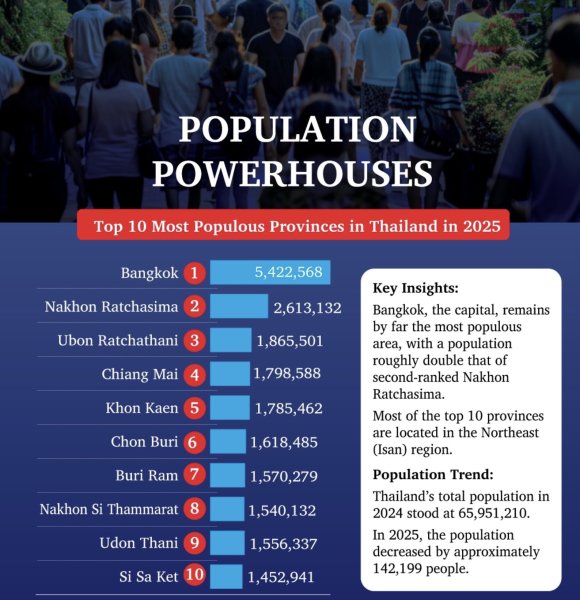
image.jpeg

Picture courtesy of Bangkokpost

Join the discussion? image.png

Already a member? image.png

image.png Adapted by ASEAN Now Bangkokpost 28 Mar 2026

User Feedback

Recommended Comments

Jim Waldron Silver Member

Jim Waldron

Advanced Member

Thailand’s latest population numbers really underline why some are calling it the sick man of ASEAN. A drop to 65.8 million people, combined with one of the fastest‑aging populations in the region, is a serious warning sign.

What’s worrying is that this isn’t just about today’s elderly struggling with low savings and limited support. It’s the long‑term picture: Thailand’s working‑age population is shrinking every year, birth rates are at historic lows, and there’s no clear plan to replace the labour that’s disappearing.

If nothing changes, the workforce shortages we’re already seeing will only intensify, dragging down growth and putting even more pressure on younger taxpayers. Meanwhile, neighbours like Vietnam and Indonesia still have young, expanding labour pools.

It’s a tough combination: an aging society, a shrinking workforce, and an economy that isn’t adapting fast enough. The trend is real, and it’s getting harder to ignore.

ChipButty Star Member

ChipButty

Advanced Member

Interesting to see how things might evolve over the next 10–20 years.

save the frogs Star Member

save the frogs

Advanced Member

Let's see if they adopt AI.

Celsius Diamond Member

Celsius

Members

Thailand running out of Thais.

No need to panic or encourage locals to have kids or anything silly like that. Just fast track the proven strategy of the glorious Western nations by adopting open borders and visa free entries for all.

Woke baby, woke!!!!

davb Silver Member

davb

Advanced Member

I think they've squeezed too much money out of the average Thai worker. And I don't think the elites want to change things so Thai workers get more than 300 or 400 baht a day.

Ralf001 Star Member

Ralf001

Advanced Member
3 hours ago, Jim Waldron said:

If nothing changes, the workforce shortages we’re already seeing will only intensify, dragging down growth and putting even more pressure on younger taxpayers. Meanwhile, neighbours like Vietnam and Indonesia still have young, expanding labour pools.

Thai's are lazy, wish we could hire more staff from Laos.

Celsius Diamond Member

Celsius

Members

2 minutes ago, davb said:

I think they've squeezed too much money out of the average Thai worker. And I don't think the elites want to change things so Thai workers get more than 300 or 400 baht a day.

I think she squeezed too mutt out of u

mfd101 Platinum Member

mfd101

Advanced Member

Thailand joining the club. Europe, China, Japan ... No reason why Thailand should be any different.

8 billion people is arguably more than the planet can sustain (at least at 'Western' levels of consumption). Get used to it.

redwood1 Ruby Member

redwood1

Advanced Member

Men need to all stop wearing condoms.....Condoms need to be banned.

Lucky Bones Platinum Member

Lucky Bones

Advanced Member
3 hours ago, Jim Waldron said:

Thailand’s latest population numbers really underline why some are calling it the sick man of ASEAN. A drop to 65.8 million people, combined with one of the fastest‑aging populations in the region, is a serious warning sign.

What’s worrying is that this isn’t just about today’s elderly struggling with low savings and limited support. It’s the long‑term picture: Thailand’s working‑age population is shrinking every year, birth rates are at historic lows, and there’s no clear plan to replace the labour that’s disappearing.

If nothing changes, the workforce shortages we’re already seeing will only intensify, dragging down growth and putting even more pressure on younger taxpayers. Meanwhile, neighbours like Vietnam and Indonesia still have young, expanding labour pools.

It’s a tough combination: an aging society, a shrinking workforce, and an economy that isn’t adapting fast enough. The trend is real, and it’s getting harder to ignore.

Way too logical.

You seem to have posted in the wrong forum.🙃🙃

Lucky Bones Platinum Member

Lucky Bones

Advanced Member
45 minutes ago, save the frogs said:

Let's see if they adopt AI.

I don't think adoption will help.🙃🙃

save the frogs Star Member

save the frogs

Advanced Member
1 minute ago, Lucky Bones said:

I don't think adoption will help.🙃🙃

depends how it's done.

tax the robots ... if it's even possible.

right now, many parents put pressure on their children for support.

I even met one girl who had suicidal tendencies because of the financial pressures.

JimHuaHin Platinum Member

JimHuaHin

Advanced Member
4 hours ago, Jim Waldron said:

Thailand’s latest population numbers really underline why some are calling it the sick man of ASEAN. A drop to 65.8 million people, combined with one of the fastest‑aging populations in the region, is a serious warning sign.

What’s worrying is that this isn’t just about today’s elderly struggling with low savings and limited support. It’s the long‑term picture: Thailand’s working‑age population is shrinking every year, birth rates are at historic lows, and there’s no clear plan to replace the labour that’s disappearing.

If nothing changes, the workforce shortages we’re already seeing will only intensify, dragging down growth and putting even more pressure on younger taxpayers. Meanwhile, neighbours like Vietnam and Indonesia still have young, expanding labour pools.

It’s a tough combination: an aging society, a shrinking workforce, and an economy that isn’t adapting fast enough. The trend is real, and it’s getting harder to ignore.

Very good summary.

Thailand has been aware of this evolving problem for decades, but has done next to nothing to address it.

Once the severe crisis hits over the next 10-15 years, then maybe the conservative power elite will act (but I am not betting on it).

ChipButty Star Member

ChipButty

Advanced Member

I know many Thai women who dont have children, and not likely to have any, and the ones who have it's only one kid,

FlorC Platinum Member

FlorC

Advanced Member

Declining populations are good.

The future is AI and robots.

No need for workers , no need for useless humans.

The more inteligent people become , the less children they have.

(yes there are exceptions).

Compare China to Africa.

Celsius Diamond Member

Celsius

Members

Dec

13 minutes ago, FlorC said:

The more inteligent people become , the less children they have.

That's probably the reason why I have superior intelligence than most on this forum.

mfd101 Platinum Member

mfd101

Advanced Member
1 hour ago, JimHuaHin said:

Thailand has been aware of this evolving problem for decades, but has done next to nothing to address it.

Once the severe crisis hits over the next 10-15 years, then maybe the conservative power elite will act (but I am not betting on it).

So what should they have done or should they do? Ban condoms and The Pill?

Even apart from the worldwide ecological aspect, I should have thought a shortage of workers would be rather good for poorly-paid or scarcely-paid-at-all Thai workers. 350฿ anyone?

nausea Gold Member

nausea

Advanced Member

One kid seems to be the norm, as it is in my home country the UK; given the greatly increased survival rates modern societies exhibit, it's enough to pass on your genes in most cases. Thailand's historic extraordinary fecundity was always its source of strength, and Thais still exhibit that love of children that enabled them to survive numerous crises, but nowadays it's transposed into dog moms and the like. My SO is definitely high on the fecundity scale, but she has two sons already, and we have 5 dogs, so hopefully that's enough to keep her happy. Personally, I have two brothers and one sister, and I feel sorry for only children who miss out on the camaderie that engenders.

captain_shane Advanced Member

captain_shane

Member
On 3/28/2026 at 4:05 AM, Jim Waldron said:

Thailand’s latest population numbers really underline why some are calling it the sick man of ASEAN. A drop to 65.8 million people, combined with one of the fastest‑aging populations in the region, is a serious warning sign.

What’s worrying is that this isn’t just about today’s elderly struggling with low savings and limited support. It’s the long‑term picture: Thailand’s working‑age population is shrinking every year, birth rates are at historic lows, and there’s no clear plan to replace the labour that’s disappearing.

If nothing changes, the workforce shortages we’re already seeing will only intensify, dragging down growth and putting even more pressure on younger taxpayers. Meanwhile, neighbours like Vietnam and Indonesia still have young, expanding labour pools.

It’s a tough combination: an aging society, a shrinking workforce, and an economy that isn’t adapting fast enough. The trend is real, and it’s getting harder to ignore.

You brand Thailand the "sick man of ASEAN" based on demographic decline, inherently assuming that endless population growth is the only valid metric of economic health. You haven't proven that a shrinking population is fatal; you merely state it as a given. A shrinking workforce forces an economy to stop relying on cheap labor and start investing heavily in technology and automation. This drives up capital per worker, which increases productivity and ultimately wages.

A shrinking population reduces strain on housing markets, public infrastructure, and natural resources, potentially increasing the quality of life per capita even if absolute gross domestic product (GDP) growth slows. GDP per capita matters more to citizens than raw GDP.

Because you decry the lack of a "plan to replace the labour," your implicit solutions are either pro-natalist policies to boost birth rates or mass unskilled immigration. Both carry disastrous unintended consequences:

The Pro-Natalist Trap: If Thailand tries to bribe its citizens into having more children (as South Korea and Japan have disastrously attempted), it will siphon billions of dollars away from productive investments. Furthermore, babies consume resources immediately but do not enter the workforce for 15-20 years. This would worsen the immediate dependency ratio, bankrupting the shrinking taxpayer base even faster than the current trajectory.

The Cheap Labor Trap: If Thailand "replaces the labour" by mass-importing unskilled workers, it suppresses domestic wages, disincentivizes corporations from investing in automation, and locks the country in a middle-income trap indefinitely.

tai4de2 Advanced Member

tai4de2

Member

What this all means is that the Thailand we've known and (mostly) loved has a sell-by date.

We'll really start to see it in about 15 years, as people who would have entered the workforce simply don't exist. That will affect everything.

And starting at around that point, the people will be even more miserable than they've started to become already. Having children has challenges, but having denied themselves that most human of experiences (or, having been denied that experience -- depending on one's point of view) will become a serious drain on the national mood over time.

Harsh Jones Gold Member

Harsh Jones

Advanced Member
On 3/27/2026 at 3:05 PM, Jim Waldron said:

And Thailand’s latest population numbers really underline why some are calling it the sick man of ASEAN. A drop to 65.8 million people, combined with one of the fastest‑aging populations in the region, is a serious warning sign.

What’s worrying is that this isn’t just about today’s elderly struggling with low savings and limited support. It’s the long‑term picture: Thailand’s working‑age population is shrinking every year, birth rates are at historic lows, and there’s no clear plan to replace the labour that’s disappearing.

If nothing changes, the workforce shortages we’re already seeing will only intensify, dragging down growth and putting even more pressure on younger taxpayers. Meanwhile, neighbours like Vietnam and Indonesia still have young, expanding labour pools.

It’s a tough combination: an aging society, a shrinking workforce, and an economy that isn’t adapting fast enough. The trend is real, and it’s getting harder to ignore.

Ah so everything is perfect in Vietnam and Indonesia of all place. What a load of nonsense.

Thailand is a more mature economy than either of those places. And has almost double the GDP per cap than either one. So obviously its demographics is more inline with a middle income country than ones that are 10-20 years behind them.

Thailand $10,440 for 2026) Vietnam ($6,150) Indonesia ($5,870)

Harsh Jones Gold Member

Harsh Jones

Advanced Member
On 3/27/2026 at 7:20 PM, JimHuaHin said:

Very good summary.

Thailand has been aware of this evolving problem for decades, but has done next to nothing to address it.

Once the severe crisis hits over the next 10-15 years, then maybe the conservative power elite will act (but I am not betting on it).

There will be no severe crisis and you have no idea what you are yapping about.

Thailand has double the GDP per cap of Indonesia and Vietnam. And by the time those countries catch up , the exact same thing will be happening with their demographics

Celsius Diamond Member

Celsius

Members

If you want to solve population problem, I recommend Japan.

20260330_111621.jpg

Create an account or sign in to comment

Account

Navigation

Search

Search

Configure browser push notifications

Chrome (Android)
  1. Tap the lock icon next to the address bar.
  2. Tap Permissions → Notifications.
  3. Adjust your preference.
Chrome (Desktop)
  1. Click the padlock icon in the address bar.
  2. Select Site settings.
  3. Find Notifications and adjust your preference.