



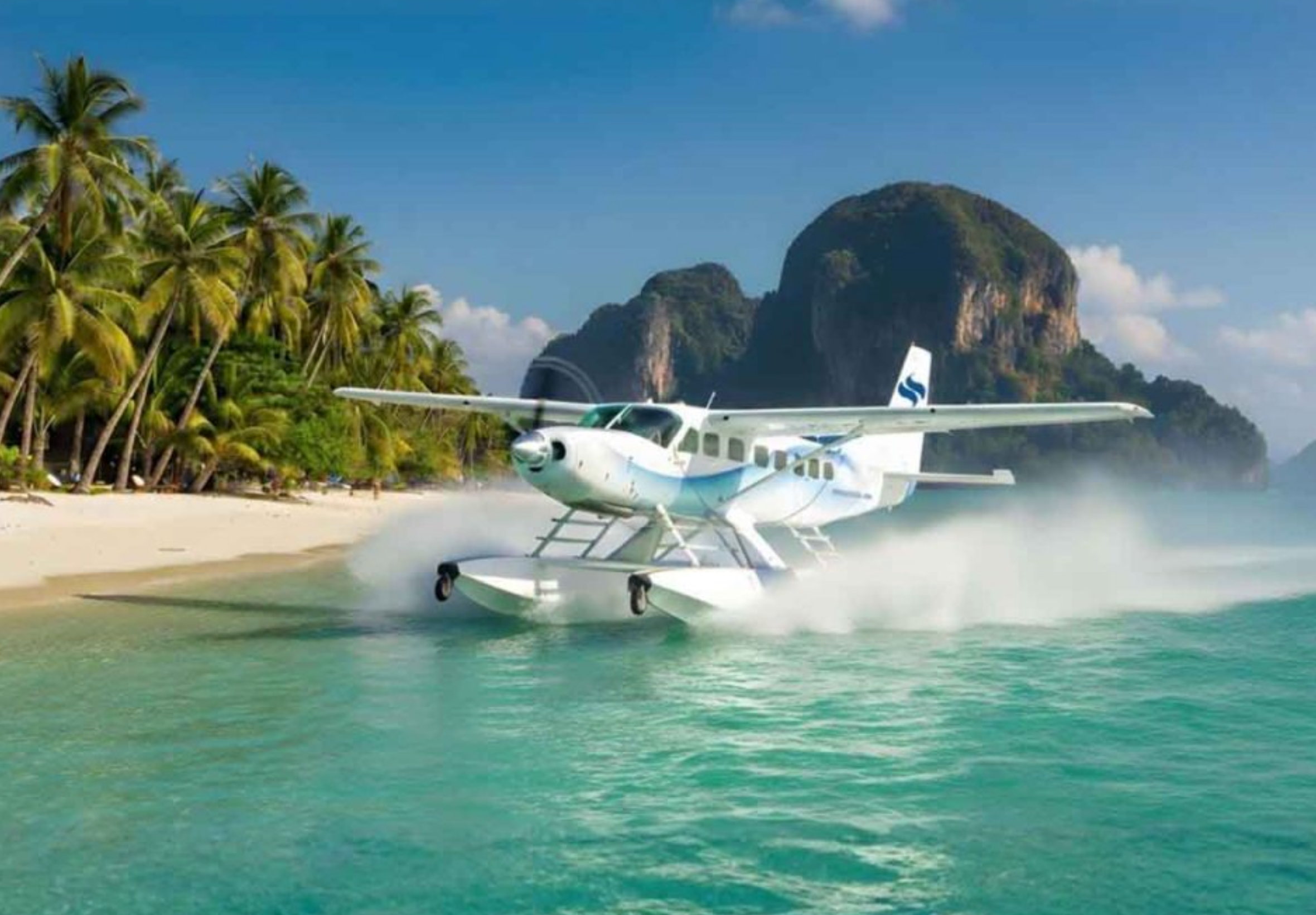

Thailand’s ambition to develop a commercial seaplane industry has been slowed by regulatory hurdles, despite strong tourism potential and growing demand, according to aviation operator Siam Seaplane. The company said outdated rules and costly approval requirements have delayed the introduction of seaplane services, leaving Thailand behind regional competitors including Vietnam and Indonesia.
Get today's headlines by email 
Worakanya Siripidej, chief executive of Siam Seaplane, said the country’s regulations had not kept pace with advances in aviation technology. She said a 2023 notification from the Natural Resources and Environment Ministry requires temporary water landing sites and floating docks for seaplanes to undergo an initial environmental examination, adding several million baht to project costs.
According to Ms Worakanya, the expense is almost equivalent to developing a boat marina and has significantly delayed the company’s planned launch. She argued that regulations should not apply a “one size fits all” approach to operators with different types of facilities.
Siam Seaplane registered in Thailand in 2019 and obtained an air operator certificate in 2024. The company, part of Seaplane Asia Group, currently operates only land-to-land charter flights using a Cessna Grand Caravan aircraft on routes including Bangkok-Samui and Samui-Phuket.
Last year, the Civil Aviation Authority of Thailand (CAAT) introduced regulations covering commercial seaplane operations and standards for temporary water take-off and landing areas. However, Ms Worakanya said the rules do not cover larger water aerodromes capable of accommodating multiple aircraft, such as those operating in the Maldives, nor do they address beach landings.
To support the industry’s development, the government and relevant agencies have established a strategic committee chaired by the deputy transport minister. Ms Worakanya said the committee is intended to act as a one-stop coordination centre involving organisations including the Department of National Parks, Wildlife and Plant Conservation, CAAT and Aeronautical Radio of Thailand (Aerothai).
Supported by CAAT and Aerothai, Siam Seaplane has asked the Natural Resources and Environment Ministry to relax some environmental assessment requirements for seaplane facilities. The review is expected to be completed during the fourth quarter of this year.
Public hearings with local communities in Krabi are also expected to conclude this year, allowing construction to begin on three temporary water take-off and landing sites at Tub Kaek and Koh Phi Phi. The company also plans facilities at Bangtao and Makham Bay in Phuket, and Koh Yao Noi in Phangnga, with commercial seaplane services targeted to begin in January 2027.
Despite global economic and geopolitical uncertainty requiring frequent adjustments to its business plans, Siam Seaplane said it received many enquiries for seaplane services. The company has ordered six additional Cessna Grand Caravan aircraft, expanding its planned fleet to seven.
"Seaplanes are a means of logistics which creates accessibility to hard-to-reach waterfront destinations across Thailand."
The company also wants to expand land-to-land flights overseas to Cambodia, Laos, Myanmar and Vietnam next year, as well as cooperate with the National Institute for Emergency Medicine in aeromedical evacuation services.
Bangkpost reported that Siam Seaplane is targeting revenue of 70 million baht next year and 650 million baht within five years, with a fleet of between seven and 15 aircraft. Around 70% of revenue is expected to come from seaplane operations, while the remainder will be generated by land-to-land charter flights. A 30-minute seaplane journey from Phuket to Koh Phi Phi is expected to cost about 50,000 baht for eight to 10 passengers.
Join the discussion? 

9 July 2026
-
 1
1
Recommended Comments
Create an account or sign in to comment