



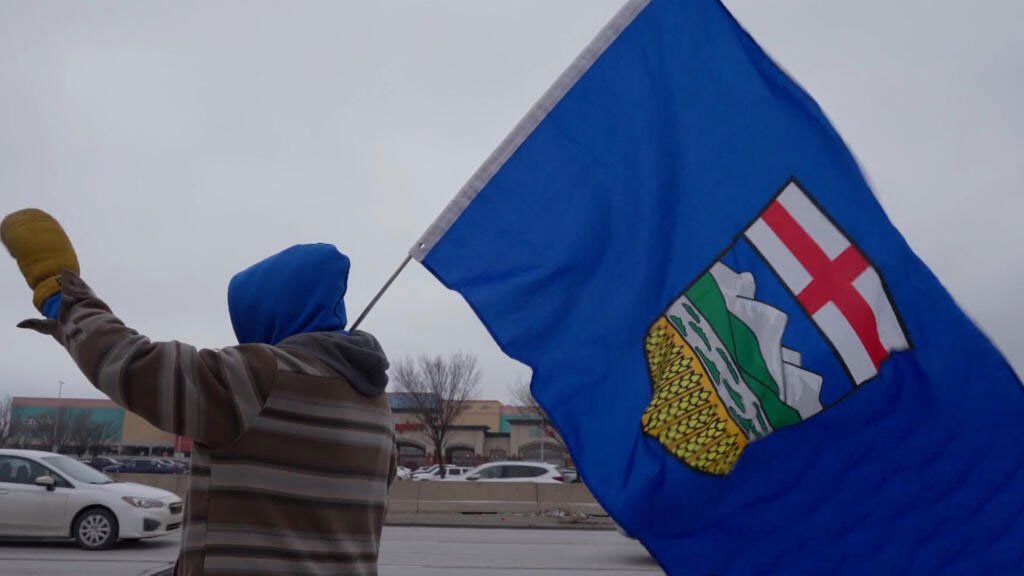

Alberta will hold a referendum in October on whether the province should remain part of Canada, in a move that marks the most serious challenge to Canadian unity in decades.
Get today's headlines by email 
Premier Danielle Smith announced on Thursday that voters will decide whether Alberta should stay within Canada or begin the constitutional process that could eventually lead to a binding vote on independence.
The referendum is scheduled for 19 October and follows months of mounting pressure from separatist groups in the oil-rich western province.
A citizen-led petition supporting separation reportedly collected more than 300,000 signatures earlier this year, while another petition backing Alberta remaining in Canada drew more than 400,000.
Polls, however, continue to indicate that most Albertans oppose leaving the country.
Referendum question announced
In a televised address, Smith said voters would be asked: “Should Alberta remain a province of Canada or should the Government of Alberta commence the legal process required under the Canadian Constitution to hold a binding provincial referendum on whether or not Alberta should separate from Canada?”
Smith said she personally supports Alberta staying within Canada.
“That is how I would vote on separation in a provincial referendum,” she said, adding that her government and caucus also back remaining in the federation.
At the same time, the premier criticised a recent court ruling that halted a petition seeking a separation referendum. An Alberta judge dismissed the petition process after Indigenous First Nations groups argued they had not been properly consulted, which they said violated their rights.
Smith said the decision unfairly blocked the voices of Albertans who supported the initiative.
“As Premier, I will not have a legal mistake by a single judge silence the voices of hundreds of thousands of Albertans,” she said.
She argued that delaying the issue would only intensify divisions and prolong debate over Alberta’s future.
Long-standing grievances with Ottawa
Support for greater autonomy — and in some cases outright independence — has grown in Alberta over concerns that the federal government in Ottawa does not adequately represent the province’s interests.
Many Albertans believe federal environmental and climate policies have harmed the province’s oil and gas sector, a major driver of the local economy.
There is also a long-standing perception that Alberta contributes more to the national economy through its resource wealth than it receives in return from the federal government.
Smith echoed some of those frustrations in her address, accusing Ottawa of moving toward a more centralised political system and interfering in provincial jurisdiction.
“I categorically reject Ottawa’s attempts to do so,” she said.
While separatist movements have historically remained on the political margins in Alberta, calls for greater provincial powers have become more prominent over the past year.
Legal hurdles remain
Even if voters support the proposal in October, Alberta would still face a lengthy and uncertain path toward separation.
Canada established legal rules for any province seeking independence after two referendums in Quebec, including a narrow 1995 vote in which 50.58% backed remaining in Canada.
Earlier this month, Prime Minister Mark Carney said any separation effort would need to comply with the federal Clarity Act, introduced after the Quebec referendums.
Under the law, any future independence vote would require a clear referendum question and a “clear majority” in favour of separation, with oversight from Canada’s House of Commons.
If those conditions were met, Alberta and the federal government would then enter negotiations over the terms of separation.
Carney has recently worked with Smith on energy and infrastructure issues, including plans for a possible new oil pipeline to the Pacific coast.
Federal ministers and opposition politicians also stressed support for national unity following Thursday’s announcement.
Dominic LeBlanc said the federal government believes Alberta’s interests are best served within a united Canada, while Conservative leader Pierre Poilievre said he would continue campaigning to keep the country united.
Join the discussion? 
Already a member? 
 Adapted by ASEAN Now. Source 23 May 2026
-
 1
1
Recommended Comments
Create an account or sign in to comment