



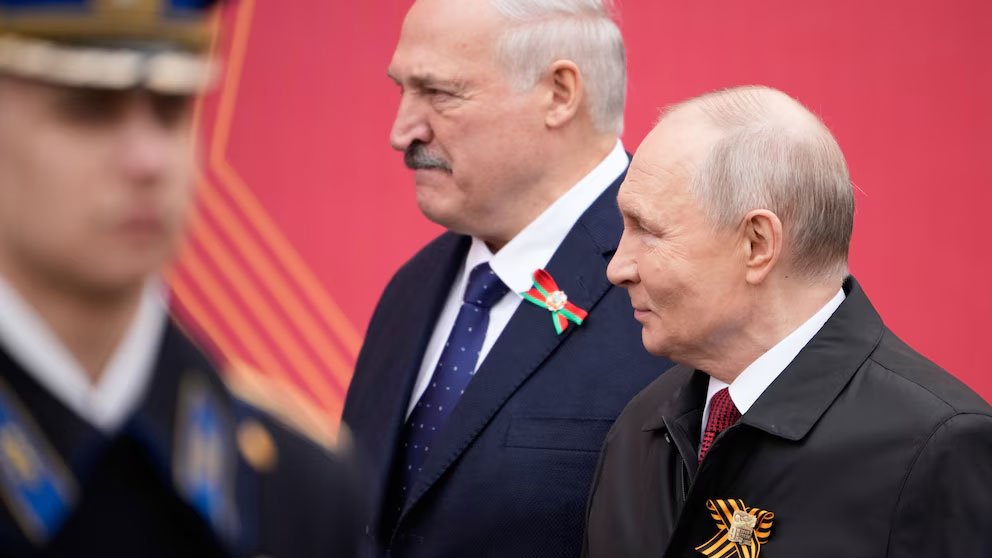

Belarus has begun joint military exercises with Russia focused on practising the use of nuclear weapons that Moscow has stationed in the country, the Belarusian defence ministry said.
Get today's headlines by email 
The drills involve missile units and warplanes and are designed to rehearse the delivery of nuclear weapons and preparations for their possible use, according to a ministry statement released on Monday.
Belarusian officials said the exercises had been planned in advance and insisted they were not directed against any other country.
Nuclear weapons deployed in Belarus
Russia has deployed tactical nuclear weapons in Belarus with the approval of President Alexander Lukashenko, a close ally of Moscow.
The move marked a significant shift in the regional security landscape, bringing Russian nuclear arms closer to NATO territory. Belarus borders Ukraine as well as the NATO members Poland, Latvia and Lithuania.
In December, Moscow announced that its latest intermediate-range nuclear-capable missile system, known as Oreshnik, had entered service in Belarus.
Belarusian authorities said the current exercises will train units to transport nuclear weapons and manoeuvre forces covertly over long distances.
Russia retains control of warheads
Russia has said it will maintain control over the nuclear weapons it has deployed in Belarus. However, President Vladimir Putin indicated that Belarus would be allowed to select targets if the weapons were used in a conflict.
The Kremlin expanded its nuclear posture in 2024 when it issued a revised doctrine placing Belarus under Russia’s nuclear umbrella.
Russia has also used a conventional version of the Oreshnik missile in strikes on Ukrainian facilities twice, first in November 2024 and again in January.
Putin has claimed the missile’s multiple warheads can travel at speeds of up to Mach 10 and are capable of evading interception. He has also said that a conventional strike using several Oreshnik missiles could cause destruction comparable to a nuclear attack.
Intermediate-range missiles such as Oreshnik can travel between 500 and 5,500 kilometres (310 to 3,400 miles). Weapons in this category were previously banned under a Cold War-era treaty between Washington and Moscow that collapsed in 2019.
Opposition criticism
The drills drew criticism from Belarusian opposition leader Sviatlana Tsikhanouskaya, who argued that hosting Russian nuclear weapons has increased risks for the country.
She said the deployment had effectively turned Belarus into a potential target.
“Lukashenko has turned Belarus into a platform for Russian threats, but Belarusians don’t need these weapons,” Tsikhanouskaya told the Associated Press. “Only a free Belarus will become a source of security, not nuclear blackmail, in Europe.”
Lukashenko has ruled Belarus, a country of about 9.5 million people, for more than three decades. His government has faced repeated sanctions from Western countries over its human rights record and for allowing Russia to use Belarusian territory to launch its invasion of Ukraine in February 2022.
Join the discussion? 
Already a member? 
 Adapted by ASEAN Now. Source 19 May 2026
Recommended Comments
Create an account or sign in to comment