



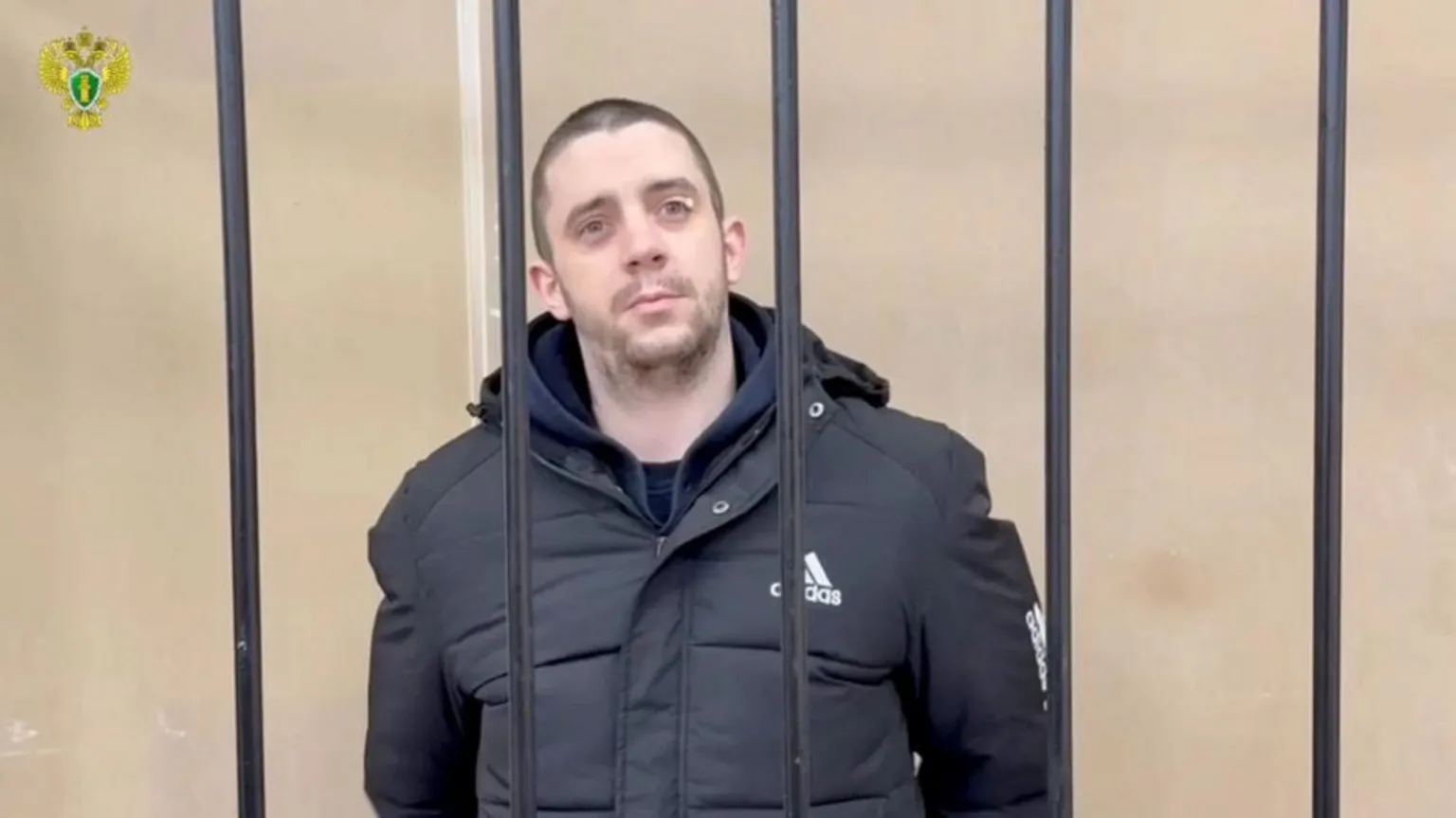

A former British soldier imprisoned in a Russian maximum-security penal colony after being captured in Ukraine has said he feels abandoned by the UK government.
Get today's headlines by email 
Hayden Davies, 33, was taken prisoner by Russian forces more than 18 months ago after volunteering to fight with Ukraine’s foreign legion. He was later convicted by a Russia-controlled court of mercenaryism — taking part in a conflict for financial reward — and sentenced to 15 years in prison.
Davies initially received a 13-year sentence in December from a court in Donetsk, a Ukrainian city currently under Russian control. However, a Moscow judge last week extended the term by two years, ruling the original punishment was too lenient.
The UK government does not recognise the court in Donetsk or Russia’s control of the region.
A spokesperson for the UK Foreign, Commonwealth and Development Office (FCDO) said officials remain in contact with Davies’ relatives and are providing consular support. The department also condemned the conviction, describing the charges as false and rejecting the legitimacy of the Russian-controlled court.
Capture and severe injuries
In letters sent to the BBC from detention, Davies described the circumstances surrounding his capture.
He said he was badly wounded during fighting on the front line and unable to escape after his radio failed and his partner was killed. “My radio broke, my partner was killed and I couldn’t escape,” he wrote.
Davies said he crawled around 150 metres to reach a ruined house where he took shelter in a basement. The journey took an entire day because of the severity of his injuries.
He described suffering intense pain from a shattered leg, with bone protruding through the skin. Using limited supplies, he attempted to treat the wound himself, pushing the bone back into place and fashioning a splint and crutches from pieces of wood.
Davies said he survived in the basement for two months, living on tinned food, before Russian troops eventually discovered him.
Life in captivity
After being detained, Davies said he spent an entire year held alone before being transferred to a shared cell.
In his correspondence, he said the isolation and lack of contact with the outside world had been difficult. He also said he had not had direct contact with British officials during his imprisonment.
“I served my country for 12 years in the army, and now, when I need help and medical treatment, no one wants to know,” he wrote.
British authorities are frequently denied access to detainees held in Russia, and diplomats are unable to travel to areas of Ukraine controlled by Russian forces.
Letters exchanged with prisoners are routinely read and sometimes censored by Russian authorities before being delivered.
Concerns over treatment
Human rights organisations have repeatedly accused Russia of denying prisoners of war and detainees proper medical care, claims Moscow rejects.
The International Committee of the Red Cross has said it does not have full access to prisoners held in Russia or in Russian-controlled territories, despite this being required under the Geneva Conventions.
A source close to Davies said he continues to suffer from a serious leg injury and is receiving little assistance.
Anastasia Shevchenko, a political activist who works with prisoners held by Russia, said Davies faced hostility in prison because he is British and considered a mercenary.
She also said she informed British embassies about his detention last year after Ukrainian prisoners helped establish contact between them.
According to Shevchenko, detainees often lack sufficient food and basic supplies. She said she had sent Davies money so he could buy additional provisions inside the prison.
The FCDO did not respond to specific questions regarding her claims.
Prisoner swaps and limited government role
Shaun Pinner, another British national captured in eastern Ukraine in 2022, was sentenced to death by a Russian-controlled court before being released months later in a prisoner exchange mediated by Saudi Arabia.
Pinner said the UK government had maintained contact with his family during his captivity but did not directly negotiate his release.
He said securing prisoner swaps is often complicated and usually depends on negotiations involving Ukraine.
In travel guidance for Ukraine, the FCDO warns British nationals that joining the conflict could breach UK law and that government assistance in such situations may be limited.
The department also stated that under international law, prisoners of war cannot be prosecuted simply for taking part in hostilities and called on Russia to comply with its obligations under the Geneva Conventions.
Join the discussion? 
Already a member? 
 Adapted by ASEAN Now. Source 20 May 2026
-
 1
1
Recommended Comments
Create an account or sign in to comment