



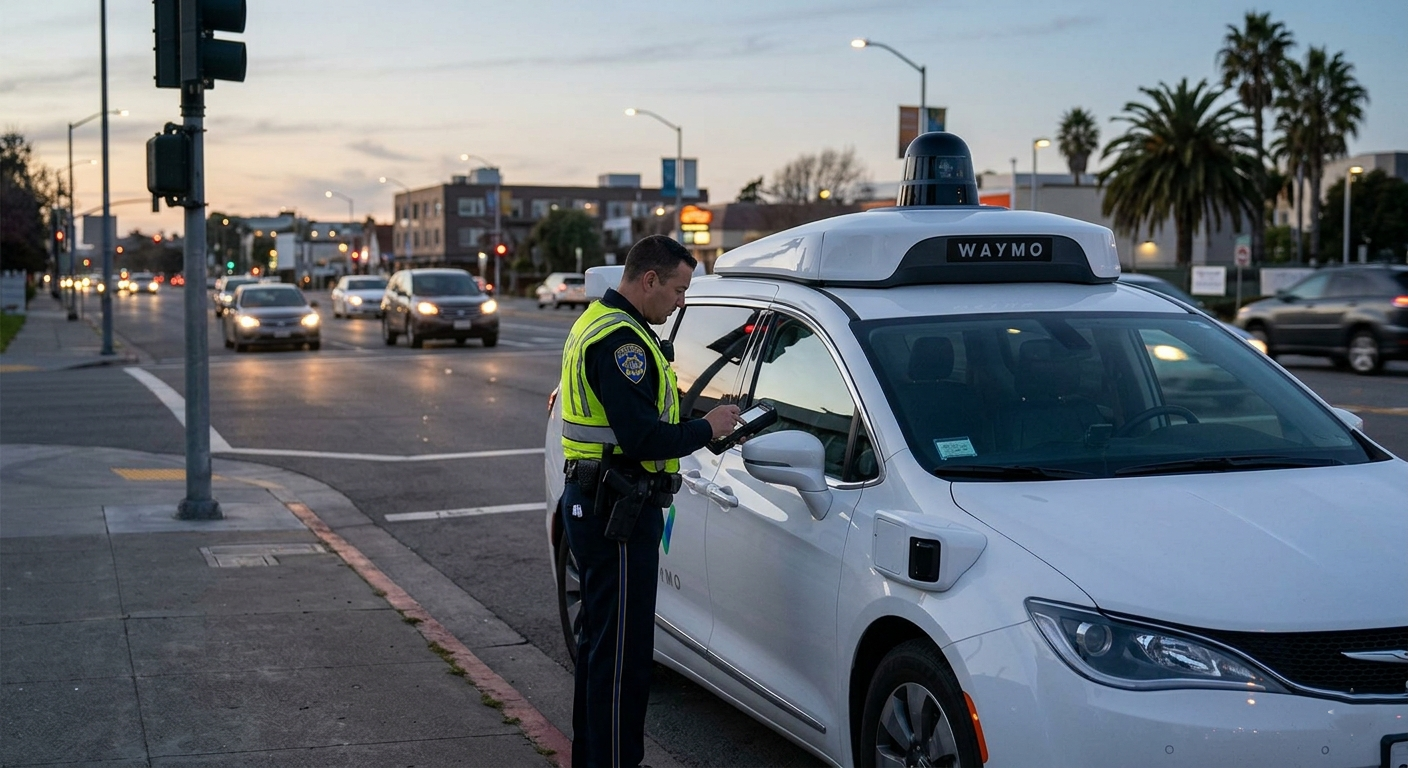

California will soon begin issuing traffic citations to companies operating driverless vehicles when their cars break road rules, closing a gap that has frustrated police as autonomous technology spreads across the state.
Get today's headlines by email 
New regulations announced by the California Department of Motor Vehicles (DMV) will allow officers to send a “notice of AV noncompliance” directly to the manufacturer responsible for a vehicle that commits a traffic offence.
The rules take effect on 1 July and form part of broader legislation adopted in 2024 aimed at tightening oversight of autonomous vehicle technology.
Officials say the measures will create a clearer system of accountability as self-driving cars become more common on city streets.
New system for traffic violations
Under the updated framework, police officers will be able to cite companies whose autonomous vehicles commit moving violations, even if no human driver is present.
Previously, enforcement posed difficulties because traditional traffic tickets are issued to drivers. When a driverless vehicle broke the rules, officers often had no straightforward way to penalise the company operating it.
The new process allows authorities to document the violation and notify the manufacturer directly.
The regulations also require companies operating autonomous vehicles to respond to requests from police or emergency services within 30 seconds. Vehicles entering active emergency zones may face penalties under the updated rules.
Steve Gordon, director of the DMV, said the changes are intended to ensure public safety while the technology continues to expand.
“California continues to lead the nation in the development and adoption of AV technology, and these updated regulations further demonstrate the state’s commitment to public safety,” he said in a statement.
State officials described the new framework as the most comprehensive set of autonomous vehicle regulations in the United States.
Incidents highlight enforcement challenges
Authorities have cited several incidents that illustrate the difficulty of regulating driverless vehicles under existing traffic laws.
In September last year, police in San Bruno, a city south of San Francisco, observed an autonomous vehicle operated by Waymo making an illegal U-turn at a traffic light.
Officers stopped the vehicle but were unable to issue a citation because there was no driver present. Instead, police contacted the company to report what they described as a technical “glitch”.
Similar situations have been reported elsewhere, prompting calls for clearer enforcement rules as robotaxis and test vehicles appear more frequently in urban areas.
Growing presence of robotaxis
Autonomous vehicles are already operating commercially in parts of California.
Waymo runs a fleet of fully driverless robotaxis in the San Francisco Bay Area and Los Angeles County. Other companies, including Tesla, hold permits allowing them to test autonomous vehicles on public roads in several California cities.
The rapid expansion has also brought operational challenges.
During a major blackout in San Francisco in December, multiple Waymo vehicles stopped in the middle of busy intersections, worsening congestion in parts of the city.
Emergency responders have also raised concerns. The San Francisco Fire Department has repeatedly warned that robotaxis have sometimes obstructed emergency vehicles or blocked access to incidents.
The new regulations are intended to address such situations by ensuring companies remain responsible for the behaviour of their autonomous vehicles on public roads.
Join the discussion? 
Already a member? 
 Adapted by ASEAN Now. Source 3 May 2026
Recommended Comments
Create an account or sign in to comment