



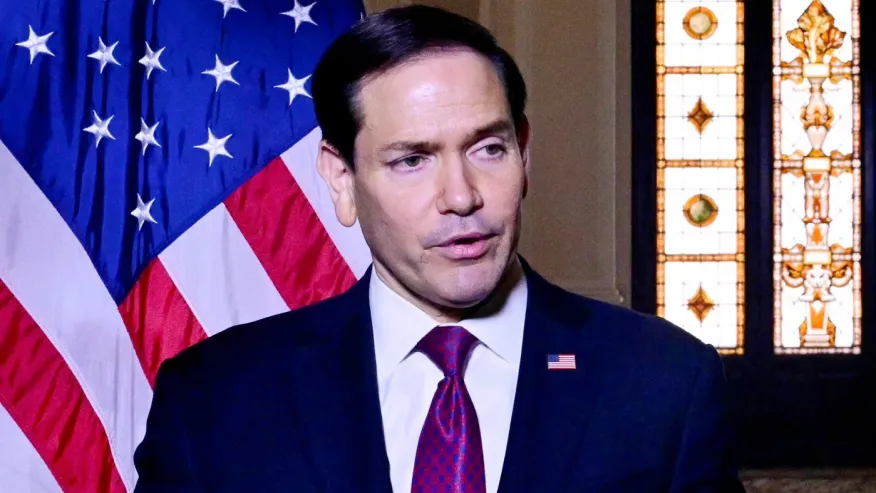

China adjusted the Chinese transliteration of US Secretary of State Marco Rubio’s name to enable his entry for high-level talks between President Donald Trump and Chinese President Xi Jinping, according to media reports.
Get today's headlines by email 
Rubio had previously been barred from entering China after the government sanctioned him in 2020 while he was serving as a US senator. The measures were imposed in response to his criticism of Beijing’s policies toward the Uyghur minority in the Xinjiang region and other alleged human rights violations.
The sanctions included a travel ban that could have complicated plans for Rubio to accompany Trump to Beijing for this week’s summit with Xi.
However, a spokesperson for the Chinese embassy said the restrictions would not prevent Rubio from travelling as part of the US delegation.
“The sanctions target Mr Rubio’s words and deeds when he served as a US senator concerning China,” embassy spokesperson Liu Pengyu told Agence France-Presse (AFP) on Tuesday.
Linguistic workaround
According to AFP, Chinese authorities began using a slightly different character to represent the first syllable of Rubio’s surname after he became secretary of state last year.
The change altered the way his name appears in Chinese without significantly affecting how it is pronounced.
Two diplomats told AFP they believed the adjustment functioned as a bureaucratic workaround. Because the sanctions were imposed using the earlier version of Rubio’s name, the altered spelling effectively sidestepped the restriction.
Chinese state media and official government communications have since used the revised transliteration when referring to Rubio.
When asked about the change last year, Chinese foreign ministry spokesperson Mao Ning said she had not noticed the shift but would look into the matter, according to The Guardian.
Background to the sanctions
Beijing sanctioned Rubio in 2020 after he criticised the Chinese government’s policies in Xinjiang and supported measures in Washington addressing alleged human rights abuses against the Uyghur population.
At the time, China announced counter-sanctions against several US lawmakers and officials who had backed legislation or public statements condemning its actions in the region.
Despite the earlier restrictions, Rubio joined Trump’s delegation to China for a two-day visit centred on strategic issues between the two powers.
Taiwan and regional tensions
Rubio has been a long-time critic of China’s government and has frequently warned about the strategic rivalry between Washington and Beijing.
During his confirmation hearing as secretary of state in January last year, he described China as the “most potent and dangerous” near-peer adversary the United States has ever faced.
He has also consistently advocated for strong US ties with Taiwan, the self-governing island claimed by China.
Speaking to reporters ahead of the summit, Rubio said Taiwan was likely to feature in discussions between the two leaders.
“I’m sure Taiwan will be a topic of conversation; it always is,” he said last week.
Rubio added that both countries understood the importance of avoiding instability in the region.
“I think both countries understand that it is in neither one of our interests to see anything destabilizing happen in that part of the world,” he said, referring to Taiwan and the broader Indo-Pacific.
The US State Department did not immediately respond to requests for comment.
Join the discussion? 
Already a member? 
 Adapted by ASEAN Now. Source 14 May 2026
Recommended Comments
Create an account or sign in to comment