




China has introduced a series of new incentives aimed at Taiwan, shortly after a senior figure from the island’s main opposition party completed a visit to the mainland.
Get today's headlines by email 
The measures, announced on Sunday through the state news agency Xinhua, include steps to ease restrictions on tourism, facilitate food and fishery trade, and allow certain Taiwanese television programs to be broadcast in China.
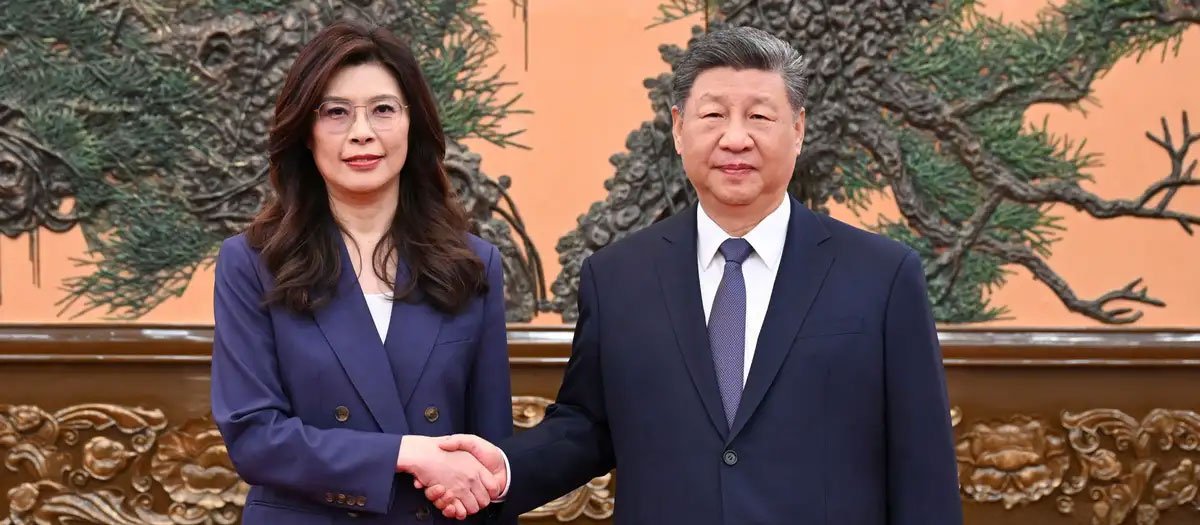
The announcement followed a trip by Cheng Li-wun, chairwoman of Taiwan’s opposition Kuomintang (KMT), who met Chinese President Xi Jinping and discussed prospects for improving cross-strait relations.
New Measures Target Tourism, Media and Trade
According to Xinhua, the package contains 10 measures designed to encourage exchanges between the two sides of the Taiwan Strait.
Among them is a proposal to establish a regular communication mechanism between China’s Communist Party and the KMT. The plan also includes the full restoration of direct flights across the strait and the possibility of permitting residents from Shanghai and Fujian province to travel to Taiwan.
The measures also address trade and cultural exchanges. Beijing said it would create a mechanism aimed at simplifying inspection procedures for Taiwanese food and fishery products entering the mainland market.
However, the state media report indicated that such arrangements would depend on a political commitment to oppose Taiwan’s independence.
China also said it would permit Taiwanese television dramas, documentaries and animation to be broadcast domestically, provided they demonstrate what officials described as “correct orientation,” contain “healthy content,” and meet high production standards.
Taiwan Government Rejects Beijing’s Proposal
Taiwan’s government criticised the initiative, arguing that the measures were politically motivated.
In a statement, Taiwan’s Mainland Affairs Council said Beijing’s offer amounted to “unilateral concessions” that it described as “poisoned pills packaged as generous gift packages.”
The council said Taipei supports cross-strait exchanges when they are conducted in a healthy and orderly manner, but added that such interactions should not be tied to political conditions or objectives.
Relations between the two sides remain tense. China claims sovereignty over Taiwan and has repeatedly warned against moves toward formal independence.
Taiwan President Lai Ching-te, who took office earlier this year, rejects Beijing’s claims and has maintained that the island is already a sovereign entity.
Opposition Party Welcomes Announcement
The KMT responded more positively to the measures, describing them as beneficial for Taiwanese citizens.
In a statement, the party said the initiatives represented a “gift” to the people of Taiwan and could help improve economic and cultural exchanges.
The announcement also comes amid continuing disagreements over tourism and trade. Large-scale Chinese tourism to Taiwan has not resumed since the COVID-19 pandemic, with both sides blaming each other for the delay.
Taiwan has also previously accused China of imposing restrictions on imports of certain agricultural and aquatic products from the island, saying the bans were sometimes justified by claims about pests or diseases that Taipei disputes.
Continuing Cross-Strait Tensions
The diplomatic divide between Beijing and Taiwan’s current administration has limited direct dialogue between the two governments.
China has refused to engage with President Lai, whom it has labelled a separatist. Taipei, however, says Beijing’s pressure campaigns and political conditions undermine the prospects for constructive engagement.
The newly announced measures highlight Beijing’s continued effort to pursue exchanges with groups in Taiwan willing to maintain closer ties, particularly the KMT, even as official relations with the island’s government remain strained.
Join the discussion? 
Already a member? 
 Adapted by ASEAN Now. Source 13 April 2026
Recommended Comments
Create an account or sign in to comment