



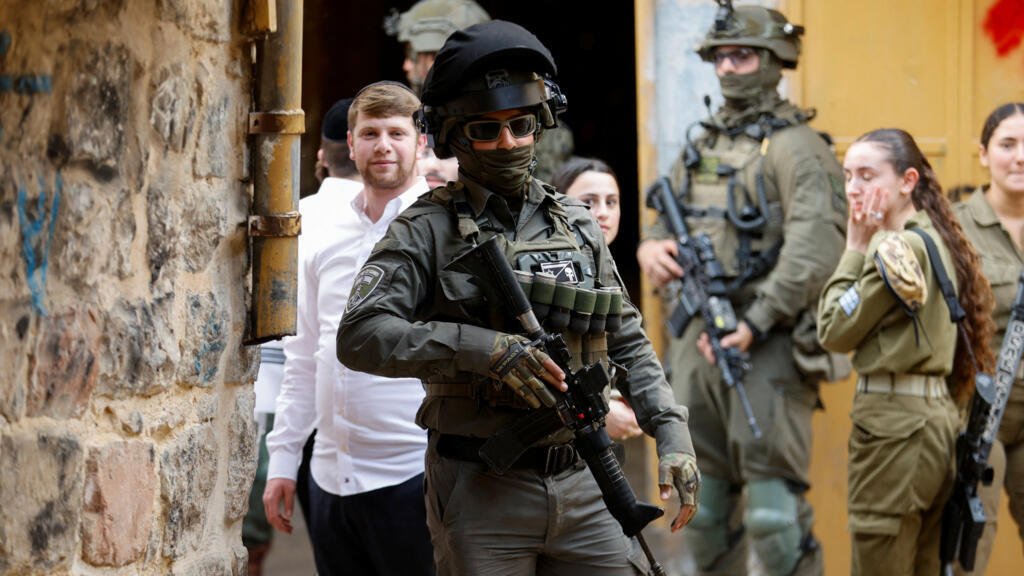

European Union foreign ministers have agreed to impose new sanctions on Israeli settlers and organisations accused of involvement in violence against Palestinians in the occupied West Bank.
Get today's headlines by email 
The decision was approved by the bloc’s 27 foreign ministers on Monday after months of delay, as concerns grow over a rise in settler attacks since the outbreak of the Gaza war in October 2023.
Officials said the measures target individuals and groups linked to extremist settler activity, though technical and legal procedures must still be completed before the sanctions formally take effect.
EU Moves After Months of Delay
The sanctions plan had previously been stalled due to opposition from Hungary’s former prime minister Viktor Orban, a close ally of Israel. A recent change in Hungary’s government removed that obstacle, allowing EU ministers to move forward with the proposal.
EU foreign policy chief Kaja Kallas said the move signalled a shift from political stalemate to concrete action.
“It is high time we move from deadlock to delivery,” she said, adding that extremism and violence must carry consequences.
French Foreign Minister Jean-Noel Barrot also confirmed the measures, saying the EU had decided to sanction several Israeli organisations accused of supporting what he described as extremist and violent settlement expansion in the West Bank.
Alongside the measures targeting settlers, EU ministers also agreed to add additional representatives from Hamas to the bloc’s sanctions list.
Israel Condemns the Decision
Israel strongly criticised the EU’s move. Foreign Minister Gideon Sa’ar said the sanctions were politically motivated and unjustified.
He said Israel would continue to defend what he called the right of Jewish people to live in the “heart of our homeland”.
Sa’ar also rejected comparisons between Israeli citizens and Hamas members, describing the EU’s approach as a “distorted moral equivalence”.
The Israeli government has long supported the expansion of settlements, which many in Israel see as a security and historical claim to the land. Critics, however, argue the policy undermines prospects for a Palestinian state.
Settlements and Rising Violence
Israeli settlements are built on land captured during the 1967 Middle East war, including the West Bank and East Jerusalem. Under international law they are widely considered illegal, a view Israel disputes.
Around 160 settlements have been established since 1967 and are now home to roughly 700,000 Israelis.
Settlement expansion has accelerated since Prime Minister Benjamin Netanyahu returned to office in late 2022 leading a right-wing coalition that includes pro-settler parties.
Violence in the West Bank has also increased since the Gaza war began, which followed the Hamas attack on Israel on 7 October 2023.
According to United Nations figures, more than 1,800 settler attacks causing casualties or property damage were recorded across about 280 Palestinian communities in 2025 alone.
Recent incidents cited by UN officials include a Palestinian man shot dead during a settler attack in the village of Tayasir and a series of assaults on villages where homes, vehicles and farmland were set on fire.
The UN human rights office has also condemned reports that settlers forced Palestinians to exhume a grave, describing the allegation as “appalling”.
Individuals and Groups Targeted
EU officials said seven settlers or settler organisations would be subject to the sanctions.
Israeli media reports indicate those listed include Daniella Weiss, a prominent figure in the settler movement who has already been sanctioned by the UK.
Organisations reportedly facing sanctions include Nachala and Regavim, both known for promoting settlement expansion. HaShomer Yosh and Amana, groups that provide financial and logistical support to unauthorised settlement outposts, are also said to be included.
Reports also name Regavim chief executive Meir Deutsch and HaShomer Yosh head Avichai Suissa among those targeted.
Suissa had previously been sanctioned by the United States in 2024 but was later removed from the sanctions list during Donald Trump’s presidency.
Separately, some EU countries are pushing for a ban on goods produced in Israeli settlements, though member states have not yet reached agreement on that proposal.
Join the discussion? 
Already a member? 
 Adapted by ASEAN Now. Source 12 May 2026
Recommended Comments
Create an account or sign in to comment