



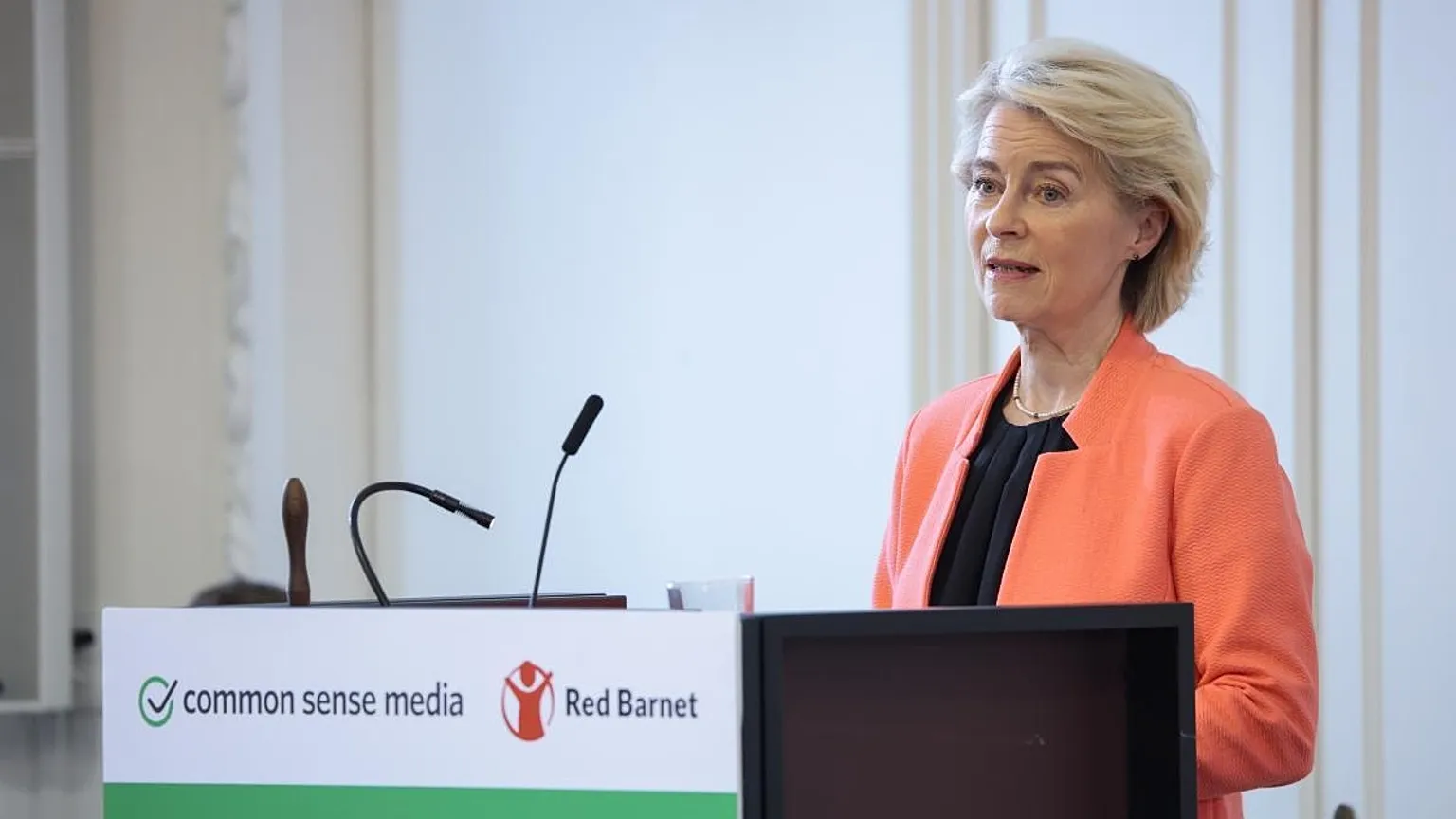

The European Commission may propose a bloc-wide ban on social media access for minors as early as this summer, Commission President Ursula von der Leyen said on Tuesday, as pressure grows across Europe to strengthen online protections for children.
Get today's headlines by email 
Speaking at the European Summit on Artificial Intelligence and Children in Copenhagen, von der Leyen said governments can no longer ignore calls to address the effects of social media on young users. Several European Union countries have urged stronger measures, arguing that platforms are designed in ways that encourage excessive use among children.
Support for stricter rules has gathered momentum in recent months, with France, Spain, Greece and Denmark leading efforts to tighten restrictions on children’s access to online platforms.
Growing concern over children’s online exposure
Von der Leyen told delegates that technology is advancing rapidly and increasingly shaping young people’s lives.
“We are witnessing the lightning speed at which technology is advancing – and how it penetrates every corner of childhood and adolescence,” she said.
Several EU governments are already developing national legislation aimed at limiting children’s use of social media. However, the Commission faces pressure to ensure that any new rules apply consistently across the bloc to avoid fragmentation within the EU’s single market.
To explore possible options, the Commission has set up an independent panel of experts to study online child safety. The group is examining issues such as digital addiction and social anxiety among minors and will advise on potential regulatory responses.
Von der Leyen said the Commission would wait for the panel’s conclusions but suggested the possibility of delaying access to social media until a certain age.
“Without pre-empting the panel’s findings, I believe we must consider a social media delay,” she said. “Depending on the results, we could come forward with a legal proposal this summer.”
National plans add urgency
The proposed timeline could allow Brussels to act before new legislation expected in France takes effect later this year.
French rules scheduled to begin in September would require platforms such as Instagram and TikTok to block users under 15 years old and deactivate existing accounts belonging to those below that age.
A major challenge for policymakers is how to verify users’ ages in a reliable and secure way. The Commission has proposed an EU-wide age-verification application that would allow platforms to confirm whether users meet the minimum age requirement before granting access.
Von der Leyen said the system could be modelled on the bloc’s digital health certificate used during the pandemic.
Debate over technical and privacy risks
While the Commission has recommended the proposed verification app to member states, several governments have responded cautiously. Some cybersecurity specialists have warned that the technology could present vulnerabilities or raise privacy concerns.
The European Union is not alone in examining stricter limits on children’s access to social media. Countries including Australia and Indonesia have already introduced measures aimed at restricting use by younger audiences.
Meanwhile, EU regulators are also scrutinising major platforms under the bloc’s Digital Services Act over concerns they may have failed to adequately protect minors online. Officials are also considering further restrictions on certain platform features believed to encourage compulsive use as part of the proposed Digital Fairness Act.
Von der Leyen acknowledged that any regulatory changes would take time but said governments must act quickly to prevent long-term harm.
“We all know that sustainable change does not happen overnight,” she said. “But if we are slow and hesitant, it will be another entire generation of children that pays the price.”
Join the discussion? 
Already a member? 
 Adapted by ASEAN Now. Source 13 May 2026
Recommended Comments
Create an account or sign in to comment