



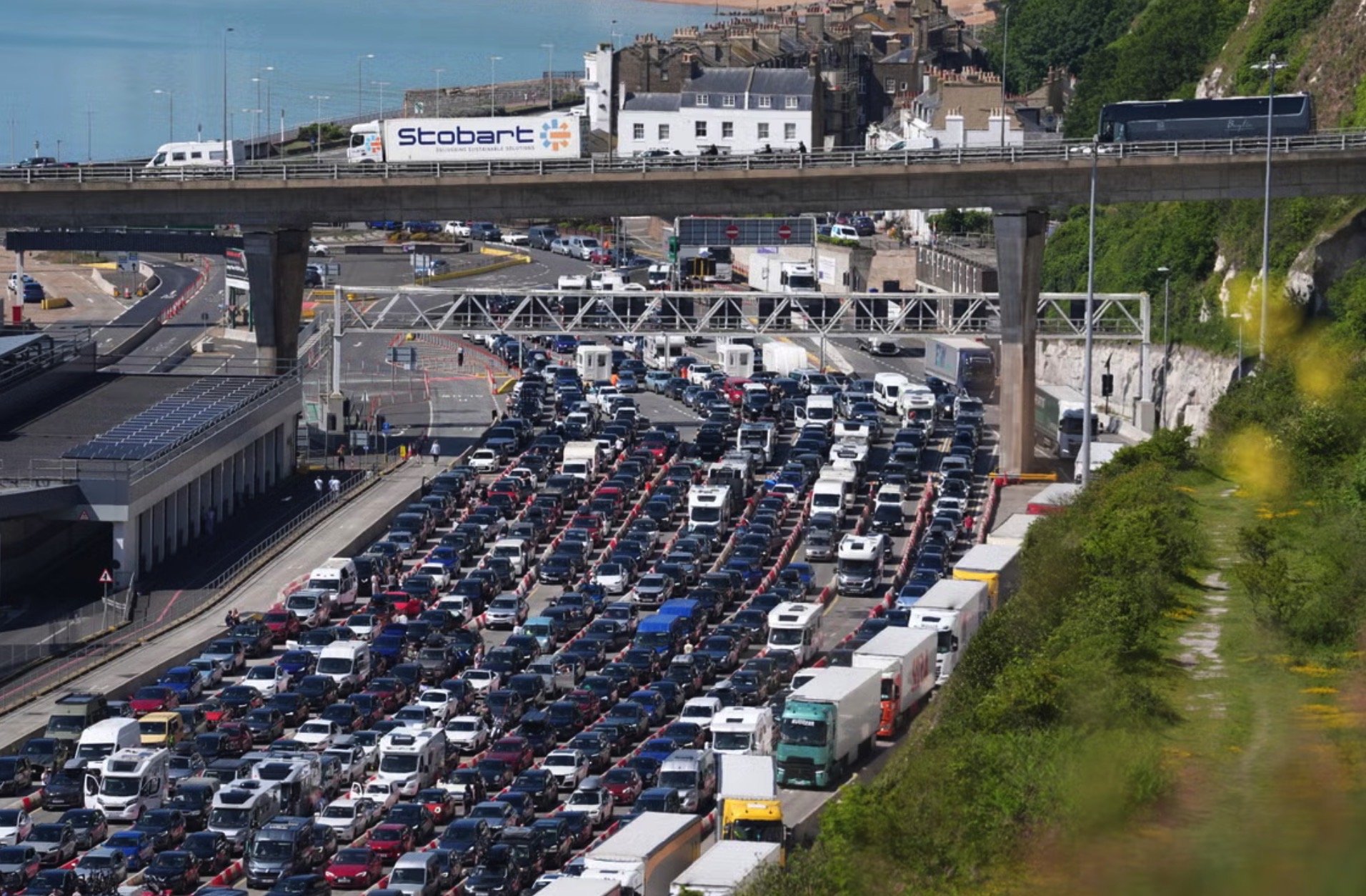

French authorities temporarily suspended additional European Union border checks at Dover on Saturday after thousands of travellers faced lengthy delays at the port during the busy May bank holiday weekend.
Get today's headlines by email 
Queues built up early in the day as holidaymakers heading for cross-Channel ferries encountered slow processing in soaring temperatures. The Port of Dover said it had raised the “challenging situation” with border authorities, leading to the temporary suspension of the extra checks to ease congestion at the terminal and on nearby roads.
Travellers reported waiting up to two hours to reach the port, followed by an additional two-and-a-half hours for processing once inside the terminal.
By lunchtime, the port said traffic conditions had improved, with queues moving slowly and processing times reduced to under an hour. Shortly after 14:00 local time, officials said traffic had become “free-flowing”.
EU Border System Tested
The busy holiday weekend is seen as an early test of the European Union’s upcoming Entry/Exit System (EES), a new digital border control programme for non-EU travellers.
Passengers travelling through Dover must complete French border checks before boarding ferries to France. The EES system will eventually introduce biometric checks, including fingerprint scans and facial recognition, across 29 countries in the Schengen Area.
Although the biometric machines have not yet been activated at Dover, French border officials were still collecting traveller information manually for entry into the system’s database. The additional processing contributed to the long delays seen on Saturday.
French authorities later reinstated the extra checks shortly before 17:00, after traffic conditions improved. Standard border procedures remained in place throughout the disruption.
Port Frustration Over Delays
Port of Dover chief executive Doug Bannister said more than 8,000 cars were expected to pass through the port on Saturday.
He said 84 kiosks had already been installed to support the future digital border system and to manage high passenger volumes safely.
However, Bannister said processing had been much slower than expected despite prior assurances from British and French authorities.
“I think we’re all quite frustrated,” he told the BBC.
Passengers who missed scheduled ferry departures because of the delays would be transferred to the next available sailing, the port added.
Travel Disruption Across UK
Elsewhere, transport disruption affected rail and road networks across Britain during the bank holiday getaway.
LeShuttle, which operates services through the Channel Tunnel between Folkestone and Calais, reported delays of around 90 minutes because of longer border processing times.
Major engineering works disrupted several rail routes, including lines between London St Pancras International and London Blackfriars, York and Darlington, and Bristol Parkway and Newport. Some services were cancelled or significantly altered.
Industrial action also affected West Midlands Railway services on Saturday.
Traffic monitoring agencies reported widespread congestion on roads across the UK. National Highways issued 22 severe congestion alerts on motorways and major A-roads by mid-afternoon, while heavy traffic was also reported in parts of Scotland and Wales.
Heatwave Conditions Expected
The travel disruption coincided with unusually hot weather across the UK during the bank holiday weekend.
Saturday became the warmest day of the year so far, with temperatures reaching 30.5C in Frittenden, Kent.
The previous day saw highs of 28.4C recorded at Heathrow, Cranwell in Lincolnshire and Cambridge.
Forecasters said temperatures were expected to rise further over the weekend, with some areas likely to meet official heatwave criteria. Amber heat-health alerts remain in place in parts of England as temperatures are forecast to stay above 30C.
Join the discussion? 
Already a member? 
 Adapted by ASEAN Now. Source 24 May 2026
Recommended Comments
Create an account or sign in to comment