



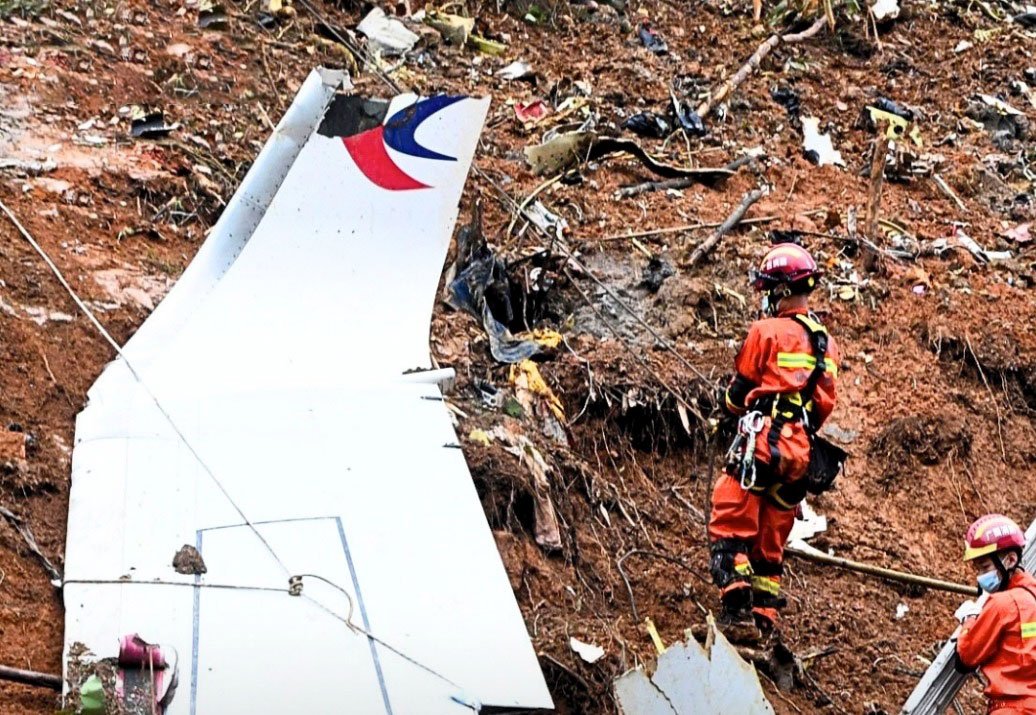

A 2022 passenger jet crash in China that killed all 132 people on board was caused after fuel to both engines was cut during the flight, according to newly released findings from the US National Transportation Safety Board (NTSB).
Get today's headlines by email 
The data indicates that fuel switches controlling the aircraft’s engines were moved to the “cut-off” position while the plane was cruising at about 8,839m (29,000ft), stopping fuel flow to both engines.
The aircraft involved in the crash was a Boeing 737 operated by China Eastern Airlines on flight MU5735. The jet went down in March 2022, marking China’s deadliest air disaster in decades.
China has not yet issued a final investigation report into the crash.
Findings from black box data
The NTSB findings were released through a request under the US Freedom of Information Act and are based on information retrieved from one of the aircraft’s flight recorders, commonly known as a “black box”.
According to the data, engine speeds on both engines decreased shortly after the fuel switches were moved. Fuel switches control the flow of fuel into aircraft engines and are typically used by pilots to start or shut down engines.
The flight recorder was recovered from the wreckage and sent to the NTSB laboratory in Washington for analysis.
The plane had departed from Kunming, the capital of China’s Yunnan province, and was scheduled to land in Guangzhou later that afternoon.
After more than an hour in the air, the aircraft suddenly entered a steep descent while nearing its destination.
Rapid descent before crash
Flight tracking data showed the aircraft falling thousands of metres in a short period of time. Data from FlightRadar24 indicates the plane was cruising at about 29,100ft before rapidly losing altitude.
Within roughly two minutes and 15 seconds, it had dropped to about 9,075ft. The last recorded data point showed the aircraft at 3,225ft shortly before contact was lost at around 14:22 local time.
Air traffic controllers attempted to contact the aircraft several times during its descent but received no response.
Investigation and unanswered questions
Because the crash occurred in China and involved a Chinese airline, the investigation has been led by the Civil Aviation Administration of China.
However, the United States also took part in the inquiry because the aircraft was designed and manufactured there. The NTSB assigned a senior investigator to assist with the probe.
Authorities initially considered several possible causes, including deliberate action, pilot error, structural failure or a mid-air collision.
Shortly after the crash, officials from the Civil Aviation Administration of China said investigators had not reached a clear conclusion.
They also said the crew held valid licences, were adequately rested and had passed health checks on the day of the flight.
Speculation over cause
Media speculation at the time suggested the crash could have been intentional, potentially involving someone in the cockpit. Chinese aviation authorities rejected those claims.
In April 2022, a Civil Aviation Administration official said such rumours had misled the public and interfered with the investigation.
China has since faced criticism for not publishing a final report into the disaster. Officials have said that releasing certain information could affect national security and social stability.
Despite the scale of the tragedy, aviation accidents are relatively rare in China, where safety standards have improved significantly over recent decades.
Join the discussion? 
Already a member? 
 Adapted by ASEAN Now. Source 6 May 2026
Recommended Comments
Create an account or sign in to comment