



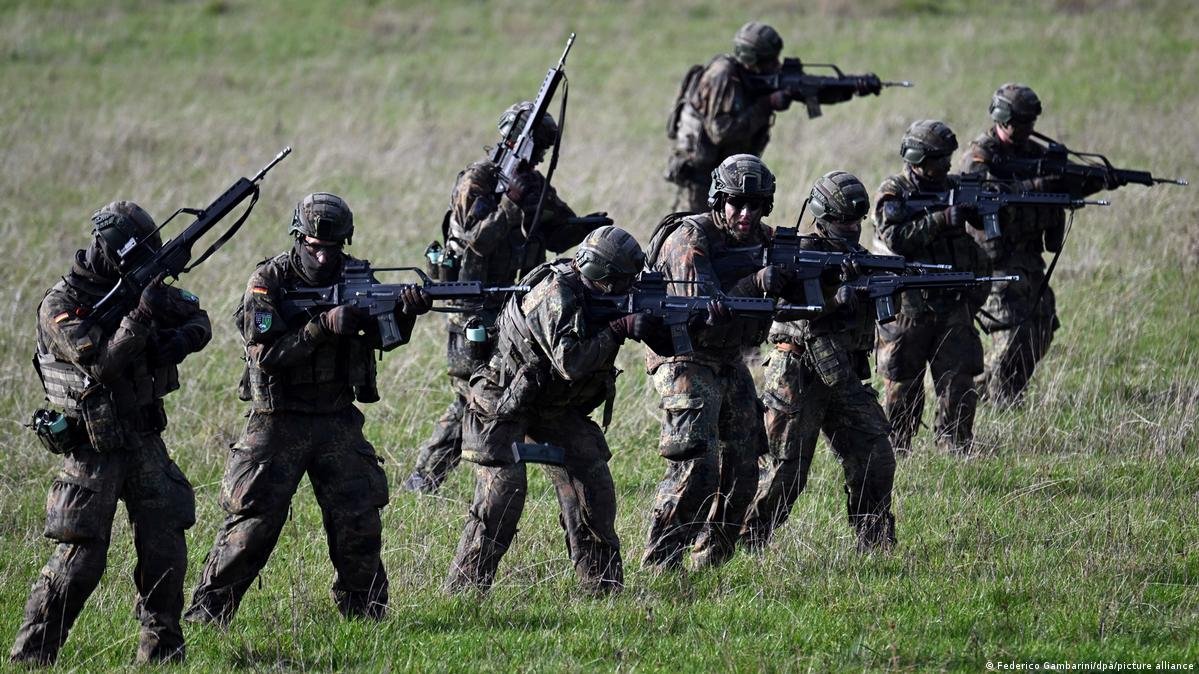

German men aged between 17 and 45 may need official approval before spending long periods outside the country under a provision linked to a new military service law introduced earlier this year.
Get today's headlines by email 
The measure forms part of the Military Service Modernisation Act, which took effect on 1 January and is intended to strengthen Germany’s defence capabilities following growing security concerns in Europe after Russia’s full-scale invasion of Ukraine.
A spokesperson for the defence ministry confirmed that men aged 17 and above must seek permission if they plan to remain abroad for more than three months.
Authorities say the requirement is designed to maintain an effective registration system for potential military personnel.
Registration system linked to defence planning
According to the defence ministry, the rule is aimed at ensuring that authorities know where eligible individuals are located in the event of a national emergency.
“In the event of an emergency, we must know who may be staying abroad for an extended period,” the spokesperson said.
Despite the formal requirement, officials indicated that approvals are generally expected to be granted. It remains unclear how the rule would be enforced if someone failed to request permission before travelling.
The provision attracted little attention until it was reported by the Frankfurter Rundschau newspaper on Friday.
Officials also acknowledged that the requirement could have significant implications for young people. The defence ministry said further regulations covering exemptions are still being developed to prevent unnecessary administrative burdens.
Roots in earlier conscription law
The legal foundation for the travel requirement lies in Germany’s Conscription Act of 1956, which has been amended several times, most recently in December.
Before the latest changes, the obligation to report extended stays abroad applied only during periods when Germany was formally in a state of national defence or mobilisation.
A defence ministry official noted that similar provisions existed during the Cold War but said they had little practical impact at the time.
Expanding the armed forces
The new legislation also outlines plans to increase the size of Germany’s active military. The government aims to expand the Bundeswehr from around 180,000 personnel to roughly 260,000 by 2035.
As part of the changes, parliament approved a system of voluntary military service in December.
Since January, all 18-year-olds in Germany receive a questionnaire asking whether they are interested in joining the armed forces.
From July 2027, they will also undergo a fitness assessment to determine whether they would be eligible for service if war were to break out.
Women may volunteer for military service, but under Germany’s constitution they cannot be required to serve.
Debate over possible return of conscription
Although the current model is based on voluntary participation, officials have said compulsory service could be reconsidered if the security environment deteriorates or if too few people volunteer.
The proposal has prompted protests from some young people since it was approved by parliament.
One organiser wrote on social media that they opposed spending “half a year of our lives locked up in barracks” training for combat.
Germany significantly reduced the size of its armed forces following the end of the Cold War, when the military had nearly half a million personnel.
Mandatory military service was suspended in 2011 under then-chancellor Angela Merkel.
Chancellor Friedrich Merz has since pledged to rebuild the Bundeswehr and aims to turn it into Europe’s strongest conventional army as the government responds to what it describes as a more dangerous security environment on the continent.
Join the discussion? 
Already a member? 
 Adapted by ASEAN Now. Source 5 April 2026
Recommended Comments
Create an account or sign in to comment