



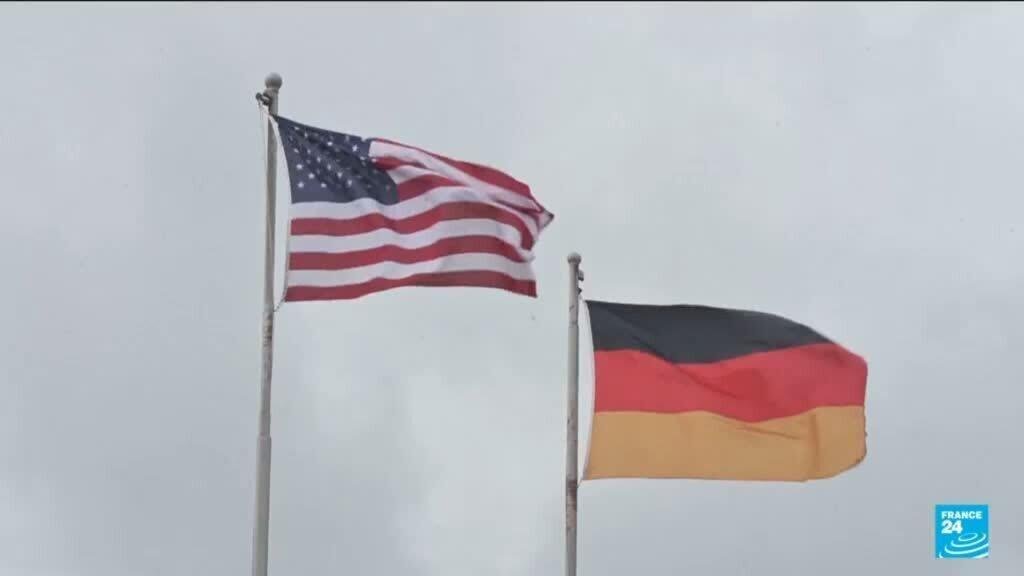

Germany’s defence minister has said the United States decision to withdraw around 5,000 troops from the country was anticipated, as the NATO alliance seeks further details from Washington about the move.
Get today's headlines by email 
Speaking to the German news agency DPA, Boris Pistorius said the continued presence of American forces in Europe — particularly in Germany — remained beneficial to both sides.
“The presence of American soldiers in Europe, and particularly in Germany, is in our interest and in the interest of the US,” he said.
A spokesperson for NATO, Allison Hart, said the alliance was working with Washington to better understand the scope and implications of the decision.
US Move Follows Political Tensions
The troop reduction comes after Donald Trump criticised German Chancellor Friedrich Merz for comments suggesting the United States had been “humiliated” by Iranian negotiators during talks related to the ongoing conflict in the Middle East.
Germany currently hosts the largest contingent of US troops in Europe. More than 36,000 American personnel are stationed in the country, compared with about 12,000 in Italy and roughly 10,000 in the United Kingdom.
Asked about the reduction on Saturday, Trump indicated the withdrawal could exceed the initial figure.
“We’re going to cut way down, and we’re cutting a lot further than 5,000,” he said, without giving additional details.
The US president has also floated the possibility of reducing American troop deployments in Italy and Spain.
Last year, Washington already scaled back its military presence in Romania, part of a broader plan by the Trump administration to shift US strategic focus from Europe toward the Indo-Pacific region.
Concerns Inside the Alliance
The announcement has prompted concern among members of the 32-nation NATO alliance that the move could weaken the organisation.
Donald Tusk, the prime minister of Poland, warned that divisions among allies posed a serious risk.
“The greatest threat to the transatlantic community are not its external enemies, but the ongoing disintegration of our alliance,” he said, calling for urgent efforts to reverse what he described as a damaging trend.
Two senior Republican lawmakers in Washington also expressed unease about the plan. Roger Wicker, chair of the Senate Armed Services Committee, and Mike Rogers, who leads the House Armed Services Committee, said they were “very concerned” by the decision to remove a US brigade from Germany.
They argued that maintaining a strong American military presence in Europe remained an important deterrent.
Europe Urged to Boost Defence Role
Pistorius said the development underscored the need for European countries to assume greater responsibility for their own security.
He said Berlin would intensify cooperation with its European partners and pointed to Germany’s growing defence spending.
For years, Trump had criticised Germany for failing to meet NATO’s benchmark of allocating 2% of gross domestic product to defence. Under the Merz government, however, spending has risen sharply.
Germany is expected to allocate €105.8bn (£91bn) to defence by 2027. When additional security-related funds are included, overall defence spending is projected to reach 3.1% of GDP, partly reflecting continued support for Ukraine in its war against Russia.
Hart said the troop reduction highlighted the importance of Europe increasing its defence commitments. NATO allies agreed at a summit in The Hague last year to work toward spending 5% of GDP on defence and related security investments.
Dispute Over Iran Talks
The dispute between Trump and Merz was sparked by remarks the German chancellor made earlier in the week.
Speaking to university students, Merz said the United States lacked a clear strategy in negotiations with Iran, accusing Iranian officials of delaying talks and leaving US diplomats without results.
He said the situation had left the United States “humiliated”.
Trump rejected the criticism on his Truth Social platform, claiming Merz believed Iran should be allowed to obtain nuclear weapons and saying the German leader “doesn’t know what he’s talking about”.
Soon after, Washington announced the planned troop withdrawal.
A Pentagon spokesperson, Sean Parnell, said the order had been issued by Defence Secretary Pete Hegseth, adding that the withdrawal was expected to be completed within six to twelve months.
The decision comes amid wider tensions between Washington and its allies over operations to reopen the Strait of Hormuz, a key oil shipping route disrupted after Iranian restrictions on maritime traffic following US and Israeli strikes in late February.
Join the discussion? 
Already a member? 
 Adapted by ASEAN Now. Source 3 May 2026
Recommended Comments
Create an account or sign in to comment