



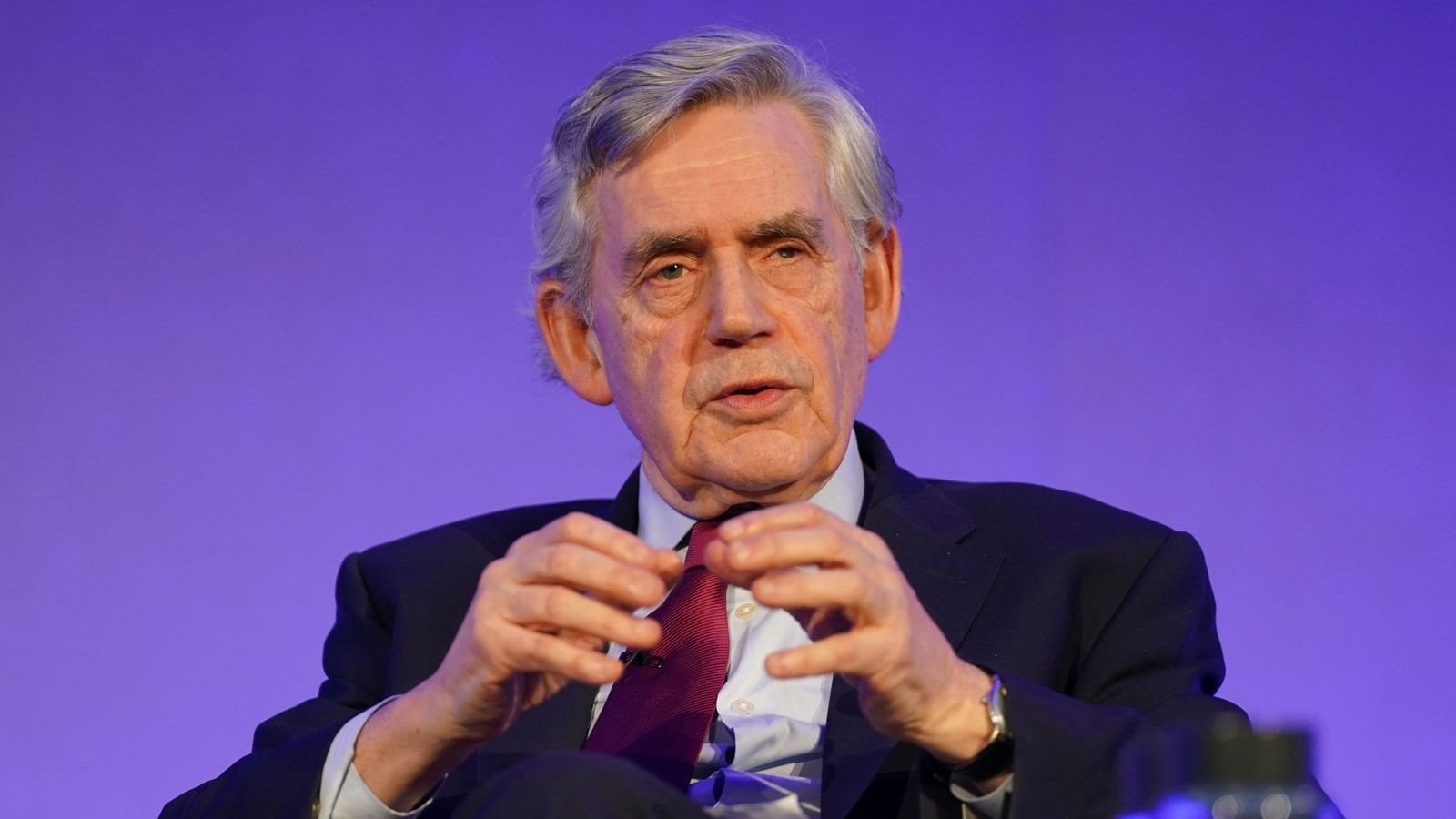

Former Labour prime minister Gordon Brown has said that Irish unity is inevitable at some point, although he added that any transition would require time and mutual agreement.
In an interview with the Guardian ahead of the publication of his new book, The Future Starts With Us, Brown said the political route to a united Ireland would be long, and would depend on whether people on all sides could come to agreement. He framed Northern Ireland as a territory that has a different relationship to the rest of the United Kingdom than Scotland does, pointing to links across the Irish Sea.
Peace Process Role
Brown’s comments come despite his longstanding opposition to Scottish independence and after his own involvement in government efforts to secure peace in Northern Ireland.
He served as Tony Blair’s chancellor when the Good Friday peace agreement was signed in 1998. A decade later, when he was prime minister, justice and policing powers were devolved to Northern Ireland’s power-sharing institutions, a step Brown described as part of the wider reconciliation process.
Opposition To Scottish Independence
Asked about continued pressure for Scotland to seek independence, Brown argued that Scotland should instead find a way to live in cooperation with other countries and that independence was not the right direction.
He said Scotland, and the rest of the UK, are geographically, economically, socially and culturally intertwined with other parts of Britain, as well as with areas of Ireland. Brown also indicated that Northern Ireland’s ties to the Republic of Ireland make unification, in the longer term, a plausible outcome.
He said Northern Ireland and the Republic of Ireland are linked by geography, and that, over time, Ireland would be united. In his view, the key question was whether communities would be able to agree on the terms and process.
Energy Policy And North Sea Transition
Elsewhere in the interview, Brown turned to energy and environmental policy, including what he described as a misconception around the choices facing Andy Burnham, the Mayor of Greater Manchester.
Brown said he did not want to act as a “backseat driver” on decision-making, but he made the case for continued oil and gas drilling in the North Sea. He referred to politically sensitive issues ahead of decisions, including the Rosebank and Jackdaw fields, where consultations had already closed.
Brown said government discussions about North Sea oil and gas and renewables were sometimes presented as a binary choice. He argued instead that the transition to renewables could build on existing capacity, keeping North Sea infrastructure and skills in place and gradually adapting them for wind, hydrogen—including hydrogen production—and carbon capture and storage.
He also said the shift could be managed through a European consortium model, involving Norway, Germany, the Netherlands, Belgium and Denmark. Brown added that environmental policy should be viewed as beneficial rather than solely as a cost, saying renewable energy costs have fallen over time.
He argued that, while producing electricity from coal and oil and gas may have been cheaper in the past, advances in solar power and wind mean that investment in environmental measures could also deliver financial advantages.
Join the discussion? 

29 August 2026
Recommended Comments
Create an account or sign in to comment