



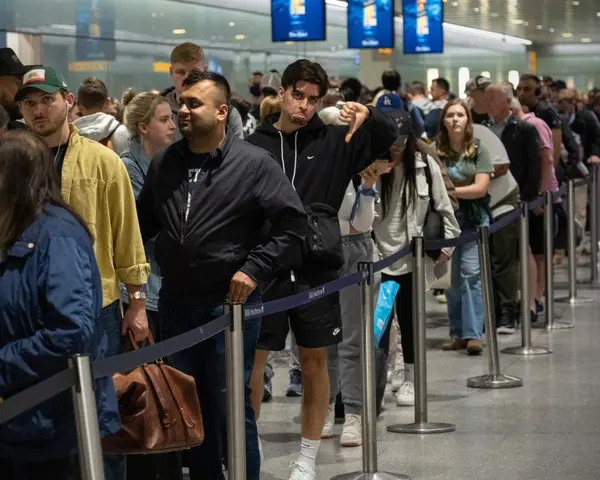

Greece has announced that British travellers will not be required to undergo new biometric checks under the European Union’s Entry-Exit System (EES), in a move aimed at preventing long queues and congestion at airports during the busy holiday season.
Get today's headlines by email 
The decision means visitors from the UK arriving at or departing from Greek airports will continue to follow the previous passport control procedures rather than registering fingerprints or facial biometrics under the EU scheme.
Greek tourism officials say the measure is intended to ensure smoother travel at a time when many European airports are struggling to implement the new border technology.
Move to ease airport congestion
The EU’s Entry-Exit System came into effect on 10 April and is designed to digitally track visitors from non-EU countries entering the Schengen area. Under the system, travellers are required to register biometric data — including fingerprints and facial scans — when entering the bloc for the first time, with facial verification used on subsequent visits.
The rules apply to so-called “third-country nationals”, including travellers from the United Kingdom, Australia, Canada and other non-EU states.
However, UK travellers represent one of the largest groups visiting Europe, particularly during the summer months. Greek authorities were concerned that applying the biometric system at smaller island airports could create significant delays.
Some airports serving popular tourist destinations such as Corfu, Crete and Rhodes can process thousands of British arrivals and departures in a single day during peak season.
Eleni Skarveli, director of the Greek National Tourism Organisation in the UK, confirmed that British passport holders would be exempt from biometric registration at Greek border points.
She said the decision was taken to ensure “a smoother and more efficient arrival experience in Greece” and to reduce waiting times at airports.
Previous passport procedures remain
Instead of biometric checks, British travellers will be processed using the system that existed before the EES rollout.
In practice, this means passports will continue to be inspected and stamped by border officers rather than scanned through biometric registration kiosks.
Officials believe this will significantly shorten processing times compared with the new EU procedures, which can take considerably longer during initial registration.
The issue of delays has already been highlighted elsewhere in Europe. Long queues linked to the new system were reported at several airports, including an incident at Milan’s Linate Airport where outbound passport control delays disrupted a flight to Manchester.
EU rollout faces challenges
Although the EES is intended to modernise border controls and replace manual passport stamping, its rollout has encountered technical and logistical difficulties in some locations.
At several border points connected to the UK — including Dover, the Channel Tunnel terminal at Folkestone and London St Pancras station — the required biometric kiosks have not yet been fully integrated with French border police systems.
EU officials have acknowledged that not all border crossings were ready for the full implementation of the system when it launched earlier this month.
Against that backdrop, Greece’s decision reflects concerns about maintaining efficient airport operations while protecting a key part of the country’s tourism industry.
British visitors form one of the largest groups of tourists travelling to Greek destinations each year, and authorities appear keen to avoid disruptions that could discourage travel.
No timeline has been announced for when Greece might begin applying the biometric system to UK travellers.
Join the discussion? 
Already a member? 
 Adapted by ASEAN Now. Source 20 April 2026
Recommended Comments
Create an account or sign in to comment