



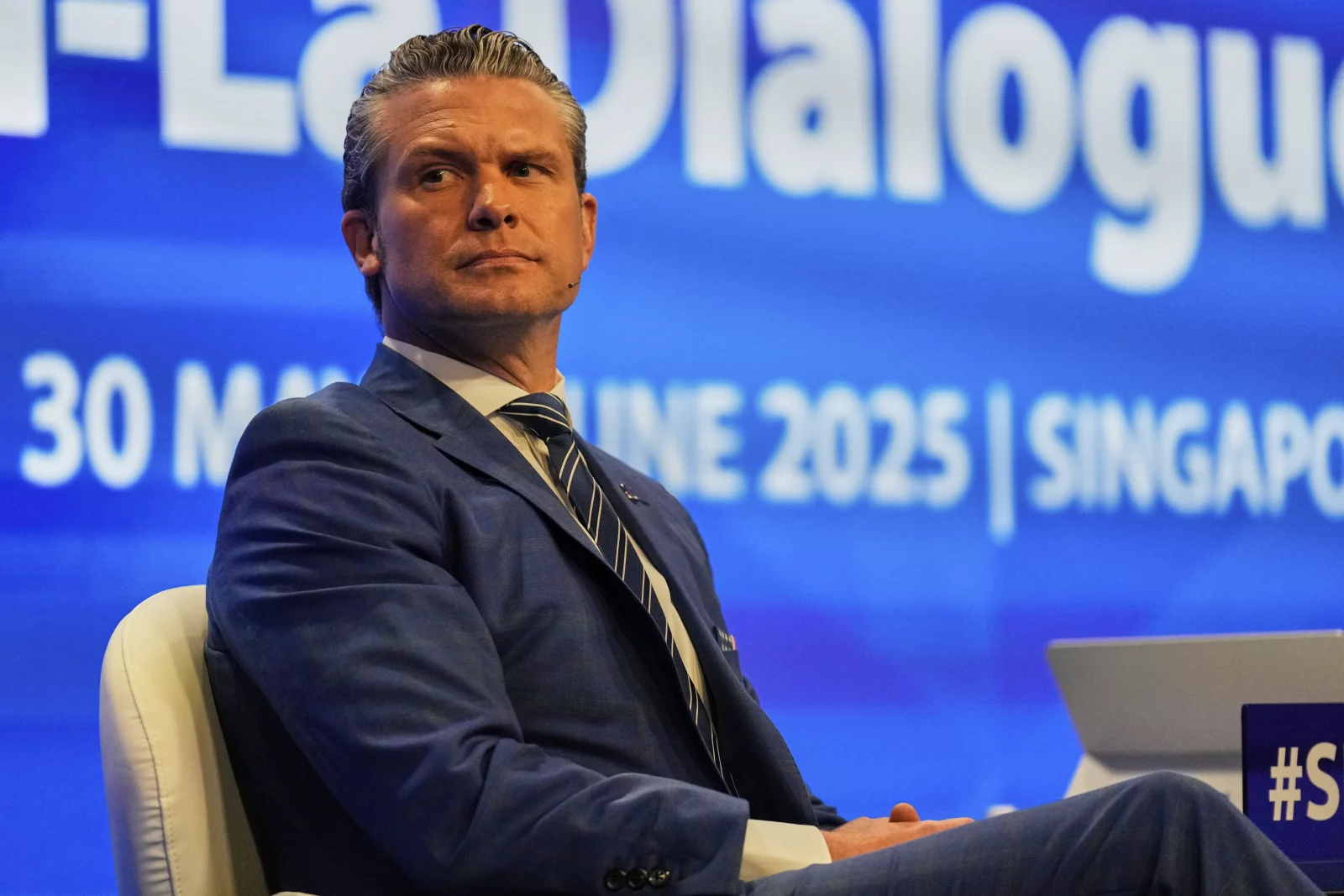

US Defence Secretary Pete Hegseth has sought to reassure Asia-Pacific allies that Washington remains committed to the region despite its involvement in other global security challenges, including the conflict with Iran.
Get today's headlines by email 
Speaking at the Shangri-La Dialogue in Singapore, Hegseth rejected suggestions that the United States was shifting its attention away from Asia.
He said Washington was capable of managing multiple security priorities simultaneously and remained focused on projecting power in the Pacific alongside its allies.
“People want to conflate that we have global obligations with the turning of our backs to this region,” Hegseth said, adding that the US was continuing to work closely with partners while also addressing concerns such as preventing Iran from obtaining a nuclear weapon.
His remarks came after questions from Shinjiro Koizumi, who raised concerns that some countries might seek to undermine confidence in the US alliance network.
Taiwan Arms Concerns Addressed
Hegseth also responded to concerns over US weapons deliveries after Washington suspended a reported $14 billion arms package for Taiwan in order to preserve munitions during the Iran conflict.
He insisted the issue should not be linked to broader US commitments in Asia, arguing that American stockpiles remained strong and that the country retained the capacity to increase weapons production if necessary.
According to Hegseth, the US remained well positioned to meet its defence obligations and support partners across the region.
Call for Greater Military Spending
A central theme of Hegseth’s address was the need for Asian allies to increase defence spending. Repeating a message he delivered at last year’s forum, he suggested countries should aim to spend 3.5% of gross domestic product on defence.
He praised nations including South Korea, Japan, Australia and the Philippines for strengthening military investment and cooperation with the United States.
Hegseth argued that military capability, rather than diplomatic rhetoric alone, was essential for maintaining regional stability.
“Rules are great, but if you can't back them up with hard power, the rules are not worth the paper they are written on,” he said, calling for more military assets and fewer discussions.
His comments contrasted with those of To Lam, who had earlier urged greater dialogue as a means of managing regional tensions.
Hegseth also criticised countries he described as “freeloaders”, specifically naming New Zealand. New Zealand’s defence minister later rejected the characterisation, saying the country was increasing military spending after years of underinvestment and was moving towards spending up to 2% of GDP on defence.
Softer Tone Towards China
The defence secretary’s remarks on China were noticeably less confrontational than in previous years.
While warning about China’s growing military capabilities, Hegseth said the United States was seeking stability rather than confrontation. He acknowledged that regional partners preferred a balance of power and did not want escalating tensions.
Speaking weeks after talks between President Donald Trump and President Xi Jinping in Beijing, Hegseth avoided strong language on Taiwan and emphasised the goal of preserving peace and prosperity across the region.
China’s decision not to send its defence minister to the forum for a second consecutive year drew attention. Instead, Beijing dispatched a lower-level delegation, a move some observers viewed as a slight against the conference while others saw it as an effort to avoid direct public confrontation with Washington.
Analysts said Asian nations could remain uneasy about growing competition between the US and China. Muhammad Faizal Bin Abdul Rahman said many countries in the region continued to favour neutrality and stability, warning that rivalry between the two powers could heighten regional concerns.
Join the discussion? 
Already a member? 
 Adapted by ASEAN Now. Source 31 May 2026
Recommended Comments
Create an account or sign in to comment