



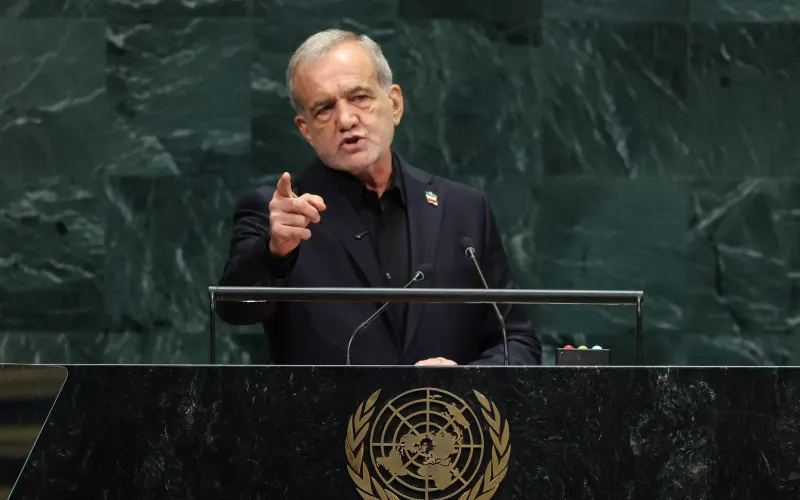

Iranian President Masoud Pezeshkian told the UN General Assembly that his country would never “bend the knee” in the face of US threats of rapid destruction, while saying Tehran is willing to pursue diplomacy to end the conflict involving the United States and Israel.
Pezeshkian was responding to remarks by US President Donald Trump, who warned that unless a deal is reached soon, the Islamic Republic could be “annihilated”. Speaking in New York, Pezeshkian said increased sanctions and pressure would not force Iran to retreat, but would instead harden the stance of the Iranian public.
UN General Assembly Address
Pezeshkian said the US president had characterised Iran as a terrorist state, adding that Iran saw itself as the target of terrorism. At the start of his speech, he said the US delegation left the chamber when he began speaking.
He then held up an image of Iran’s late Supreme Leader, Ayatollah Ali Khamenei, who Iran said was killed during a strike on his residence in late February, when the US and Israel launched a joint attack, according to Iranian state accounts.
Pezeshkian also displayed photographs of victims Iranian authorities said were killed in missile strikes on a primary school in Minab and a sports complex in Lamerd. Iranian officials said more than 175 civilians died, with two thirds of them children. The United States has denied striking Lamerd and said it was still investigating what happened in Minab.
“People who had done nothing were hit,” Pezeshkian said, adding that Iran had defended itself with force.
Strait of Hormuz Condition
Pezeshkian linked any potential settlement to Iran gaining access to shipping through the Strait of Hormuz and said a US blockade would have to end. He said it was not acceptable for the benefits of the strait to be shared by others while Iran is denied the ability to use the waterway.
He argued that any agreement should address how Iranian vessels are prevented from transiting the route, which is vital for global oil and gas shipping. Iran has said it wants to keep a level of control over the strait and collect fees from vessels that pass through it, a proposal the US has rejected.
Recent Attacks And Wider Context
A day after Pezeshkian’s speech, an attack on a cargo ship in the Strait of Hormuz killed an Indian sailor, the Agence France-Presse news agency reported, citing Omani and Indian authorities. India’s foreign ministry condemned the incident and called for passage through the strait to be restored without hindrance.
The conflict follows months of escalation. In February, Iran retaliated for a large US-Israeli air campaign by launching missile and drone attacks on Israel and on neighbouring Gulf Arab states hosting US military bases. Iran said it effectively closed the strait by attacking commercial vessels across the Gulf, the Gulf of Oman and the Arabian Sea. The US responded in April with a blockade of Iranian ports and ships.
In June, the US and Iran reached a preliminary understanding to end the war and reopen the strait, but it broke down within weeks after attacks on shipping resumed and the US reinstated its blockade.
Nuclear Programme And Dialogue
On nuclear issues, Pezeshkian reiterated that Iran would not abandon its right to a civilian nuclear programme and would not seek nuclear weapons. He said Tehran’s position is that there should be no nuclear weapons and no limits on peaceful nuclear technology.
Trump, in his UN address, argued the war had blocked Iran from obtaining a nuclear bomb and demanded Iran’s leaders “relinquish their nuclear ambitions”.
Pezeshkian also said the language of force from Washington reflected a bullying approach, but that Tehran was prepared for dialogue and negotiations that do not accept threats.
On Tuesday, indirect talks were held between Iranian Foreign Minister Abbas Araghchi and US envoy Steve Witkoff, with Qatar brokering meetings on the sidelines of the UN General Assembly in New York. Witkoff said he hoped the discussions would be constructive and that mediators would continue their work. Iran’s foreign ministry spokesman Esmail Baqai said the talks were not new and that Araghchi maintained Iran’s conditions, including the end of the US blockade and the release of frozen Iranian assets.
Join the discussion? 

24 September 2026
Recommended Comments
Create an account or sign in to comment