



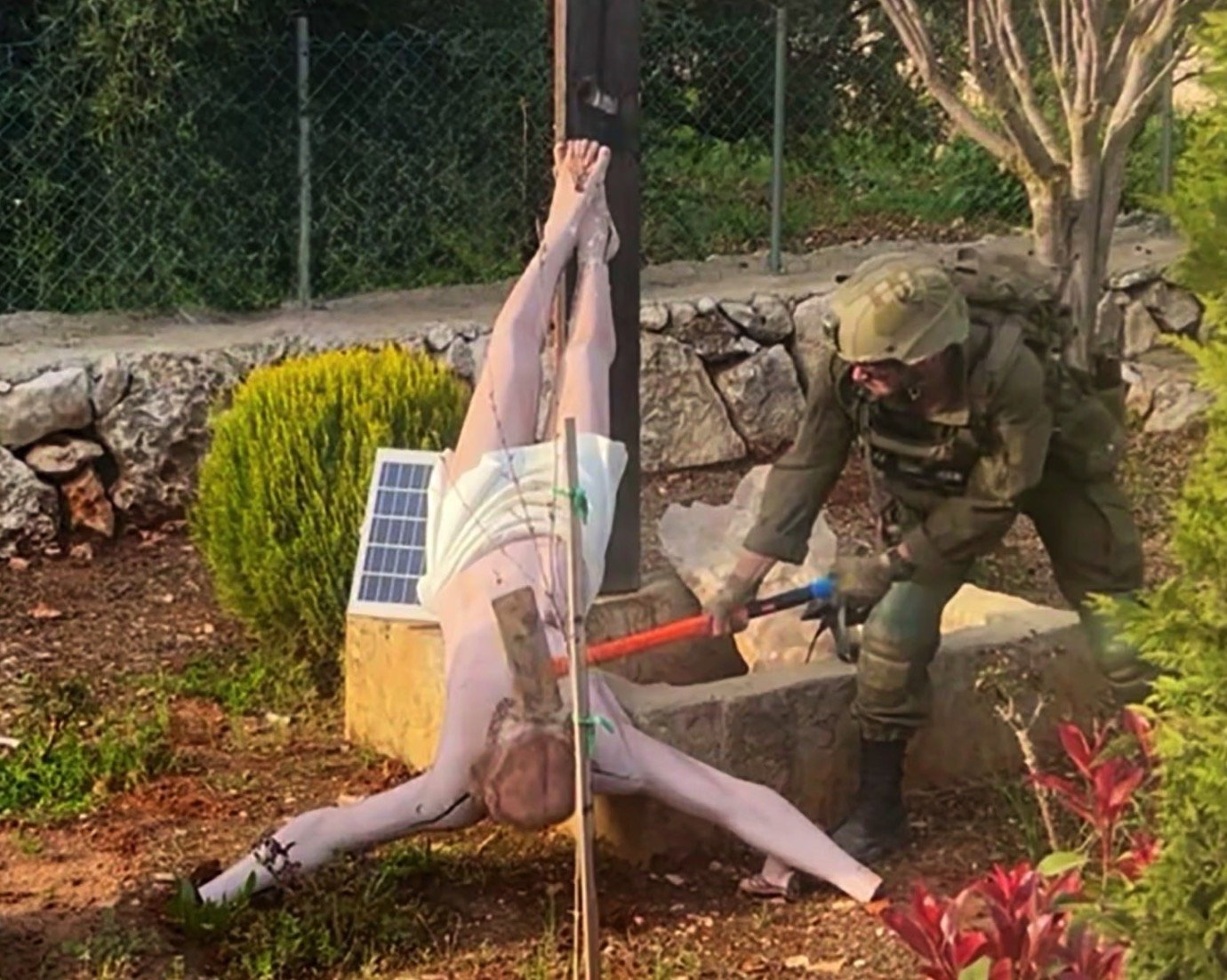

The Israeli military has launched a criminal investigation after a soldier was photographed striking a statue of Jesus with a sledgehammer in southern Lebanon, an incident that has drawn condemnation from Israeli leaders and foreign officials.
Get today's headlines by email 
The image, which circulated widely on social media, appears to show an Israeli soldier hitting the head of a fallen statue of the crucified Jesus with a sledgehammer. The statue stands in the village of Debl, a Christian community in southern Lebanon near the Israeli border.
Israeli military officials confirmed the photograph was genuine and said the soldier involved had been identified. The individual has not been publicly named.
Investigation and official response
The Israel Defense Forces (IDF) said it had begun a criminal investigation into the incident. Military officials also said they were working with residents of the village to restore the statue.
Israeli Prime Minister Benjamin Netanyahu condemned the act, saying he was “stunned and saddened” when he learned about it. He said the soldier responsible would face “harsh disciplinary action”.
Israel’s foreign minister, Gideon Saar, also criticised the incident, describing it as a “shameful and disgraceful” act. Writing on social media, he said he expected strict measures to be taken against whoever carried out the damage and apologised to Christians who felt offended by the episode.
A spokesperson for the Israel Defense Forces confirmed the soldier had been identified but declined to disclose further details.
International criticism
The incident triggered anger in Lebanon and abroad, including among Christian communities in the United States and Europe.
The Italian government strongly criticised the act. Italy’s defence minister, Guido Crosetto, described the incident as “unacceptable and unjustifiable”.
Religious authorities also voiced concern. Archbishop Vincenzo Paglia warned that acts targeting religious symbols reflected a broader cultural problem, saying intolerance and extremism could arise when respect for culture and belief erodes.
Tensions between the Vatican, Italy and the Israeli government have already been strained in recent weeks following disagreements over the broader regional conflict.
Earlier, Italian Prime Minister Giorgia Meloni criticised Israeli authorities after police prevented Pierbattista Pizzaballa, the Latin patriarch of Jerusalem, from entering the Church of the Holy Sepulchre in Jerusalem. Meloni said that incident represented an affront to believers and religious freedom.
Damage to religious sites
The episode involving the Jesus statue comes amid wider accusations that religious and historical sites in southern Lebanon have been damaged during Israel’s military operations in the area.
Residents of the Lebanese town of Bint Jbeil recently reported the destruction of the Grand Mosque of Bint Jbeil, a building with historical roots dating back to the Roman era.
Local groups have also reported damage to the shrine of Saint Peter in the city of Chamaa, a site regarded as sacred by both Shia Muslims and Christians.
Under the Geneva Conventions, intentionally targeting or destroying religious sites and places of worship is considered a violation of international humanitarian law.
Israel has also released footage showing large-scale demolitions of buildings in towns along the Israel–Lebanon border, with the military saying it plans to continue destroying structures in the area.
Conflict in southern Lebanon
Lebanon became directly involved in the wider regional conflict in early March when the Iran-backed militant group Hezbollah launched rockets towards Israel in support of Tehran.
Israel responded with extensive air strikes across Lebanon and a ground incursion into the south. Although a ceasefire between the two countries began last week, Israeli troops have remained deployed in parts of southern Lebanon.
Join the discussion? 
Already a member? 
 Adapted by ASEAN Now. Source 21 April 2026
Recommended Comments
Create an account or sign in to comment