



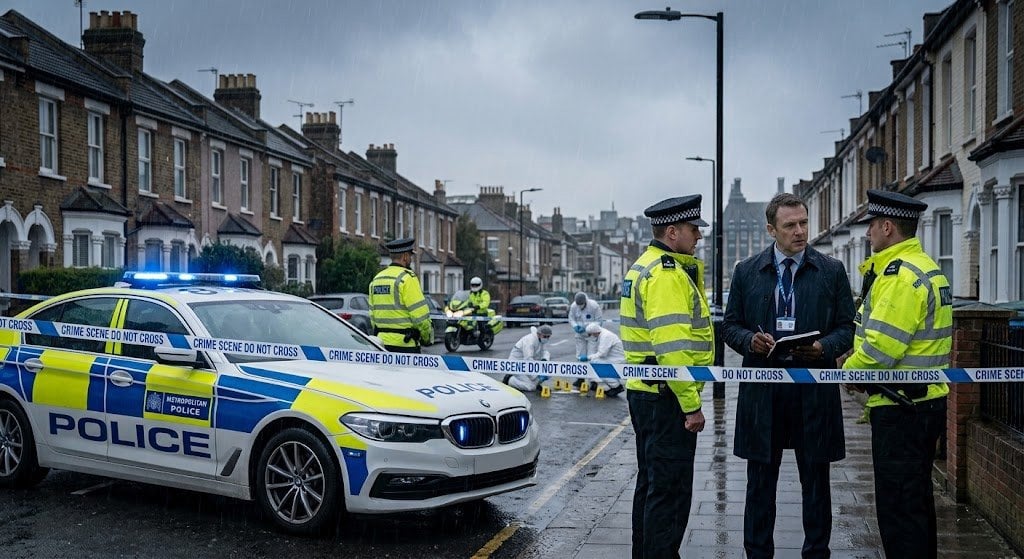

A new analysis of homicide cases in London has found that most unsolved murders involved victims from minority ethnic backgrounds, with black people accounting for a large share of killings that remain unresolved.
The study, carried out by Action on Armed Violence, reviewed unsolved homicides in the capital between 2019 and 2023. It found that minority ethnic British people made up 61% of victims in that period. When researchers focused specifically on murders that were still unsolved, they reported that 92.9% of cases were linked to a victim who was a person of colour.
Disparities In Unsolved Victims
Across the full set of homicides recorded between 2019 and 2023, black people were victims in 40% of cases. The study also found black victims represented 73% of all unsolved murder cases during the same timeframe.
It broke this down further by weapon type. Black victims accounted for 83.7% of unsolved shootings, with 36 victims, and 73.5% of unsolved stabbings, with 39 victims.
Campaigners said the findings should be viewed alongside the wider challenge of trust between communities and police. Iain Overton, of Action on Armed Violence, said the data indicated London’s unsolved murders were not evenly distributed, with cases concentrated among young black men and those involving firearm violence. He added that this could reinforce mistrust if families see that communities most affected by deadly violence are less likely to see those responsible brought to justice.
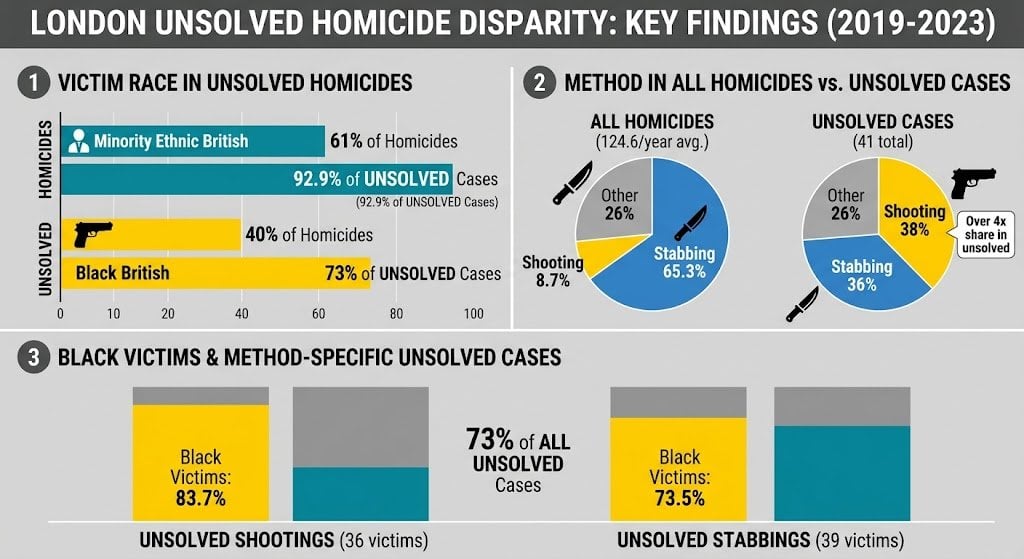
Chart created with AI
Shootings More Likely To Remain Unsolved
The research also found that deaths involving shootings were more likely to remain unsolved than killings involving stabbings.
Between 2019 and 2023, London averaged 124.6 homicides per year. Stabbings accounted for 65.3% of all killings, while shootings made up 8.7%. However, among 41 murders from that period that remained unsolved, shootings accounted for 38%, far higher than their share of the overall total.
The study said the average age of homicide victims in London is about 36. For unsolved cases, the average dropped to 28, indicating that unresolved killings skew towards younger victims.
Police Say Investigation And Trust Issues Matter
The Metropolitan police said the disparity is linked, in part, to levels of trust in policing among black communities. Commander Paul Brogden, head of homicide, said serious violence disproportionately affects certain groups, particularly young black men, who he said have the lowest trust in the police. He added that this can mean victims or witnesses are less likely to come forward and place trust in investigations.
Brogden also highlighted the complexity of solving firearm-related offences compared with domestic murders. He said officers use tools such as CCTV and forensics, but that witness evidence can be crucial to securing convictions.
A senior homicide detective at Scotland Yard, DCI Alex Gammampila, said shootings often involve more planning than stabbings, which he described as more likely to be spontaneous. He said this makes firearms offences harder to solve.
The Met said it has a high clear-up rate for homicides, with nine out of 10 killings resulting in justice. Last year the force recorded 97 homicides in London, down from 153 in 2019 and the lowest figure in a decade.
The Action on Armed Violence study also examined a wider period, saying that between 2015 and 2024 there were 110 unsolved homicides, representing 9% of 1,222 killings.
Join the discussion? 

23 August 2026
Recommended Comments
Create an account or sign in to comment