



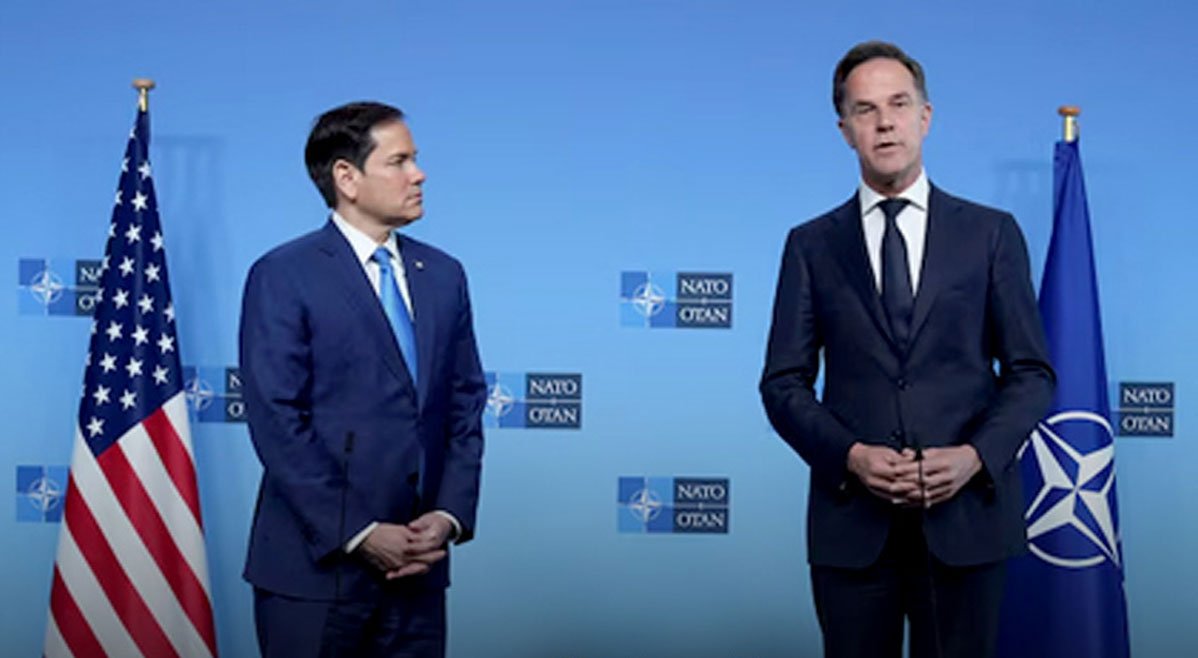

US Secretary of State Marco Rubio has sought to reassure Nato allies over shifting American troop deployments in Europe, following a series of announcements by President Donald Trump that have unsettled members of the alliance.
Get today's headlines by email 
Rubio spoke after a meeting of Nato foreign ministers in Helsingborg, where concerns were raised over recent US decisions involving troop movements in Poland and Germany.
Troop changes spark uncertainty
Trump announced on Thursday that the US would deploy an additional 5,000 troops to Poland.
The move came only a week after the Pentagon cancelled a planned deployment of 4,000 troops to the country and days after Washington confirmed plans to withdraw 5,000 troops from Germany.
The sequence of announcements has caused confusion among Nato members, many of whom are already uneasy about Washington’s long-term commitment to European security.
Rubio addresses Nato concerns
Speaking to reporters on Friday, Rubio said the US was continually reviewing its military posture abroad in light of wider global obligations, including ongoing tensions in the Middle East linked to the conflict involving the US, Israel and Iran.
“Allies understand that the United States troop presence in Europe is going to be adjusted,” Rubio said, adding that consultations with Nato partners had already taken place.
US says allies were informed
While acknowledging concerns among allies, Rubio said they were aware changes were under discussion even if they were not fully satisfied with them.
Rubio also said troop deployments were being reassessed as part of broader global military commitments, including operations outside Europe.
Trump links move to Polish ties
Trump announced the new deployment to Poland while Nato ministers were meeting in Sweden.
In a post on his Truth Social platform, he linked the decision to Washington’s relationship with Polish President Karol Nawrocki, whom Trump supported during Poland’s presidential election campaign.
Uncertainty over deployment plans
The US president did not clarify whether the extra troops were connected to the previously cancelled deployment or represented a separate operation altogether.
Questions have also been raised about whether the troops leaving Germany could instead be redirected to Poland.
Germany withdrawal adds to confusion
Earlier this month, Washington confirmed plans to reduce its military presence in Germany after tensions between Trump and German Chancellor Friedrich Merz over the conflict involving Iran.
The overlapping announcements have left several allies uncertain about the direction of US military planning in Europe.
Sweden highlights allied unease
Swedish Foreign Minister Maria Malmer Stenergard said the mixed signals from Washington had been difficult for allies to interpret.
“It is confusing indeed, and not always easy to navigate,” she said while hosting the Nato talks.
US remains central to Nato defence
The US remains Nato’s largest military power and has stationed troops across Europe for decades as part of the alliance’s collective defence structure.
Since Russia launched its full-scale invasion of Ukraine in February 2022, European allies have repeatedly urged Washington to maintain a strong military presence on the continent.
Large US military presence in Europe
Germany hosts the largest number of US troops in Europe, with more than 36,000 personnel stationed there.
Poland and the UK each host around 10,000 US troops, while Italy has roughly 12,000.
Trump presses Nato on spending
Trump has long criticised Nato members for relying too heavily on the US and failing to spend enough on defence.
He has repeatedly argued that European allies should contribute more financially to the alliance.
Europe moves toward self-reliance
Several Nato countries have since pledged increases in defence spending, though tensions remain over Washington’s broader “America First” foreign policy approach.
The White House has recently indicated that it plans to reduce overall US troop numbers in Europe as part of that strategy.
Nato Secretary General Mark Rutte said Europe would continue moving towards greater military self-reliance.
Rubio stresses value of alliance
Rubio also acknowledged longstanding debate within the US over the value of Nato, saying the alliance must remain beneficial not only for Europe but also for the United States.
Join the discussion? 
Already a member? 
 Adapted by ASEAN Now. Source 23 May 2026
Recommended Comments
Create an account or sign in to comment