



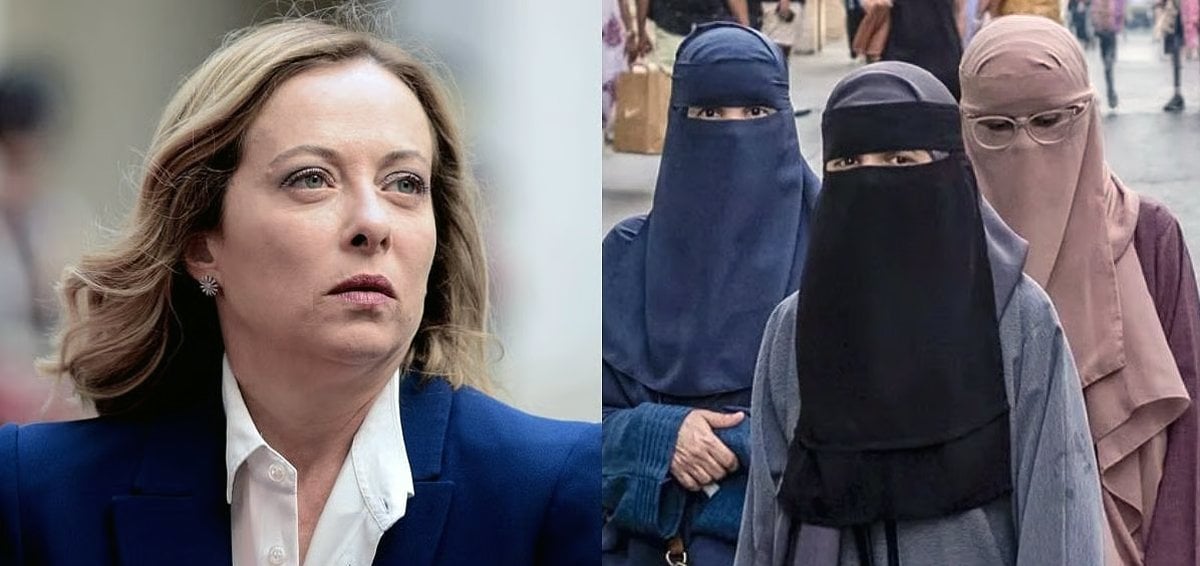

Italian Prime Minister Giorgia Meloni’s planned ban on full-face veils in schools has prompted concern among some Muslims, who say the measure targets a small minority and risks turning a religious issue into a political symbol.
At the al-Wahid mosque in Milan, located in a quiet courtyard in the Navigli district, worshippers said the proposal struck them as unclear and unnecessary. During Friday prayers, some residents said they viewed it as aimed at garments worn by only a limited number of students, rather than at behaviour in classrooms.
Concern In Milan Mosque About Focus On Face Coverings
Mulayka Laura Enriello, a 58-year-old high school maths teacher, said she had never encountered students wearing face-covering clothing during her career. She said some girls wear headscarves to school, and that staff and pupils do not typically object.
In an interview with Al Jazeera, Enriello said that while schoolchildren who want to wear a hijab are not challenged, the proposed restriction felt inhumane. She added that if a girl arrived in a burqa, she would still have to treat her as a minor who may believe she is doing something appropriate.
The mosque’s imam, Yahya Pallavicini, also said the ban raises what he described as a “false problem”. He told Al Jazeera that the focus on a garment used by a small minority distorts the public’s “perception” of Islam.
What The Draft Decree Would Do
Meloni presented the proposal on Sunday during a rally for her nationalist conservative Brothers of Italy (FdI) party, describing it as a step towards gender equality. She said pupils must attend school with their faces uncovered.
Italy’s state-run Ansa news agency reported that as few as 500 to 600 female students currently wear a full-face covering.
The decree, however, avoids explicit reference to the terms burqa and niqab. Instead, it bars participation at school by anyone wearing a full-face covering, or in “any other modality” that prevents identification.
Nico Tonti, a researcher in legal studies at the University of Bologna, said the measure is already in force but that Parliament can scrutinise its “proportionality” to its stated goals and whether it is compatible with rights protecting religious freedom. In an interview with Al Jazeera, he said Italian law has previously prohibited items in public that make personal identification difficult except where there is a “valid reason”, and that court decisions have increasingly treated religious observance as such a reason.
Wider Political Framing And Election Timing
The debate over garments worn by some Muslims is not limited to Italy. French far-right activists from Collectif Nemesis staged a theatrical protest at the League’s annual rally in Pontida last week, removing full-face coverings on stage as the crowd shouted “liberta” (“freedom”).
Renata Pepicelli, a professor of Islamic Studies at the University of Pisa, said the gesture echoed an approach she associated with French colonial authorities in Algeria in 1958, when groups of Algerian women removed and sometimes burned their veils, at times under coercion, in a show of support for Paris. She told Al Jazeera that the veil remains a “battlefield” and that removing it can symbolise social predominance, adding that Meloni’s plan fits into a wider climate.
Observers have also pointed to the timing ahead of the 2027 elections. Meloni faces a challenge from the right as the National Future party of former general Roberto Vannacci gains support, reaching 8% in opinion surveys since its creation in February.
Lorenzo Castellani, a professor of political institutions history at LUISS University, said Meloni is seeking to send a strong signal to right-wing voters, for whom immigration and security are major concerns. He predicted her campaign will centre on three areas: immigration, security and political stability.
Castellani said the first two topics allow her to respond to voter priorities without leaving Vannacci to lead on identity issues, while the stability theme differentiates Meloni by emphasising her government’s ability to deliver and continue.
Italy’s political scene has a reputation for instability, but Meloni has led the country’s longest-lasting government since the Second World War. Earlier this month, she surpassed Silvio Berlusconi’s record of 1,412 consecutive days in office. Castellani said she is likely to link immigration and security to a message of continuity in the next vote.
Join the discussion? 

29 September 2026
Recommended Comments
Create an account or sign in to comment