



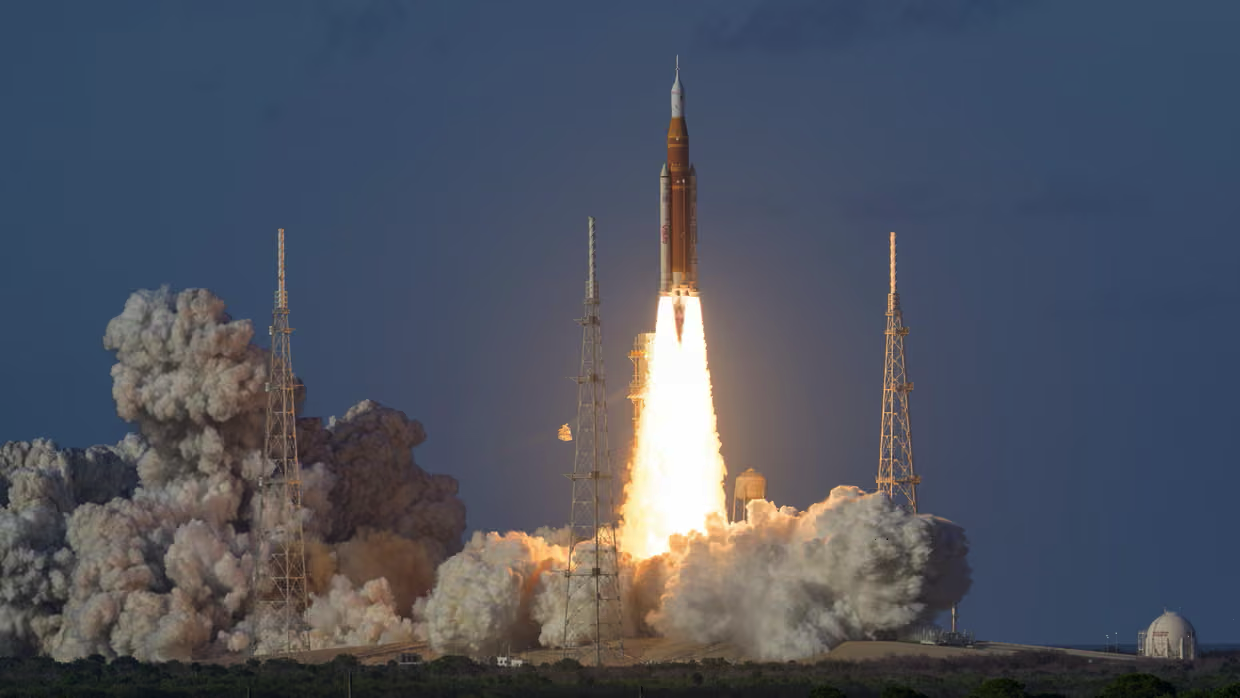

NASA launched the Artemis II mission on Wednesday evening from Kennedy Space Center, sending astronauts toward the moon for the first time in nearly 54 years.
Get today's headlines by email 
The rocket successfully lifted off from Florida’s Space Coast and placed the crew aboard the Orion spacecraft into Earth orbit. The capsule will circle the planet until a planned engine burn on Thursday that will push it onto a trajectory toward the moon, beginning the next stage of the roughly 240,000-mile journey.
Historic Return Beyond Earth Orbit
Inside the spacecraft, the astronauts immediately started checking onboard systems following the climb to orbit, which reached speeds of about 17,500 miles per hour. Mission controllers in Houston later confirmed that Orion’s four solar arrays had deployed correctly, ensuring a steady power supply during the mission.
The flight marks the first time humans have travelled beyond low Earth orbit since Apollo 17 in December 1972.
Crew Set for Record-Breaking Journey
Commander Reid Wiseman said before launch that the mission had been long anticipated.
“The nation, and the world, has been waiting a long time to do this again,” he told reporters at Kennedy Space Center.
The crew includes three Americans and one Canadian: Wiseman, Christina Koch, Victor Glover, and Jeremy Hansen of the Canadian Space Agency.
Their ten-day flight will loop around the moon but will not attempt a landing. The mission still carries several milestones. Koch will become the first woman to travel into cislunar space, the region between Earth’s orbit and the moon, while Glover will be the first person of colour to do so. Hansen will be the first non-American astronaut to reach the same region.
During the journey the astronauts are expected to travel farther from Earth than any humans before them. At its most distant point, Orion could reach roughly 253,000 miles from Earth—surpassing the record of 248,655 miles set during the troubled Apollo 13 mission in 1970.
Mission Tests Future Moon Plans
NASA officials view Artemis II as a key step toward returning humans to the lunar surface later this decade.
During the flyby, the crew will photograph areas near the moon’s south pole from an altitude between 4,000 and 6,000 miles. Those regions are being studied as potential landing zones and sites for a future lunar base.
The mission also serves as a major systems test. Astronauts will evaluate life-support equipment, spacecraft controls, and other hardware required for later flights, including Artemis IV, a planned mission intended to place astronauts on the moon again.
The astronauts will spend the entire journey inside Orion’s compact living space, roughly the size of a small camper van. Medical teams will track the crew’s health throughout the mission, examining the effects of radiation and microgravity.
Wiseman acknowledged that the confined conditions could prove challenging during the trip.
“By day six, seven, eight or nine we might feel like we need space,” he said, adding that the crew had trained closely together to manage such situations.
Crowds Gather for Launch
The launch drew huge crowds along Florida’s Space Coast. Beaches and causeways near Cape Canaveral and Cocoa Beach filled with spectators eager to watch the rocket lift off.
Local officials estimated that up to 400,000 people gathered to witness the launch, filling hotels and public viewing areas.
For NASA, the mission signals the revival of human exploration beyond Earth orbit and lays groundwork for future lunar operations. Agency administrator Jared Isaacman recently outlined plans for a permanent presence on the moon, including a proposed $20 billion lunar base by the end of the decade.
“What we learn from these missions will help enable America’s return to the lunar surface,” Isaacman said earlier this year.
Join the discussion? 
Already a member? 
 Adapted by ASEAN Now. Source 2 April 2026
-
 1
1
Recommended Comments
Create an account or sign in to comment