



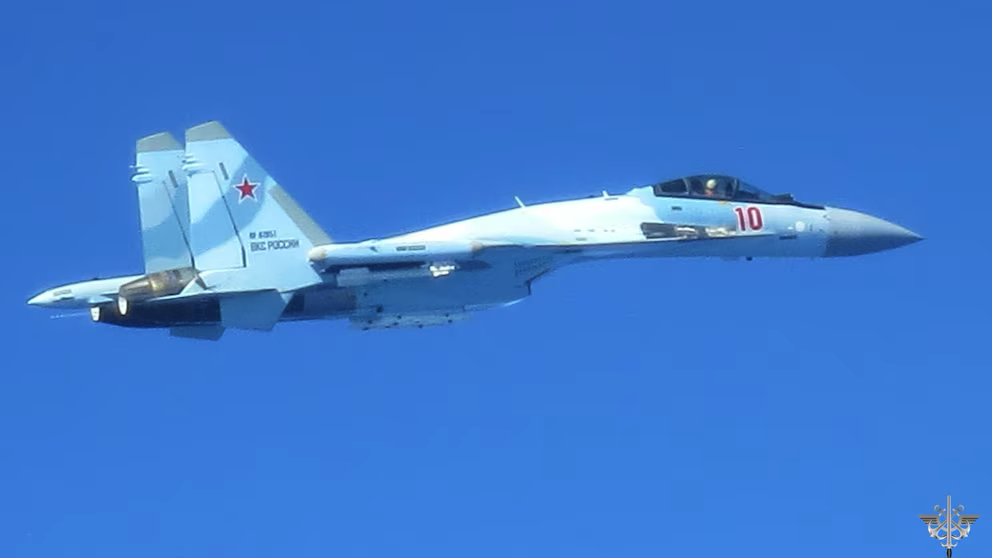

NATO fighter aircraft were scrambled on Monday to intercept Russian military planes flying over the Baltic Sea, as alliance members monitored a formation of bombers and fighter jets operating near NATO airspace.
Get today's headlines by email 
The operation involved several NATO and partner nations responding to a Russian flight that included long-range strategic bombers and escort fighters. The interception took place as part of NATO’s routine air-policing mission in northern Europe.
Multinational response from NATO and partners
French Rafale fighter jets stationed in Lithuania were among the aircraft dispatched to monitor the Russian formation. The aircraft were deployed from Šiauliai Air Base, where France is currently participating in NATO’s rotating air-policing mission designed to protect the airspace of Baltic states.
The French fighters were equipped with air-to-air missiles and joined aircraft from Sweden, Finland, Poland, Denmark and Romania in tracking the Russian aircraft.
According to the French detachment involved in the mission, the Russian group consisted of two Tu-22M3 supersonic strategic bombers accompanied by around 10 fighter aircraft. The escort included both Su-30 and Su-35 jets, which rotated duties protecting the bombers during the flight.
The allied aircraft monitored and visually identified the Russian planes while maintaining distance, a standard procedure during such encounters.
Russia says flight was scheduled
Russia’s Defence Ministry said the operation was a planned training flight conducted over neutral waters of the Baltic Sea. In a statement posted on Telegram, the ministry said the mission lasted more than four hours.
“At certain stages of the route, the long-range bombers were accompanied by fighters of foreign states,” the ministry said.
It added that Russian long-range aviation regularly carries out flights over international waters in regions including the Arctic, North Atlantic, Pacific Ocean, Baltic Sea and Black Sea.
The ministry said all flights are conducted in accordance with international rules governing the use of airspace.
NATO monitoring flights near alliance territory
NATO aircraft frequently intercept Russian military flights near the alliance’s borders, particularly in the Baltic region. The alliance says Russian aircraft often operate without activating their transponders, communicating with civilian air-traffic controllers or filing flight plans.
Such measures can pose potential risks for civilian aviation, prompting NATO to dispatch fighters to identify and monitor the aircraft.
The Baltic air-policing mission was established in 2004 after Lithuania, Latvia and Estonia joined NATO. Because the three countries lack their own fighter aircraft capable of carrying out air-defence missions, allied nations take turns deploying jets to patrol their airspace.
Many Russian flights observed by NATO aircraft travel between mainland Russia and the Kaliningrad exclave on the Baltic coast.
Even before Russia’s full-scale invasion of Ukraine in 2022, NATO reported intercepting Russian aircraft roughly 300 times a year, most often over northern European waters.
Activity continues in Baltic region
Lithuania’s defence ministry said NATO aircraft were scrambled four times between April 13 and April 19 to intercept Russian aircraft that were not following standard flight procedures.
Officials said some of the aircraft involved were flying without flight plans and had switched off their transponders.
Monday’s interception was the latest example of continued military activity in the Baltic Sea region, where NATO and Russia frequently track each other’s aircraft operating in international airspace.
Join the discussion? 
Already a member? 
 Adapted by ASEAN Now. Source 22 April 2026
-
 1
1
Recommended Comments
Create an account or sign in to comment