



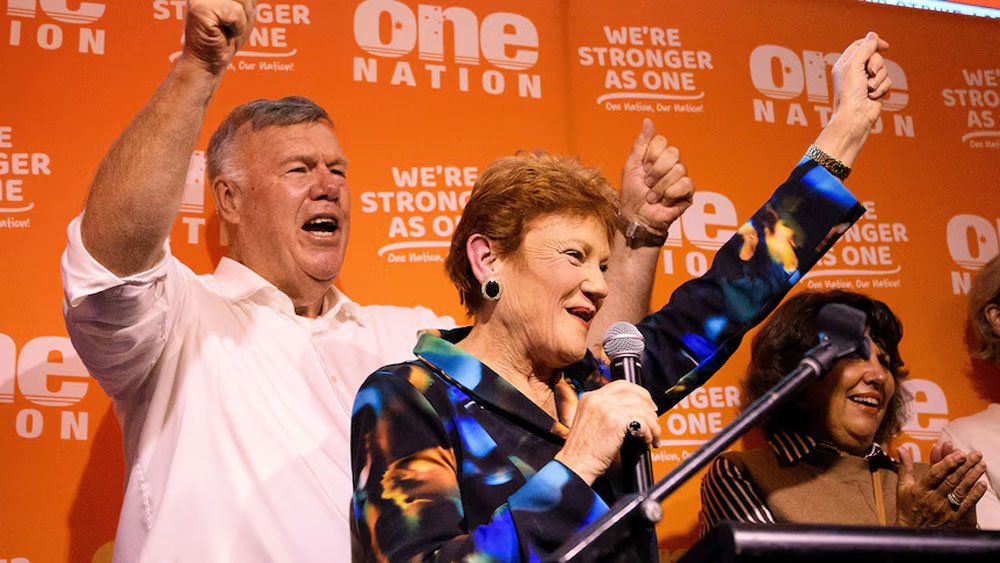

Australia’s right-wing One Nation party has secured its first seat in the federal lower house, marking a historic breakthrough for the populist party in a by-election in New South Wales.
Get today's headlines by email 
With most votes counted, One Nation candidate David Farley won the seat of Farrer with around 57% of the two-candidate preferred vote, comfortably ahead of independent contender Michelle Milthorpe.
The vote was triggered by the resignation of Sussan Ley, who stepped down after losing her position as leader of the opposition Liberal Party.
Although the result will not threaten the Labor government’s sizeable parliamentary majority, the outcome is widely seen as a sign that some voters are shifting away from Australia’s traditional political parties.
Breakthrough for One Nation
Saturday’s vote represented the first federal electoral test for One Nation since the party performed strongly in the South Australian state election in March, where it recorded the second-largest share of votes among all parties.
Celebrating the victory, party leader Pauline Hanson told supporters the result represented more than just a local win.
She said the outcome was a “win for Australia” and indicated that the party intended to contest other electorates in future.
Farley, whose professional background is in agribusiness, described the result as a turning point for the party.
Addressing supporters, he said One Nation had moved beyond its early stage and suggested the party was entering a new phase of political growth.
Preferential voting system
Australia uses a preferential voting system in federal elections, requiring voters to rank candidates in order of preference.
If no candidate wins an outright majority of first-choice votes, preferences from lower-ranked candidates are redistributed until two remain. The final result is then calculated between those two candidates to determine who commands majority support.
Farley’s victory came after preferences were distributed, producing a final two-candidate preferred tally in his favour.
A seat long held by major parties
The electorate of Farrer covers about 127,000 square kilometres across regional New South Wales—an area larger than South Korea—and includes centres such as Albury, Griffith and Deniliquin.
Historically, the constituency has been held by candidates from either the Liberal or National parties, making One Nation’s win a significant break from long-standing voting patterns.
One Nation had previously never secured a seat in the federal House of Representatives. In the late 1990s, Hanson held a parliamentary seat as an independent before losing her re-election bid. She later returned to federal politics as a senator.
During the by-election campaign, Farley said he had grown disillusioned with the major parties, arguing that their promises often differed from their actions once in parliament.
Test for opposition leadership
The by-election also provided an early test for the newly appointed leaders of the Liberal and National parties.
Angus Taylor replaced Ley as leader of the Liberal Party in February, while Matt Canavan took over leadership of the Nationals from David Littleproud in March.
Both parties remain under pressure following their heavy defeat in last year’s federal election, the worst result in the coalition’s history.
Since then, the opposition alliance has faced internal disputes and declining support in opinion polls.
The result in Farrer adds to the challenges confronting the coalition as it seeks to rebuild support among voters.
Join the discussion? 
Already a member? 
 Adapted by ASEAN Now. Source 10 May 2026
Recommended Comments
Create an account or sign in to comment