



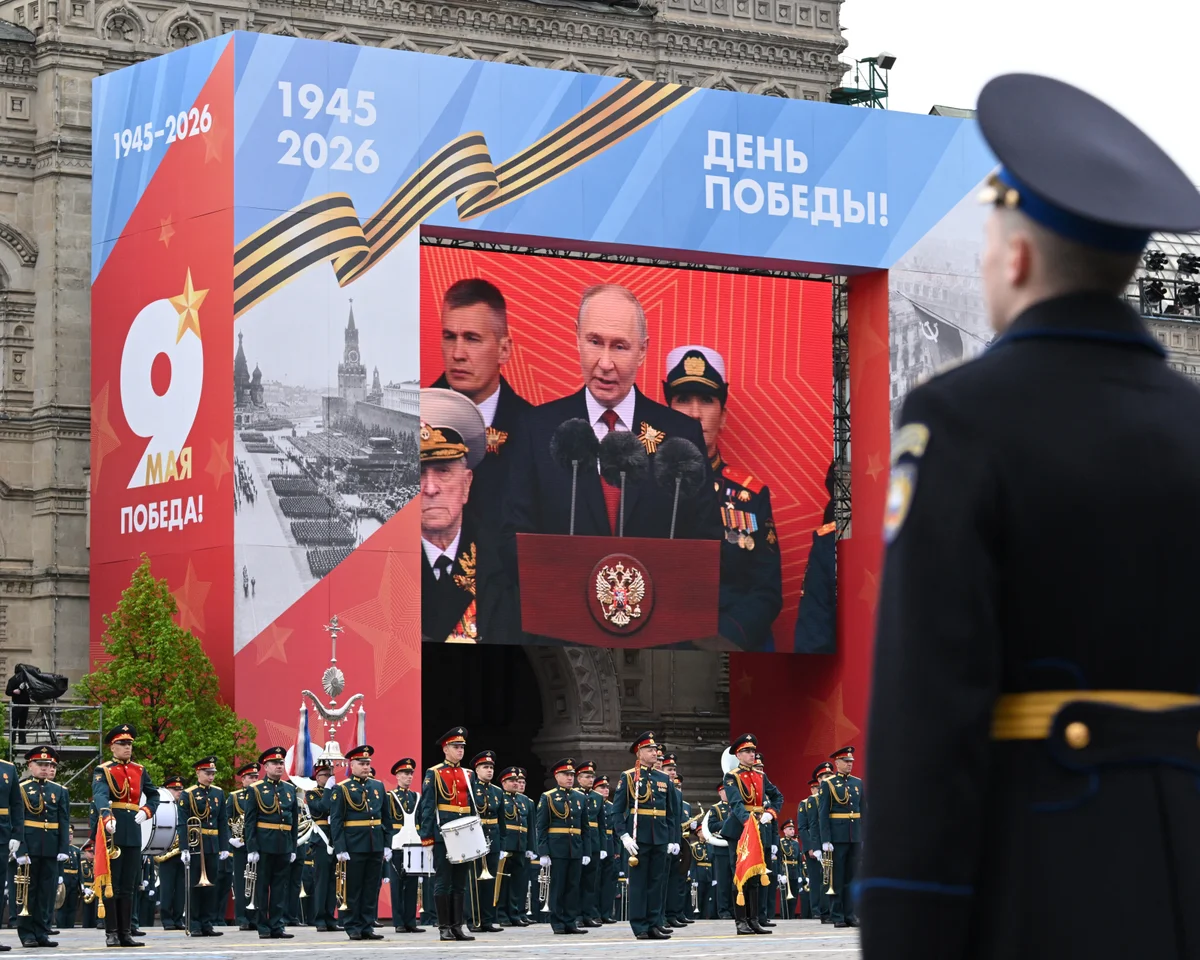

Russia’s president Vladimir Putin declared that his country would ultimately prevail in the war in Ukraine as he presided over a scaled-down Victory Day parade in Moscow, held under tight security amid concerns about possible Ukrainian attacks.
Get today's headlines by email 
Speaking in Red Square, Putin linked the conflict in Ukraine with the Soviet Union’s fight against Nazi Germany during the Second World War. He said the sacrifices of the wartime generation continued to inspire Russian troops engaged in what the Kremlin calls a “special military operation”.
“They stand against an aggressive force armed and supported by the entire NATO bloc,” Putin told the crowd. “Despite this, our heroes move forward. Victory has always been and will always be ours.”
Heightened security across Moscow underscored the tense atmosphere surrounding the annual event. Authorities restricted internet services across the city and deployed extensive protective measures amid fears of Ukrainian drone or missile strikes.
Parade scaled back
Despite Putin’s confident tone, the parade itself was markedly reduced compared with previous years. The event lasted about 45 minutes — roughly half the usual duration — and lacked many of its traditional displays of military hardware.
Missiles and armoured vehicles, a central feature since they were introduced to the parade in 2017, were not shown this year. Instead, attendees watched a video presentation highlighting Russia’s drone technology and nuclear capabilities.
The audience included a small group of foreign leaders from Belarus, Kazakhstan, and Uzbekistan. Soldiers from North Korea also marched through the square, reflecting increasingly close ties between Moscow and Pyongyang as North Korean troops have supported Russian forces in Ukraine.
Pro-Kremlin commentator Sergei Markov described the ceremony as “a modest parade”, adding that Russia still faced “enormous challenges”.
Ceasefire and security concerns
Uncertainty over potential attacks lingered until shortly before the event began. On the eve of the parade, Donald Trump, the US president, announced that Russia and Ukraine had agreed to a three-day ceasefire and a prisoner exchange.
The temporary halt in fighting was expected to last until 11 May.
Earlier in the week, Putin had urged Ukrainian president Volodymyr Zelenskyy to observe a ceasefire during the celebrations. Kyiv initially dismissed the suggestion as an attempt to protect the parade from drone attacks.
Zelenskyy responded shortly before the event with a decree stating that Ukraine would “permit” the parade to go ahead by choosing not to strike Moscow, citing the request by the US president.
Russian officials acknowledged that the extensive security measures in the capital were designed largely to protect Putin, reflecting the ongoing threat posed by Ukrainian long-range strikes.
War strains and uncertain outlook
This year’s parade marked the first Victory Day celebration since Russia’s war in Ukraine has lasted longer than the Soviet Union’s entire campaign against Nazi Germany during the Second World War.
Putin has repeatedly portrayed the current conflict as a continuation of that historic struggle, a comparison rejected by Ukraine and its allies.
Symbolically, the Russian leader was seated alongside soldiers who had fought in Ukraine rather than veterans of the Second World War, as had been customary in earlier years.
Inside Russia, the prolonged conflict has begun to strain both public sentiment and the economy. Weeks of internet shutdowns ahead of the parade, introduced as security precautions, have prompted public frustration.
Economic growth, which had been supported by heavy military spending, has slowed sharply. Inflation is rising and the federal budget deficit has reached record levels.
On the battlefield, the war has largely stalled. Both Russian and Ukrainian forces have suffered heavy losses and are struggling to make significant advances while continuing attacks on each other’s energy infrastructure.
Despite the stalemate, there has been little sign of a shift in Moscow’s position. Kremlin aide Yuri Ushakov said Russia saw no basis for new talks involving the United States and Ukraine unless Ukrainian forces withdrew from the Donetsk Oblast region — a demand Kyiv has rejected.
Ukrainian forces continue to hold several fortified cities in Donetsk, positions that have been defended at significant human cost.
Join the discussion? 
Already a member? 
 Adapted by ASEAN Now. Source 10 May 2026
Recommended Comments
Create an account or sign in to comment