



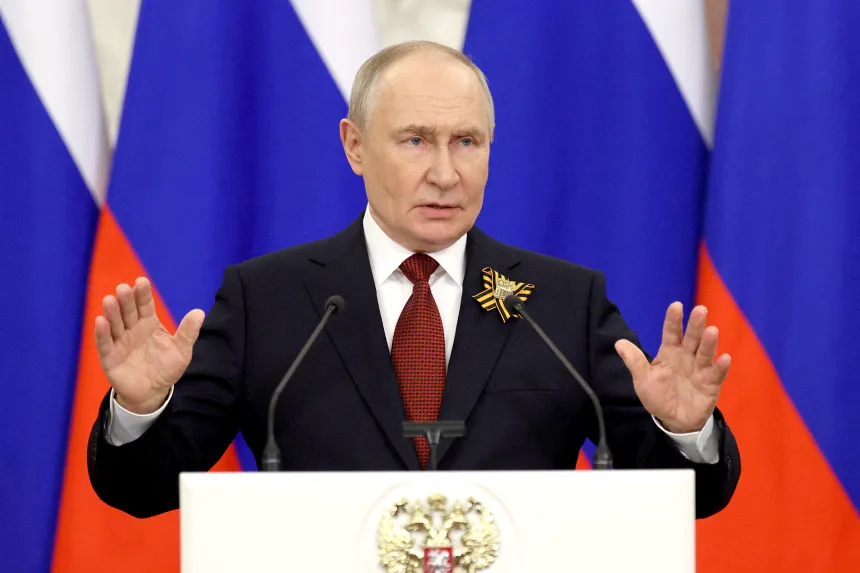

Russian President Vladimir Putin is facing mounting military and economic pressure as the war in Ukraine drags on, according to Estonia’s top intelligence official, who said the Kremlin may soon lose its ability to negotiate from a position of strength.
Get today's headlines by email 
Kaupo Rosin, head of Estonia’s Foreign Intelligence Service, told CNN that Russia’s battlefield setbacks, growing casualties and economic strain are increasing pressure on Moscow. Speaking from the agency’s headquarters in Tallinn, Rosin said the next few months could prove decisive.
“In four or five months, Putin may no longer be able to negotiate from a position of strength,” Rosin said, arguing that “time is not in Russia’s favor.”
Battlefield gains slow
Estonia, a former Soviet republic and NATO member bordering Russia, closely monitors developments inside its neighbor. Rosin said attitudes within the Kremlin have shifted as Russian forces struggle to make meaningful advances in Ukraine.
“I do not hear any more talk about total victory,” Rosin said. “People in the Kremlin recognize that the situation on the Ukrainian battlefield is not going too well.”
Analysts from the Washington-based Center for Strategic and International Studies have estimated that Russian troops advanced by an average of about 70 meters a day over a two-year period ending in January, while suffering roughly 1,000 killed or wounded daily.
Recent progress has slowed further. US Secretary of State Marco Rubio said last week that Russia was losing between 15,000 and 20,000 troops each month. Ukrainian officials reported more than 35,000 Russian soldiers were killed or seriously wounded in April, broadly in line with the previous two months. Neither side regularly publishes official casualty figures, and the claims cannot be independently verified.
Drone warfare reshapes conflict
Rosin said the war has increasingly become dominated by drones, limiting the possibility of major breakthroughs by either side.
“Both sides are unable to conduct a massive, mechanized breakthrough,” he said.
Ukraine and Russia have both expanded their drone capabilities during the conflict. Ukraine says improved interceptor drones are reducing the effectiveness of Russian attacks on cities.
Ukraine’s defense minister Mykhailo Fedorov said this week that the proportion of Iranian-designed Shahed drones destroyed by interceptors had doubled in the past four months.
Economic strain deepens
Rosin said Russia’s only realistic option for significantly accelerating its offensive in eastern Ukraine would be another large-scale mobilization of troops. However, he warned such a move could create internal instability.
Russia’s partial mobilization in 2022 triggered protests and prompted many men to leave the country to avoid conscription. Since then, authorities have relied heavily on financial incentives to attract recruits.
At the same time, Russia’s economy is coming under increasing pressure from war spending, labor shortages, sanctions and Ukrainian attacks on energy infrastructure.
Last week, Moscow lowered its economic growth forecast for 2026 from 1.3% to 0.4%. Deputy Prime Minister Alexander Novak blamed labor shortages, high government spending and Western sanctions.
Rosin said Ukrainian drone strikes on refineries, export hubs and pipelines had caused “billions and billions of dollars” in damage to Russia’s energy sector. He added that attacks on Moscow have brought the war closer to ordinary Russians.
Internal concerns in Moscow
Despite the pressures, Rosin believes Putin is unlikely to abandon his objectives in Ukraine. He said the Kremlin would continue trying to weaken Ukraine, including through attacks during the coming winter and political efforts aimed at installing a pro-Russian government in Kyiv.
Rosin also described growing concern within the Kremlin over domestic stability, with tighter security measures around Putin and reports of fears over possible internal unrest.
He said Russian soldiers returning from the war have contributed to rising violence and crime, with some joining organized criminal groups. A study last year by the Center for Strategic and International Studies estimated that returning soldiers had killed or injured more than 1,000 people inside Russia.
Although Rosin said he sees little immediate sign of mass protests due to the tight control of Russia’s security services, he warned that authoritarian systems can sometimes weaken rapidly beneath the surface.
Join the discussion? 
Already a member? 
 Adapted by ASEAN Now. Source 24 May 2026
Recommended Comments
Create an account or sign in to comment