



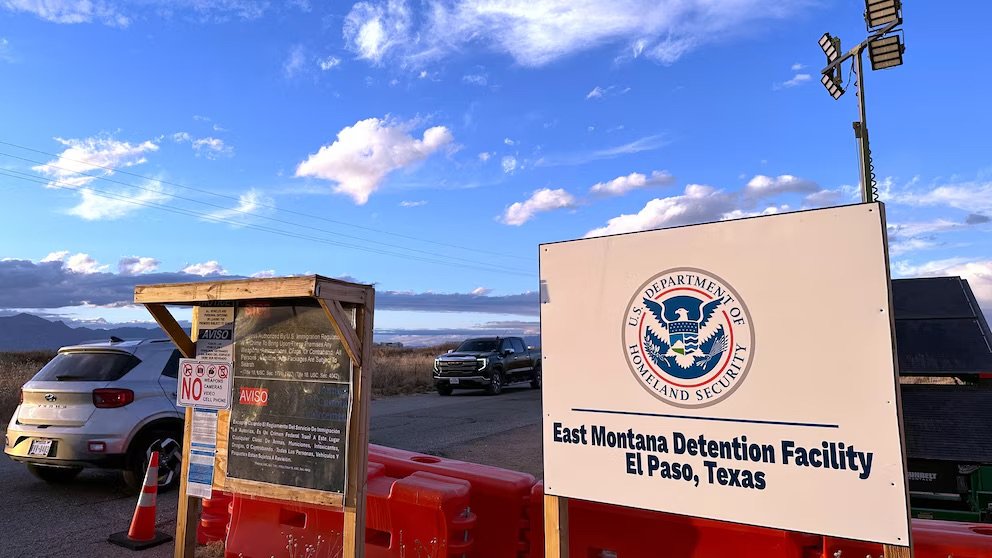

The wife of an active-duty Army sergeant and mother of a 6-year-old was deported to Honduras on Monday, according to the sergeant and the Department of Homeland Security.
Army Sgt. Hedar Leonel Turcios Juarez said his wife, Cristy Maryori Villafranca Trejo, was removed from the United States. He said her deportation has come amid what advocacy groups describe as increased immigration enforcement affecting the spouses and parents of military personnel.
Turcios Juarez confirmed that United States Immigration and Customs Enforcement detained Villafranca outside a Walmart in July while their daughter was watching. He said Villafranca left Honduras in 2016 because of violent crime there.
After attending high school in the United States, Turcios Juarez joined the Army and became a US citizen in 2024 following a nine-month deployment to the Middle East. He said he had begun pursuing citizenship for his wife, hoping his service would help speed up her naturalisation process.
A DHS spokesperson said the department had removed Cristy Maryori Villafranca-Trejo in line with US law. In a statement, DHS said ICE conducted a targeted operation on July 11 to arrest her, adding that she illegally entered the country in 2016 and had been released under the Obama administration.
Turcios Juarez Says Wife Was Targeted In July
Turcios Juarez said his wife had been “supportive” throughout his military service, including during his deployment, and he argued she was not a threat. He said the family’s focus was keeping them together.
He and other military families described fears that enforcement actions are reaching into households where one parent serves in uniform.
An Associated Press investigation reported that President Donald Trump’s second-term deportation campaign has swept up more than 50 parents and spouses of service members, with at least six deported.
Other Cases Involve Detention Of Spouses
Danitza James, chief executive of Repatriate Our Patriots, which works with Families United to help service members reunite with relatives, said the group also relies on contacting Congress for assistance. She said it is working with eight active-duty service members and one veteran whose family members were detained as of 20 August.
ABC News spoke with families involved in two cases. In one, Army Staff Sgt. Alexis Jaramillo, stationed at Fort Polk in Louisiana, said his wife, Maisa Lopes Eliaser, was taken into custody in front of him during an appointment to be interviewed for a green card.
Jaramillo said Lopes Eliaser arrived in the US from São Paulo, Brazil, in 2019 on a tourist visa and overstayed while he worked to pursue her legal status. He said she spent two days in Pickens County Jail in Georgia before being transferred to the South Louisiana ICE Processing Center, where she slept in a large room with around 80 people for about six weeks.

Army Staff Sgt. Alexis Jaramillo's wife, Maisa Lopes Eliaser was taken into custody in front of Jaramillo, who was dressed in uniform. Picture courtesy of ABCnews
He said that on 13 July, ICE put her on a bus to Alexandria International Airport in Louisiana and flew her to Bogotá, Colombia, before her final trip to Brazil. He said she used someone else’s phone to call him during a layover. Jaramillo said he was in contact with Sen. Mark Kelly, a Navy veteran, before and during the case.
Kelly’s office told ABC News that its team established communications with the ICE field office and provided updates to Jaramillo. ABC News reported that DHS did not respond to a request for comment on Lopes Eliaser’s case at the time.
Policy And Citizenship Pathway Under Scrutiny
The reported cases test an approach long described as protecting military families within the immigration system. The National Military Family Association says undocumented parents and spouses of service members have generally been shielded from deportation under policies adopted by both Republican and Democratic administrations.
Military recruiters have also promoted service as a route to citizenship, and lawmakers have created pathways for troops and certain relatives. Green card holders may join the US military, and troops can apply for naturalisation after one year of honourable service.
A DHS spokesperson said in response to another recent ICE arrest that having a family member in the military is not an automatic exemption from immigration enforcement, adding that military service by an immediate relative does not grant parole, lawful status or immunity.
Racial and ethnic minorities make up a growing share of the force. In the Army, Hispanic recruits rose from about 19% of new enlistments in 2020 to nearly 27% last year, based on internal data reviewed by ABC News. Department of Homeland Security figures cited by ABC News show naturalisations connected to military service more than tripled from about 4,500 in 2020 to 16,000 in 2024.
Congress Seeks Explanations
Congressional Democrats have raised questions about whether the Pentagon and DHS are coordinating enforcement affecting service members and their families. In a letter sent on 9 August to DHS, the Department of Defense and the Department of Veterans Affairs, they said they would investigate whether such coordination is occurring.
James said that addressing the issue requires legislative or policy change rather than individual case interventions.
Join the discussion? 

25 August 2026
-
 2
2
Recommended Comments
Create an account or sign in to comment