



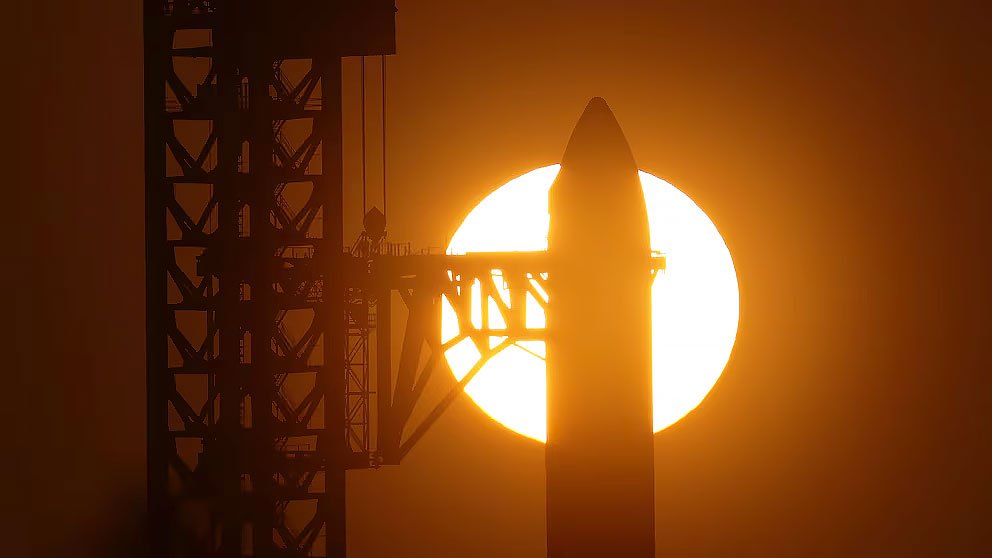

SpaceX launched the largest and most powerful version of its Starship rocket on Friday, carrying out the 12th test flight of the spacecraft that the company hopes will eventually take humans to Mars and the moon.
Get today's headlines by email 
The upgraded rocket, known as Starship V3, lifted off from the company’s Starbase facility in southern Texas near the Mexican border. The launch came two days after SpaceX chief executive Elon Musk announced plans to take the company public.
The mission carried 20 mock Starlink satellites, which were due to be released later in the flight. The launch followed a scrubbed attempt on Thursday evening caused by last-minute problems at the launch pad.
New Design and More Power
The latest Starship model stands 407 feet (124 metres) tall, making it slightly larger than earlier versions while delivering greater engine thrust. The redesigned booster includes fewer but larger grid fins to help guide it back toward Earth after separation, along with a bigger fuel transfer system supplying its 33 engines.
The stainless steel spacecraft also features upgraded navigation systems, increased computing capability and additional cameras. Engineers have added docking cones intended for future rendezvous operations and lunar missions.
SpaceX has faced several setbacks during previous test flights. Back-to-back launches last year ended in midair explosions that scattered debris over the Atlantic Ocean, while other missions also failed before completing their objectives. Friday’s launch was intended to demonstrate improvements to the upgraded design.
Although Starship is designed to be fully reusable, SpaceX did not attempt to recover any parts during this mission. The first-stage booster was expected to fall into the Gulf of Mexico, while the spacecraft and its satellite payloads were planned to end their journey in the Indian Ocean.
Moon Race Intensifies
NASA is relying on Starship as part of its Artemis programme, which aims to return astronauts to the moon for the first time since the Apollo era. NASA has awarded billions of dollars in contracts to both SpaceX and Blue Origin, the company founded by Jeff Bezos, to develop lunar landing systems.
The companies are competing to provide the spacecraft that will carry astronauts from lunar orbit to the moon’s surface.
While Starship has already completed several brief spaceflights lasting around an hour, Blue Origin’s Blue Moon lander has yet to launch. A prototype mission is expected later this year.
NASA plans to follow April’s crewed lunar flyby mission with an orbital docking test next year under Artemis III. During that mission, astronauts aboard the Orion capsule are expected to practise docking with Starship, Blue Moon or both systems.
A crewed lunar landing under Artemis IV could take place as early as 2028 using whichever lander is ready first. NASA aims to establish a long-term base near the moon’s south pole, supported by astronauts and robotic systems.
Private Missions Planned
SpaceX has also begun taking reservations for private journeys aboard Starship.
Businessman Dennis Tito, recognised as the world’s first space tourist, and his wife signed up several years ago for a planned flight around the moon, although no timetable has been confirmed.
This week, cryptocurrency investor Chun Wang announced plans to join Starship’s first interplanetary mission to Mars. Wang previously funded a privately chartered SpaceX Dragon flight that became the first human mission to orbit above both the north and south poles.
Neither the cost nor a launch date for the proposed Mars mission has been disclosed.
Join the discussion? 
Already a member? 
 Adapted by ASEAN Now. Source 24 May 2026
Recommended Comments
Create an account or sign in to comment