



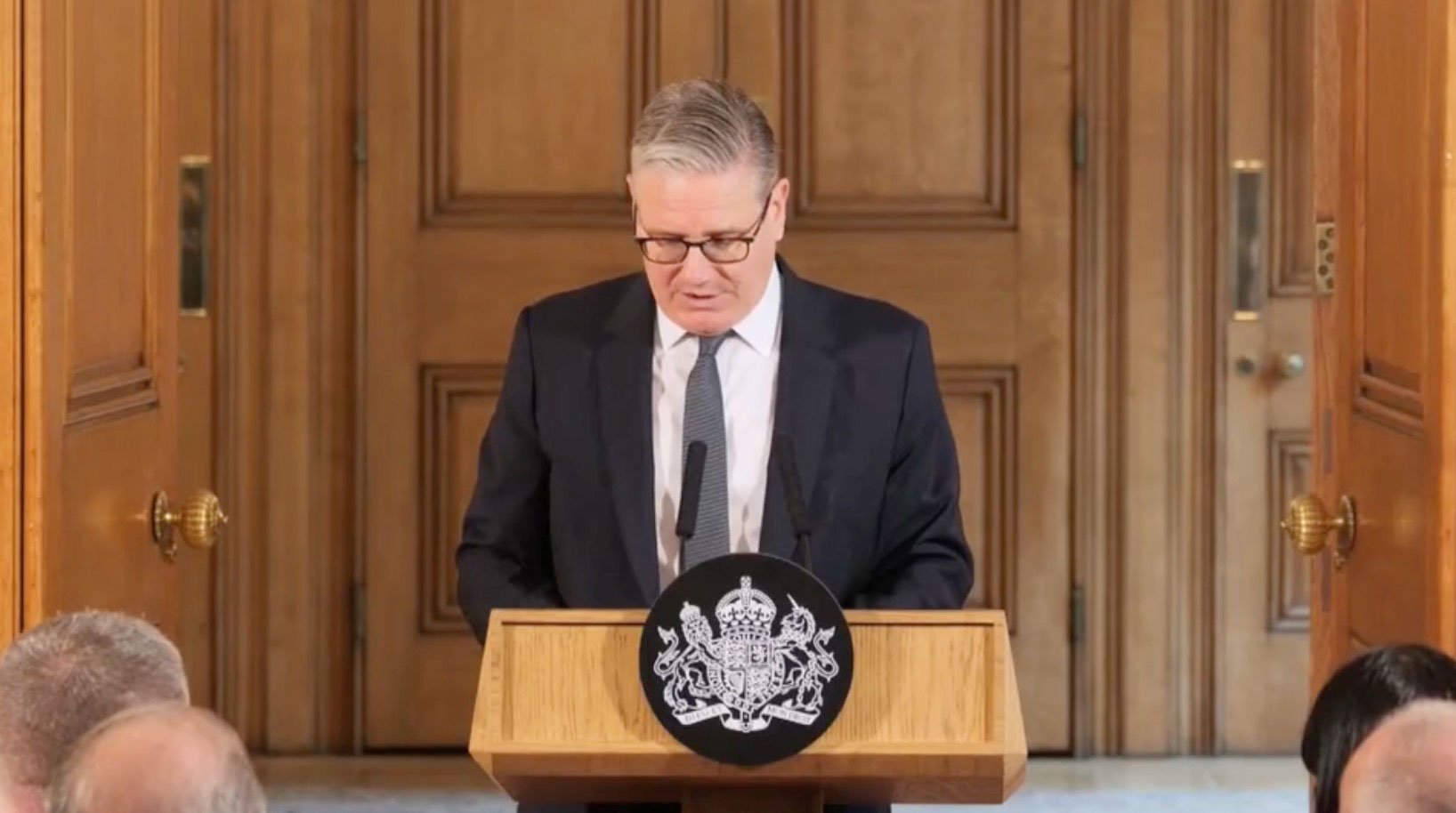

Prime Minister Sir Keir Starmer has said all parts of British society must act to confront what he described as a “crisis” of antisemitism, announcing new funding and faster legal action against hate crimes following a series of attacks targeting Jewish communities.
Get today's headlines by email 
Speaking at a summit at Downing Street, Starmer told leaders from policing, business, higher education and the arts that tackling antisemitism required a coordinated national response. He said the government would strengthen security, accelerate prosecutions and expect institutions to take stronger action against anti-Jewish hatred.
Recent incidents have included violent assaults and suspected arson attacks on Jewish sites, prompting growing concern within the community and criticism of the government’s response.
Summit response to rising attacks
The meeting brought together senior figures including Metropolitan Police Commissioner Sir Mark Rowley, Greater Manchester Police Chief Constable Sir Stephen Watson, university vice-chancellors and representatives from organisations such as Arts Council England.
Starmer said recent attacks on British Jews represented “a crisis for all of us”.
“It is not enough simply to say we stand with Jewish communities,” he said. “We must show that through action, and that responsibility lies with each and every one of us.”
The government announced £1.5m in additional funding aimed at strengthening community cohesion and improving protection for Jewish communities in areas facing the highest risks.
Hate crime prosecutions will also be prioritised, with the Director of Public Prosecutions issuing guidance allowing charges to be brought quickly once the evidential threshold is met, with supporting evidence gathered later.
Measures targeting institutions
Universities will be required to publish data on antisemitism on their campuses and demonstrate the steps they are taking to address the problem.
A Downing Street spokesperson said further measures could follow if institutions fail to respond adequately, though details would be set out later.
The government also said the Arts Council should withdraw public funding from cultural projects that promote antisemitism.
Phil Rosenberg, president of the Board of Deputies of British Jews, said the summit had been constructive but acknowledged anger within the community.
“There is anger that antisemitism has been allowed to fester and become a crisis,” he said. “We need to protect, prosecute and partner.”
Investigation into recent incidents
The summit followed a stabbing in Golders Green in north London last week in which two Jewish men were seriously injured.
Police say Shloime Rand, 34, and Moshe Shine, 76, were attacked in the incident. A third man, Ishmail Hussein, who knew the suspect, was also assaulted earlier the same day.
Essa Suleiman, 45, has been charged with three counts of attempted murder linked to the attacks.
Counter-terrorism officers are also investigating a suspected arson attack at a former synagogue in Whitechapel in east London. Other recent incidents include suspected arson attacks on ambulances belonging to a Jewish charity and on a synagogue in north London.
Starmer said authorities were examining whether foreign actors might have been involved in some cases.
“Our message to Iran, or to any other country seeking to foment violence, hatred or division in our society, is that it will not be tolerated,” he said.
Ministers are considering new powers that could allow the government to ban organisations seen as state-backed threats, including Iran’s Islamic Revolutionary Guard Corps.
Political debate over protests
The issue has also sparked political debate over pro-Palestinian demonstrations held in recent months.
Conservative leader Kemi Badenoch described current levels of antisemitism as a “national emergency”, arguing that hatred toward Jews had become normalised.
Starmer has suggested the government may consider banning some marches if their cumulative impact causes fear within Jewish communities.
However, organisers of the protests reject claims that the demonstrations are linked to antisemitic violence and say participants have a right to peaceful protest.
Liberal Democrat MP Munira Wilson said while many people march peacefully, hateful speech should face zero tolerance.
Funding for community programmes
Alongside the £1.5m announcement, the government said it would expand the £4m Common Ground programme with an additional £1m to support community initiatives, including youth programmes, school projects and interfaith work aimed at countering antisemitism.
Another £500,000 will go to Barnet Council in north London, which has a large Jewish population and has seen several recent incidents.
These measures add to £25m previously allocated for increased police patrols and enhanced security at synagogues, schools and community centres.
Join the discussion? 
Already a member? 
 Adapted by ASEAN Now. Source 6 May 2026
Recommended Comments
Create an account or sign in to comment