



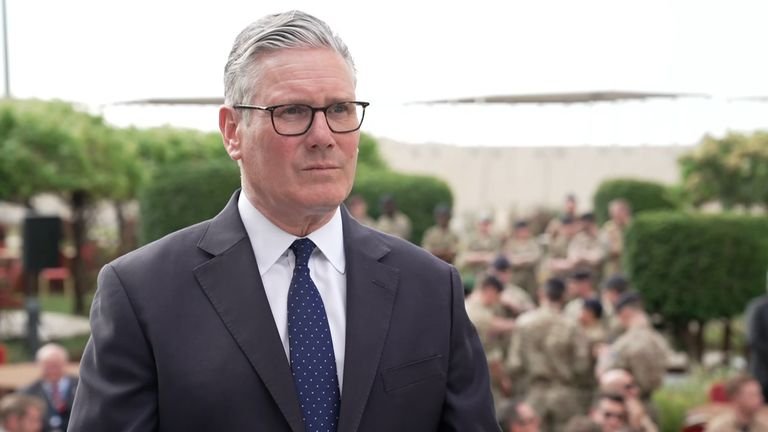

Prime Minister Keir Starmer has urged the United States and Iran to continue diplomatic efforts to resolve their conflict, after initial negotiations between the two sides ended without an agreement.
Get today's headlines by email 
The talks, held in Pakistan and involving senior officials from Washington and Tehran, concluded early on Sunday without producing a breakthrough. The outcome has raised uncertainty over the future of a fragile two-week ceasefire between the two countries.
Speaking after the talks, the UK prime minister warned against further escalation in the Middle East and called on both sides to seek a path forward through dialogue.
UK urges continuation of ceasefire
Downing Street said Starmer discussed the stalled negotiations during a phone call on Sunday with Haitham bin Tarik. Oman has often played a mediating role in regional diplomacy.
According to a statement from the prime minister’s office, both leaders stressed the importance of maintaining the ceasefire and avoiding any actions that could worsen the conflict.
“The leaders discussed the peace talks held in Pakistan over the weekend and urged both sides to find a way through,” a Downing Street spokeswoman said. “It was vital there was a continuation of the ceasefire, and that all parties avoided any further escalation.”
The UK was not directly involved in the negotiations but has repeatedly called for a diplomatic solution to the war.
Disagreement over nuclear commitments
The talks were attended by US Vice-President JD Vance, who travelled to Pakistan for the discussions.
Vance said the absence of a deal stemmed largely from Iran’s refusal to commit to abandoning efforts to develop a nuclear weapon.
Iran’s delegation was led by parliamentary speaker Mohammad Bagher Ghalibaf. He said Tehran had proposed “forward-looking initiatives” but argued the United States had not yet earned Iran’s trust.
Despite the lack of agreement, British ministers stressed that the meeting itself represented an important step.
Health Secretary Wes Streeting said it was “disappointing” that the talks had not yet produced a deal but emphasised the significance of the two sides engaging directly.
“The mere fact that the Americans and the Iranians were able to get around the table together is highly unusual and necessary,” he said on the BBC’s Sunday with Laura Kuenssberg programme. “It’s the only way we’re going to end this war.”
Streeting added that the UK hoped for a negotiated settlement that would definitively address Iran’s nuclear ambitions.
Tensions with Washington
Streeting also defended Starmer’s decision not to commit the UK to participating in potential US-Israeli military strikes against Iran.
He criticised recent remarks by US President Donald Trump, who last week warned that “a whole civilisation will die tonight” unless Iran agreed to a deal, describing the language as “outrageous” and “extraordinary”.
However, Streeting suggested the US president’s actions should be judged separately from his rhetoric, noting that Trump’s statements — particularly on social media — do not always reflect his eventual policy decisions.
Differences over Iran and other international issues have strained the traditionally close relationship between London and Washington. Starmer recently said British households were frustrated by rising energy costs driven by global tensions, including actions linked to Trump and Russian President Vladimir Putin.
Shipping and economic concerns
The conflict has also disrupted shipping through the Strait of Hormuz, a critical route for global energy supplies that Iran has effectively blocked during the fighting.
Starmer has discussed with Trump the need to restore safe passage for commercial vessels through the strait. The UK is due to host talks this week with a coalition of countries aimed at reopening the route.
Asked whether Britain might deploy Royal Navy ships to escort vessels through the waterway, Streeting said it would be too early to confirm any plans.
Meanwhile, political leaders in the UK warned that the conflict’s economic impact could soon be felt by households. Rising energy costs linked to disruption in Middle Eastern oil and gas supplies have contributed to higher food prices.
Ed Davey, leader of the Liberal Democrats, said food inflation could intensify later this year and called for greater support for domestic farming to strengthen food security.
Wider political debate
Opposition politicians also used the debate to press for changes in defence spending. Conservative shadow defence secretary James Cartlidge argued that the UK should increase funding for its armed forces, proposing that welfare spending be reduced to finance higher defence budgets.
The Green Party of England and Wales said diplomatic efforts must continue and called for the ceasefire between the US and Iran to be preserved while urging an end to Israeli bombing in Lebanon.
Despite the stalled negotiations, British officials say diplomacy remains the only viable path to ending the conflict.
Join the discussion? 
Already a member? 
 Adapted by ASEAN Now. Source 13 April 2026
Recommended Comments
Create an account or sign in to comment