



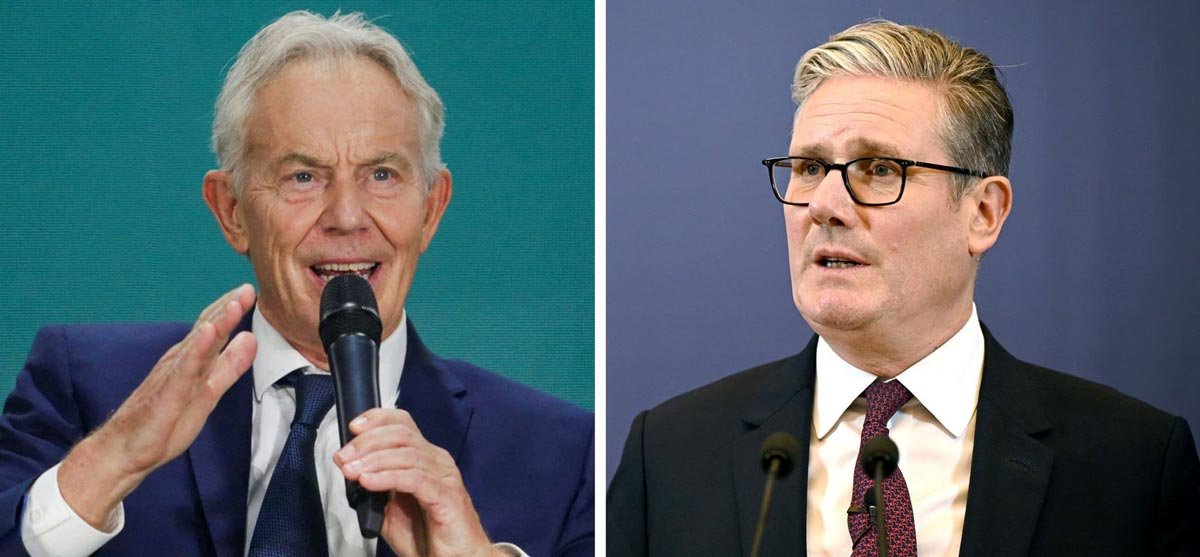

Sir Keir Starmer has defended his government’s policy record after former Labour prime minister Tony Blair accused Labour of lacking a “coherent plan” for the country.
Get today's headlines by email 
In a lengthy essay critical of the government’s direction, Blair argued that measures such as higher employers’ National Insurance contributions, stronger workers’ rights legislation and the planned phase-out of the oil and gas industry had damaged business confidence and weakened economic growth.
Starmer rejected the criticism, saying his administration had made the correct choices given the economic conditions it inherited after taking office in 2024.
Speaking to broadcasters, the prime minister said he agreed that Labour should debate “policy and ideas”, but insisted the circumstances facing his government were very different from those Blair encountered when he came to power in 1997.
Policy dispute deepens
Blair, who won three consecutive general elections as Labour leader, said the party’s difficulties were rooted not in communication problems or Starmer’s personality but in the absence of a clear governing strategy.
Writing in a 5,600-word essay — his most substantial critique of the current Labour government so far — Blair said Labour was operating from the “wrong political position” to secure a second term in office.
He backed some government policies, including infrastructure investment, planning reform and efforts to improve trade relations with Europe. However, he argued that other commitments should be reconsidered because of current economic pressures.
Among his recommendations were scaling back parts of the net-zero agenda that prioritised clean energy over cheaper energy, continuing welfare reforms and removing barriers to business growth.
Starmer responded with a lengthy rebuttal on Substack, arguing that his government inherited the most difficult economic situation since 1979.
He admitted Labour had made mistakes, including its now-reversed decision to restrict winter fuel payments. He also acknowledged businesses had been heavily affected by increased National Insurance contributions.
Despite this, Starmer said Labour had made the “big political choices right”.
Government points to economic progress
The prime minister cited falling migration, reductions in NHS waiting lists and lower knife crime levels as evidence that government policies were delivering results.
He also argued that the UK economy was outperforming comparable countries despite continuing global instability, including the impact of wars in Ukraine and Iran on living costs.
Labour’s popularity, however, has fallen sharply since its landslide election victory in 2024. The government has faced criticism over several policy reversals, including changes to winter fuel payments and disability benefit reforms.
Business groups have also argued that tax increases and workers’ rights reforms have discouraged hiring and limited economic growth.
Leadership pressure mounts
Blair’s intervention comes at a difficult time for Starmer, following poor local election results and ministerial resignations that have fuelled speculation about his future as Labour leader.
Attention is now turning to an upcoming by-election in Makerfield, where Labour faces a strong challenge from Nigel Farage’s Reform UK after the party performed well in May’s council elections.
Greater Manchester mayor Andy Burnham is Labour’s candidate and is widely expected to seek the party leadership if successful.
Former health secretary Wes Streeting, who resigned earlier this month in protest over Starmer’s leadership, has also indicated he would stand in any future leadership contest.
Both Burnham and Streeting criticised Blair’s essay, saying it underestimated the role inequality has played in shaping Britain’s political and economic problems.
Asked whether he would remain leader if pressure intensified over the summer, Starmer said he would not “walk away”.
Join the discussion? 
Already a member? 
 Adapted by ASEAN Now. Source 29 May 2026
Recommended Comments
Create an account or sign in to comment