



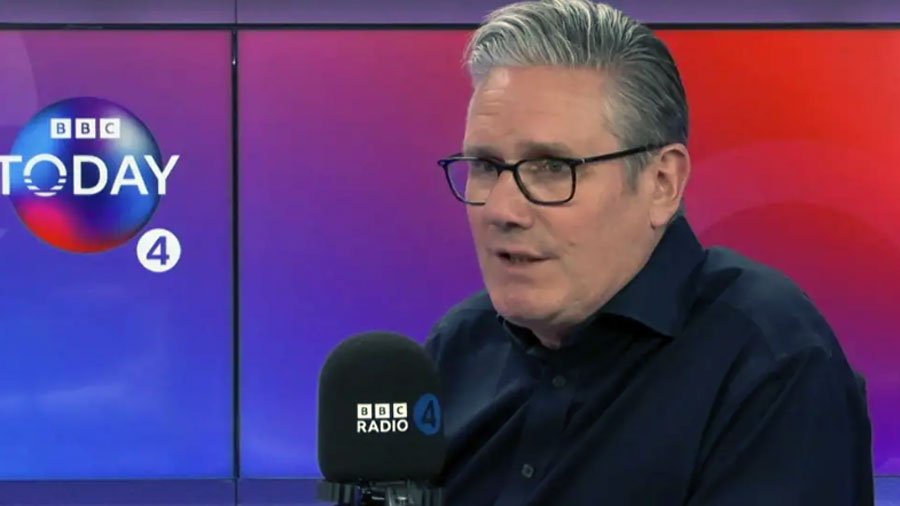

Prime Minister Sir Keir Starmer has suggested that some protests could potentially be banned, amid growing concern about the impact of repeated pro-Palestinian marches on Britain’s Jewish community.
Get today's headlines by email 
Speaking on BBC Radio 4’s Today programme, Sir Keir said he remained committed to protecting the right to peaceful protest but indicated the government was considering stronger measures in certain cases.
“I think certainly the first, and I think there are instances for the latter,” he said when asked whether he supported tougher policing of protest language or halting some demonstrations entirely.
His remarks come days after two Jewish men were stabbed in the north London area of Golders Green.
Stabbing attack and terror investigation
Shloime Rand and Moshe Shine were seriously injured in the attack on Wednesday but have since been discharged from hospital.
Police have charged 45-year-old Essa Suleiman with three counts of attempted murder. He is also accused of attacking Ishmail Hussein, a man he had known for about two decades, in a separate incident in Southwark on the same day.
Authorities declared the Golders Green stabbing a terrorism incident.
The attack follows a series of violent incidents targeting Jewish people in recent months.
Debate over protests
Calls for stronger action on protests have intensified following the attack.
Jonathan Hall KC, the government’s independent reviewer of terrorism legislation, recently proposed a temporary halt to pro-Palestinian marches, arguing it was currently “impossible” for them not to foster antisemitism.
Chief Rabbi Sir Ephraim Mirvis also called for a pause, saying the demonstrations had contributed to what he described as a growing “tone of Jew hatred” in the UK.
Sir Keir said he understood concerns expressed by Jewish communities about the “cumulative effect” of repeated demonstrations.
“In relation to the repeated nature of the marches, many people in the Jewish community have said to me it’s the repeat nature, it’s the cumulative effect,” he said.
He added the government would examine whether additional powers were needed to address such concerns.
At the same time, the prime minister emphasised that strong opinions about the conflict in the Middle East should not be suppressed.
“I will defend the right of peaceful protest very strongly and freedom of speech,” he said.
Political reactions
The suggestion of possible restrictions drew criticism from several political figures and campaign groups.
The Stop the War Coalition, which has helped organise a number of pro-Palestinian marches, said it condemned antisemitism and racism but argued it was wrong to link the demonstrations with attacks on Jewish people.
Green Party deputy leader Zack Polanski accused the government of exploiting fear within the Jewish community to justify greater limits on protest rights.
Jeremy Corbyn’s political movement, Your Party, also warned that responses to the attacks should not undermine civil liberties.
Other parties took a different view. Conservative leader Kemi Badenoch said it was time to ban the marches altogether, arguing they had become a platform for intimidation and violence against Jews.
The Liberal Democrats said demonstrations should only proceed if they can be carried out safely and should be closely scrutinised by police.
Existing powers and controversial slogans
Police in England and Wales already have the authority to place restrictions on protests, including limiting their routes or timings. Officers can request an outright ban if such conditions are insufficient to prevent serious public disorder, although such powers are rarely used.
Earlier this year the government approved a police request to ban London’s Al Quds Day march, the first such prohibition since 2012.
Sir Keir also criticised chants such as “globalise the intifada”, describing them as “very dangerous” to the Jewish community and saying they should be prosecuted.
The term “intifada”, meaning uprising in Arabic, became widely known during the Palestinian uprising against Israeli rule in the West Bank and Gaza in 1987. Jewish organisations often interpret the phrase as a call for violence against Jews, while pro-Palestinian groups say it represents resistance to Israeli occupation.
During a visit to Golders Green on Thursday, the prime minister was confronted by protesters chanting “Jew harmer”.
He acknowledged that many Jewish people in Britain currently felt fearful but rejected claims the government had failed to respond, pointing to increased police presence and additional funding to protect Jewish communities.
Join the discussion? 
Already a member? 
 Adapted by ASEAN Now. Source 3 May 2026
Recommended Comments
Create an account or sign in to comment